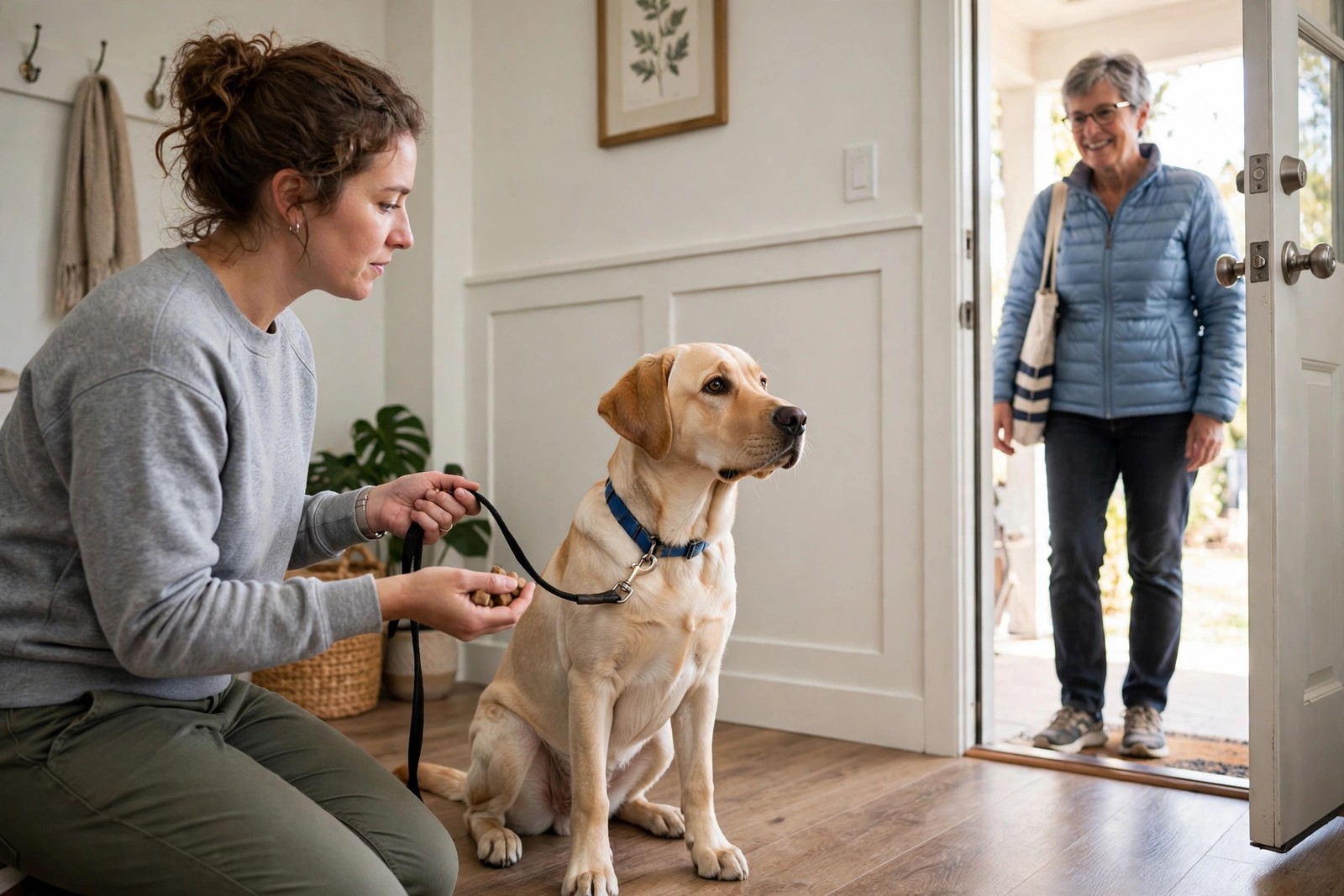
A teenage Labrador greeting is a physics problem as much as a training one: a strong, fast-growing dog at peak sociability launches at visitors because people are the best thing in his world, and smaller visitors, children, older relatives, anyone unsteady, can genuinely be knocked down. Willpower lectures to the dog will not fix it, and neither will pushing him down, which most Labradors read as wrestling. What works is a rehearsed greeting routine where calm behaviour is what makes people arrive, and jumping is what makes people leave.
Set the Stage Before Anyone Arrives
Decide the greeting job in advance and make it simple: four paws on the floor, ideally settling into a sit, while the visitor approaches. Put the dog on a lead held by a designated handler before the door opens, position a gate so the first meetings happen with a barrier available, and have treats in the handler's pocket, not the visitor's hand, so the dog's attention stays on behaviour rather than on mugging the guest. Exercise the dog earlier in the day and give him a toilet break before guests arrive; a rested-enough, empty dog can think, while a coiled one cannot.
Tell visitors the rules before they enter, ideally by message beforehand: ignore the dog completely while he is bouncy, no eye contact, no hands, no excited voices, and greet him only when the handler says he is ready. One visitor who squeals and pets the jumping dog can undo a month of family discipline, because jumping that works occasionally is the hardest kind to extinguish.
Practise Greetings in Stages
Do not make real visitors your first training material. Stage one is family members the dog knows, entering calmly while the handler feeds treat after treat for paws staying down and pays a jackpot for a chosen sit. The greeter approaches only while the dog is calm, and steps back out of reach the second paws leave the floor, without scolding. Ten short repetitions teach more than one long chaotic arrival.
Stage two is a calm adult friend briefed on the script. Stage three is greeting at a slight distance outdoors, where arousal is lower, before stage four, a real arrival at the door. A toy carried in the mouth helps many Labradors: it occupies the mouth, gives the excitement somewhere to go, and can become part of the routine the dog offers proudly. Scattering a handful of treats on the floor as the visitor settles is another honest tool in the early weeks, because a nose-down dog is not a jumping dog.
Protect Smaller Visitors Until Calm Is Proven
Until your dog has a track record, smaller visitors meet him on your terms or not at all: dog behind the gate for the hello, on a lead at a distance with the handler, or settled with a chew in another room while the visit happens. Let the visitor choose whether to approach, stroke or throw a treat from a distance, and never hold a small visitor up to be greeted or place them where a lunge could reach. If your dog cannot settle after a reasonable time, that is information, not failure: he spends that visit behind the gate with something good to chew, and training continues with staged guests.
Adolescence means progress wobbles; expect a dog who was polite at eight months to test everything again during the teenage months, and simply return to an earlier stage without frustration. If greetings involve mouthing, grabbing clothing or knocking people down despite consistent staging, bring in a qualified trainer early, while the dog is still young and the habit is still young with him. In KinsLe, Care Teams keeps the greeting script, the current practice stage and the gate plan for smaller visitors in one shared household plan, so whoever answers the door runs the same routine and marks practice done with a timestamp.