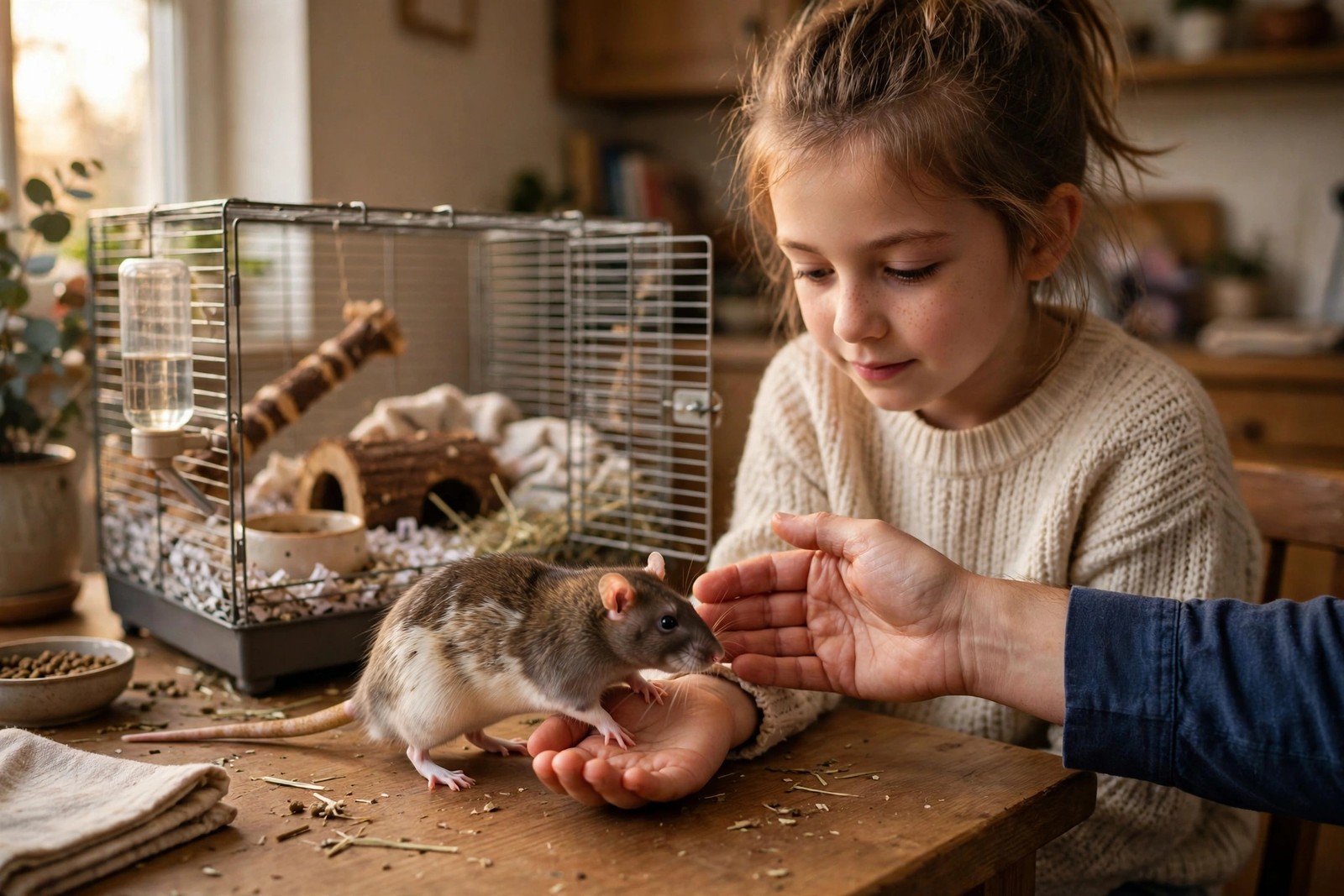
A rat that is grabbed, chased, or lifted awkwardly learns one lesson quickly, that small hands mean capture, and it will spend handling time looking for the exit. A rat that is offered a stable platform, fed from an open palm, and put back before it has had enough learns the opposite lesson, and will often climb onto a familiar hand voluntarily. Teaching children to handle a rat gently is therefore mostly teaching patience. The child's job is to be furniture the rat trusts, low, still, and predictable, and to let staying be the rat's own decision every single time.
The Hand as a Platform, Not a Claw
Start seated on the floor or at a table with the cage nearby, so a wriggle never becomes a fall. The child flattens one hand, fingers together, palm up and resting on the surface rather than hovering, and waits for the rat to step on and investigate. Treats offered from that open palm teach the rat that the hand delivers good things and never closes around it. When the rat does need lifting, teach scooping from below, one hand sliding under the body and the other supporting from the side, so the rat is carried on a platform of hands rather than gripped around the middle. State the absolute rule early and repeat it until it is automatic: never lift or catch a rat by the tail. A tail grab frightens the rat, can injure it, and instantly undoes the trust the palm work built.
Short Sessions and an Open Door Home
End every session while the rat is still relaxed, ideally before it starts scanning for a way off the hand. A few calm minutes finished early teaches more than a long hold that ends in a scramble. The cage stays within reach with its door open throughout, and if the rat heads back to it, the session is simply over, without pursuit, coaxing it back out, or a hand following it inside. That guaranteed retreat is what makes staying meaningful, because a rat that can always leave and often chooses not to is showing real confidence. Wash hands before handling so the rat does not smell like the child's lunch, and wash again afterward as a fixed part of the routine. An adult supervises every session, close enough to steady a hand or end things early, and watches the rat's signals, a frozen posture, flattened ears, or determined escape attempts all mean the session finishes now.
One Written Set of Rules for the Whole Household
Children handle the rat best when the rules do not change between adults, siblings, and visiting friends. Write the household's handling list down once: flat palm offered, scooping from below, tail never touched, sessions kept short, cage door open, hands washed at both ends. The Care Teams list on KinsLe holds that written set, with a named adult assigned to supervise each handling session and the children assigned their roles, offering the palm, bringing the treats, and closing the cage afterward. Because the assignments are written rather than remembered, a grandparent or older sibling running the session follows the same steps the rat already trusts. Keep the agreed handling list in KinsLe on the Care Teams board, with the supervising adult named for each handling turn.