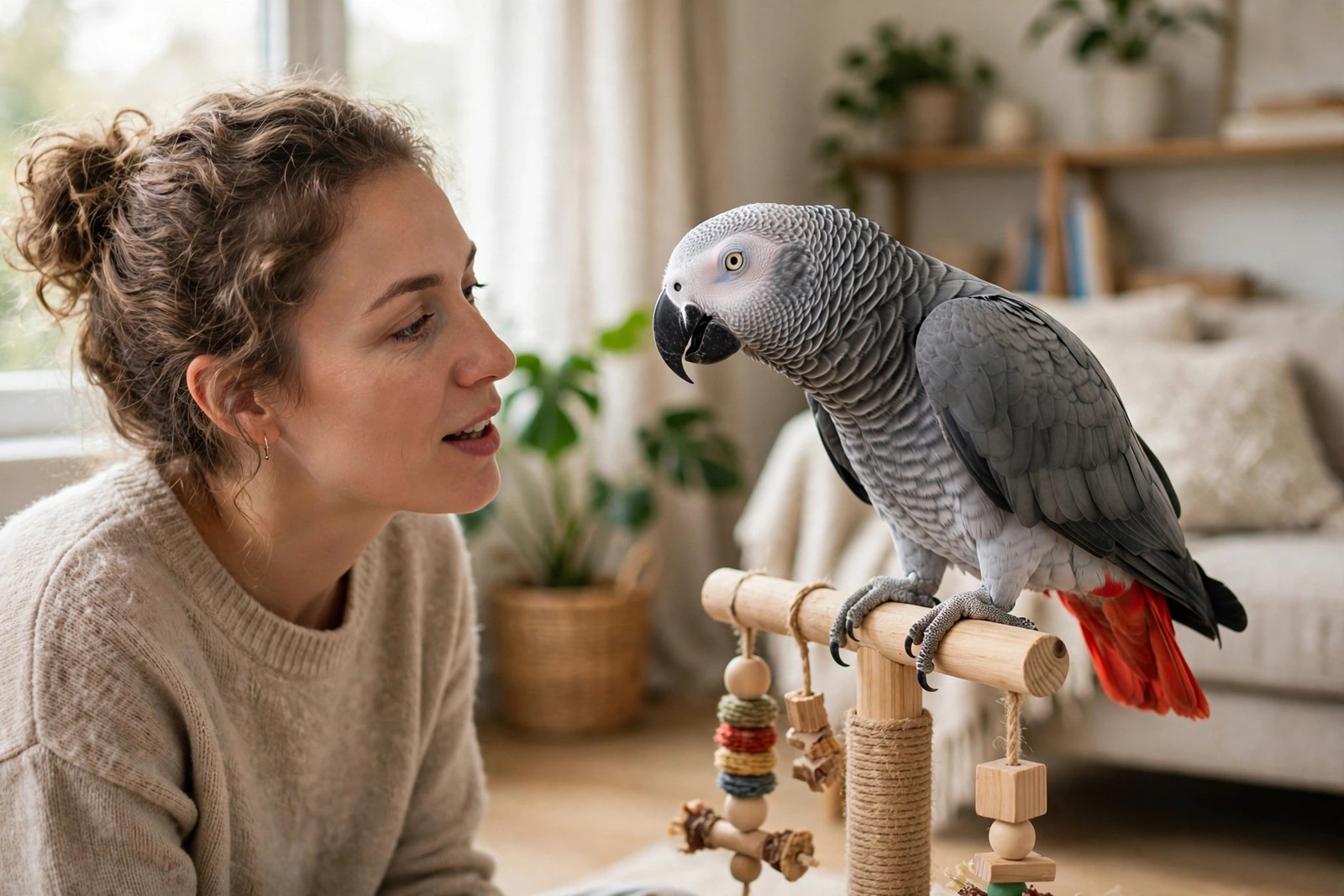
African greys are among the most gifted mimics in the bird world, but they are not feathered recorders. A grey learns speech the way it learns everything: socially, from a flock member it is bonded to, in moments that mean something. Owners who drill a word fifty times at a bored bird get silence; owners who use one word, in context, with feeling, a few times a day, get — eventually — a bird who says it back at the right moment and clearly enjoys the reaction.
One Word, In Its Real Moment
Start with a single short, expressive word and attach it to the event it belongs to. Say "hello" with genuine brightness every time you walk into the room, name a favourite food as the bowl appears, or say "bye-bye" as you leave. The pairing of word, event, and your enthusiasm is the lesson. Use the same word, the same cheerful tone, and resist adding a second word until the first is established. Speak clearly and slightly slowly, facing the bird, and respond with delight to any approximation — a mumbled, gravelly attempt is a first draft to reward with attention and praise, never to correct or ignore.
Short Sessions When the Bird Is Alert
Timing matters more than total minutes. Offer practice in short bursts — five to ten minutes, a few times a day — when your grey is bright-eyed, vocal, and engaged, often in the morning and early evening, and stop while it is still fun. A sleepy, moulting, or preoccupied bird learns little, and pushing on teaches it to tune you out. Live conversation also includes simply talking around your grey through the day — narrating what you are doing, answering its whistles and sounds — because greys absorb vocabulary from social exposure well beyond formal sessions.
Why Recordings Disappoint
Leaving speech recordings or videos on loop for hours is the most common wasted effort. With no social partner, no eye contact, and no reaction to the bird's own sounds, most greys treat looped speech as wallpaper noise and learn little from it. A short recording can support a routine you already practise live, but it cannot replace you. Likewise, never withhold food, cover the cage as punishment for silence, or compare your bird to fluent greys online — individuals vary enormously, and some greys, however loved and well taught, prefer whistles, sounds, and a modest vocabulary.
Realistic Timelines and Health Notes
Expect months, not days. Young greys often babble and mumble under their breath for a long private rehearsal period before a first clear word appears, sometimes not until well into their first year or beyond, and the first word frequently arrives when you are in another room, because that is when the bird practises. A grey who suddenly stops vocalising altogether, eats less, or shows changed droppings needs an avian veterinarian, since going quiet can signal illness rather than a training plateau.
Steady, shared practice keeps the chosen word and its moment identical across the household, and KinsLe Care Teams lets you assign each day's greeting, mealtime, and goodbye repetitions to different family members, each turn logged so your grey hears the lesson socially, not on a loop.