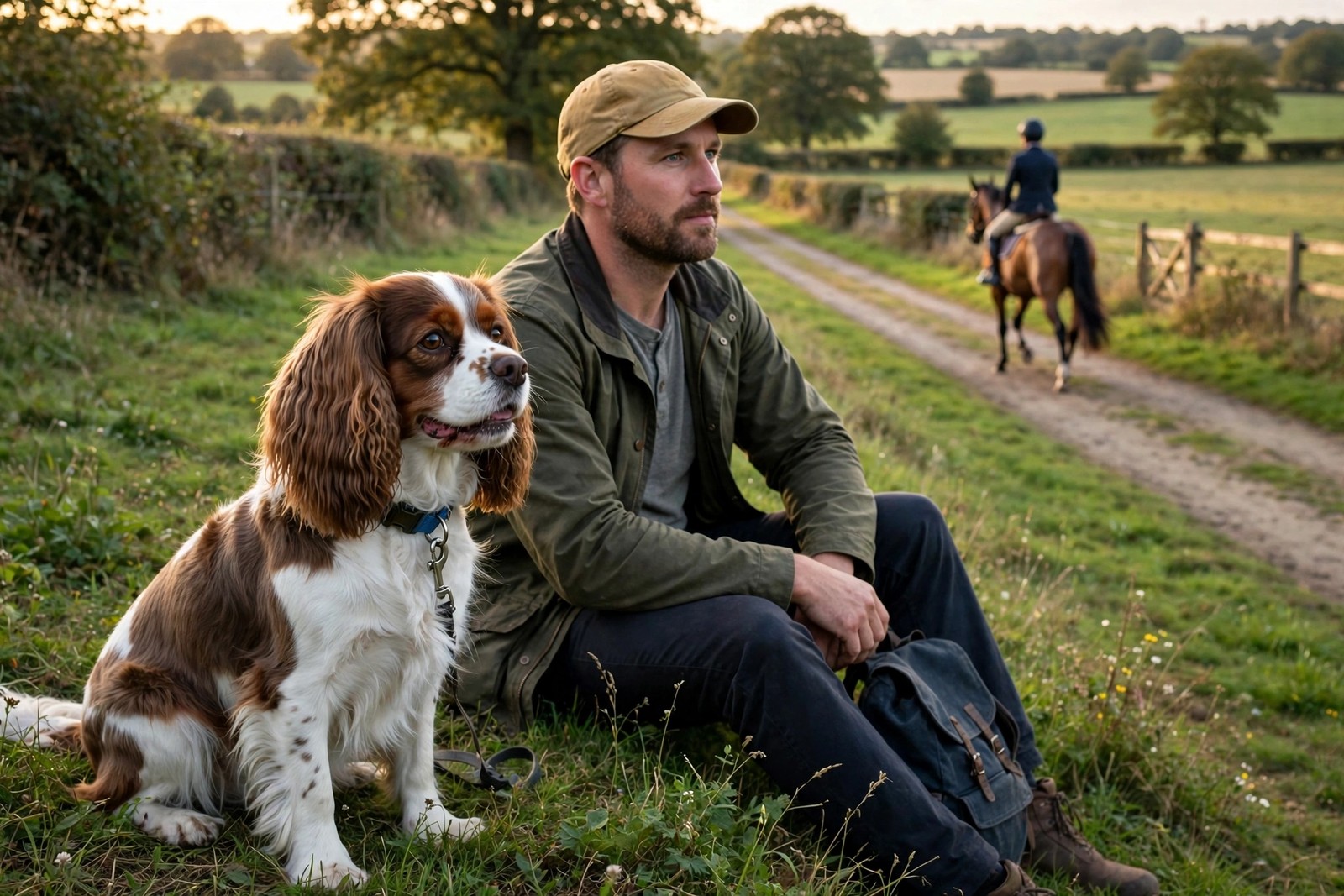
A horse is probably the largest moving thing your dog will ever meet, and it can be frightened by a barking, lunging dog just as easily as the dog is overwhelmed by it. Calm around horses is therefore a safety skill for everyone involved: your dog, the horse, and the rider keeping balance on top. The training rests on one principle your dog sets, not you: work at the distance where your dog can notice a horse, still take food, and still look back at you.
Learn Your Dog's Working Distance
Start by finding that distance honestly. For many dogs it begins across a whole field, not across a path. Signs you are inside the working distance include a hard stare that will not break, a closed mouth, food refused or snatched, whining, and a body leaning forward on the lead. Signs you are at a teachable range are softer: your dog glances at the horse, glances back, eats gently, and can answer a known cue. Work at the teachable range even when it feels embarrassingly far away, because a dog rehearsing calm at a long range is learning; a dog rehearsing panic at a short one is learning that too.
Practise Beside Fields Before Trails
Practise first beside fields and stables, behind a fence, in two field sessions a week. Let your dog watch horses graze and move at a distance, paying every look back at you and every moment of relaxed watching with excellent food. Play a simple pattern: look at the horse, look at you, get paid. When looking away comes easily at one distance, close it by a few metres on the next visit, not by half the field. Fenced practice removes the two worst variables of the trail: a horse approaching head-on with nowhere for you to go, and a rider forced to pass a struggling dog at close range. Many dogs need several weeks of field work before a bridle path pass is a fair request.
Run the Same Passing Routine Every Time
On the path, routine replaces reaction. Spot the horse early, step well off the path to the side the rider can see, and stop rather than walking on toward it. Position yourself between your dog and the horse, keep the lead short but loose, and feed steadily as the horse passes, paying check-ins and calm watching. A hand touch or a settled stand gives your dog a job; sniffing the verge is another good one for dogs who settle through their nose. Say a friendly hello to the rider so they know you have seen them, and never step behind a horse, where a startled kick is the real danger and where neither horse nor rider can see your dog coming. Let the horse be fully past and moving away before you walk on.
Respect the Horse and Rider
Trail manners protect your training as much as your safety. Keep your dog on a lead anywhere horses ride, give way early and visibly, and move off the path on narrow stretches rather than squeezing past. Some dogs, especially herding and chasing breeds, find moving horses far harder than standing ones, so judge each pass by what the horse is doing, not only by distance. If your dog barks and lunges despite weeks of distance work, keep training behind fences and take advice from a qualified behaviour professional, because a loose or lunging dog under a horse's feet can injure everyone involved.
In KinsLe, Care Teams keeps that routine identical between walkers: log the two weekly field sessions as assigned duties and note your dog's current working distance, so anyone walking your dog steps off early, stands in the same spot, and pays the same calm behaviour.