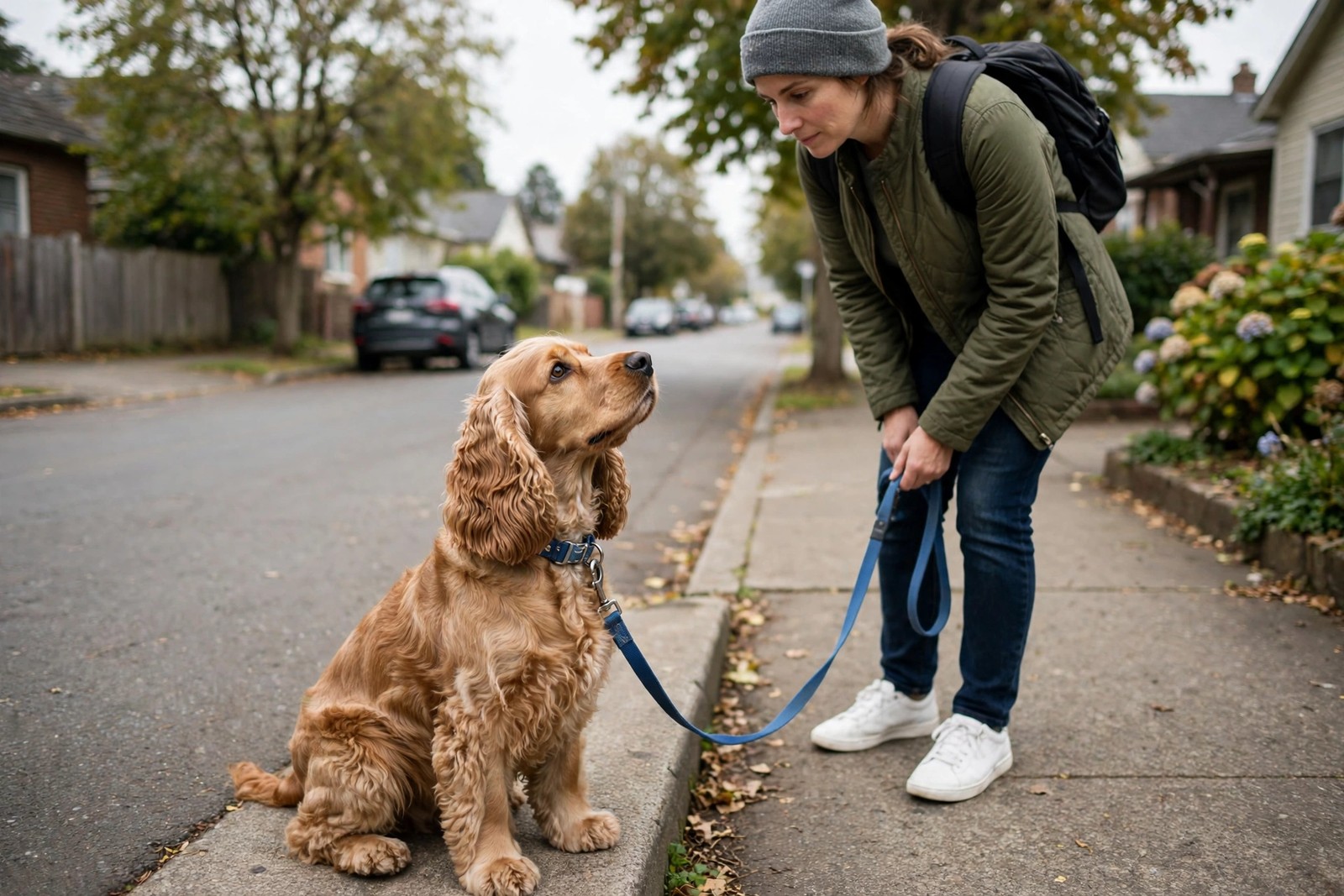
Surging into the street is usually not naughtiness; it is momentum. The walk has flowed forward for twenty minutes, the other side smells interesting, and nothing in the dog's experience has marked the kerb as a place where the rules change. A kerb routine installs that marker: one picture, repeated at every single crossing, until the kerb itself becomes the cue to stop and look at you.
Pick One Kerb Picture and One Release Word
Decide exactly what happens at a kerb and hold the whole household to it. A workable picture: you stop at the edge, your dog stops beside you, sits or stands still, and looks up at you; you check the road; then you say one release word, such as "cross" or "let's go," and step off together. The release word matters as much as the stop, because a dog released by your first step forward learns to anticipate the step, while a dog released by a word learns to wait for the word. Keep the lead short at kerbs from the start, not as a correction but as geometry: a dog already at the end of a long lead is halfway into the road before any cue can land.
Train It Away From Traffic First
Build the picture where nothing is at stake. Practise at the garden gate, at the end of the driveway, and at the edges of pavements on very quiet streets, paying the check-in generously every time: eye contact at the boundary earns excellent food and warm praise before the release word sends you both onward. Start with two quiet crossings on every walk and grow from there, rather than drilling ten crossings in one session until the dog is bored and sloppy. Dogs learn boundary habits through sheer repetition in real life, so every genuine kerb on every genuine walk is a training rep, which is exactly why the routine must be identical each time.
Add Roads One Level at a Time
Grade the challenge like a ladder. Quiet residential streets come first, then streets with parked cars that hide the view, then junctions where traffic turns, then busier roads with buses, bikes and noise. At each new level, pay more, wait longer before releasing, and let your dog watch traffic pass from the kerb so movement itself becomes part of the boring picture. Take special care at crossings with no clear kerb, such as dropped crossings and shared driveways, by stopping at the same imaginary line every time; dogs read your stopping place as faithfully as a painted edge. If your dog surges at a new level, that level was a jump too far: return to the previous one for a few walks and climb again.
Hold the Line When You Are in a Hurry
The routine dies on busy mornings, when crossing without the pause feels faster. Protect it precisely then, because a habit your dog sees you skip is a habit your dog will skip. If you are genuinely short of time, shorten the walk, not the kerbs. Keep children and other walkers inside the same rule: nobody crosses on a different word, and nobody lets the dog pull them across because the road looked empty. An empty-looking road is exactly where a quiet bicycle or an electric car arrives unheard, which is why the pause must be automatic rather than judgment-based, for the dog and for the human alike.
In KinsLe, Care Teams makes that one picture a shared duty rather than your private habit: write the kerb routine and release word into the walking duties for each person, and every logged walk confirms your dog paused, checked in and crossed on the same word, whoever held the lead.