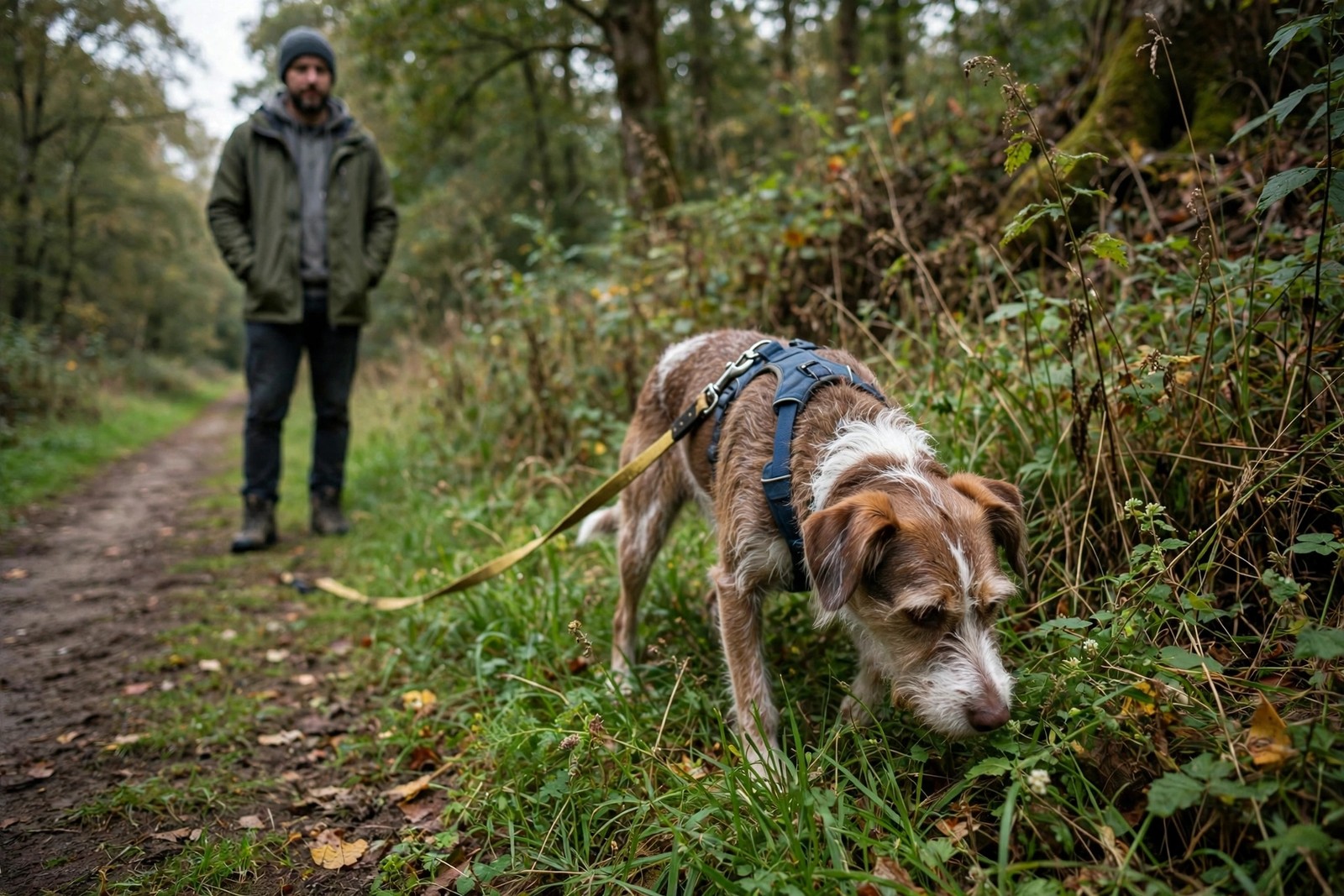
After a night of fireworks or a stay at the vet's, many dogs come home with stress still circulating: panting at nothing, pacing between rooms, sleeping lightly and startling awake, or going off food they normally inhale. A decompression walk is the deliberate opposite of a normal exercise walk. Instead of covering distance to a destination with cues, heelwork and greetings along the way, you give the dog a quiet place, time, and control — and let sniffing and gentle movement do the physiological work of bringing arousal back down.
What Makes a Walk a Decompression Walk
Four conditions define it. The place is quiet and green where you can manage it — a field edge or woodland path with few dogs and no busy road alongside. The dog has freedom of movement, on a long line of several metres or off lead only where that is legal and genuinely safe, so pace and direction are the dog's choices rather than yours. Nothing is asked: no training, no recall drills, no ball games, and no greetings. And it lasts — forty minutes or more — because the settling effect builds through the walk; ten minutes of sniffing at the park gate is a pleasant outing, not decompression.
Follow at the dog's speed. Stand still while the dog investigates one patch of grass for five unhurried minutes, double back when the dog doubles back, and let the route be inefficient. Sniffing is the active ingredient: a dog working scent with its nose down and body loose is processing the environment at its own pace, which is the state a stressed nervous system needs to practise.
Using One After Fireworks Night
Go the morning after, once the noise has fully stopped and your dog is willing to leave the house; a dog that will not go out is not ready, and a garden sniff session is the right first step instead. Keep the day around the walk quiet: predictable meals, visitors postponed, children briefed to let the dog choose contact, and no make-up training sessions. Repeat over the following two or three days and read the recovery in ordinary signs — appetite back, sleep deepening, play offered again, and the startle response fading. If a dog is still not eating, still pacing, or still unable to settle well after the event has passed, that persistence is a reason to call your vet rather than to walk longer.
Using One After a Vet Stay
After an overnight vet stay or a procedure, clear the walk with the vet first: some dogs need restricted exercise or wound protection that rules out a long line dragging through wet grass. Where the vet approves, a gentle decompression walk the day after homecoming helps a dog discharge the strangeness of the clinic in a familiar landscape. Keep it slower if energy is low, protect any wound or bandage from mud and water, and skip the walk entirely on days the vet has prescribed rest; a quiet sniff around the garden on a long line gives some of the same benefit within those limits.
Common Mistakes That Undo It
- Choosing the popular dog park at peak hour, where greetings, chases and conflicts add arousal instead of draining it.
- Hurrying the dog along, calling it away from every sniff, or turning the walk into a training session with recalls and sits at every corner.
- Expecting one walk to finish the job; recovery from a frightening night is a curve across days, and the walks work cumulatively.
Keep a brief note across those days — when the walk happened, how long it lasted, and how appetite, sleep and startle responses looked afterwards — because the trend across three days tells you far more than any single outing. Logging that recovery note in KinsLe Care Teams means a partner or sitter can see at a glance that quiet walks are still the plan, and nobody helpfully substitutes a lively dog-park trip on day two.