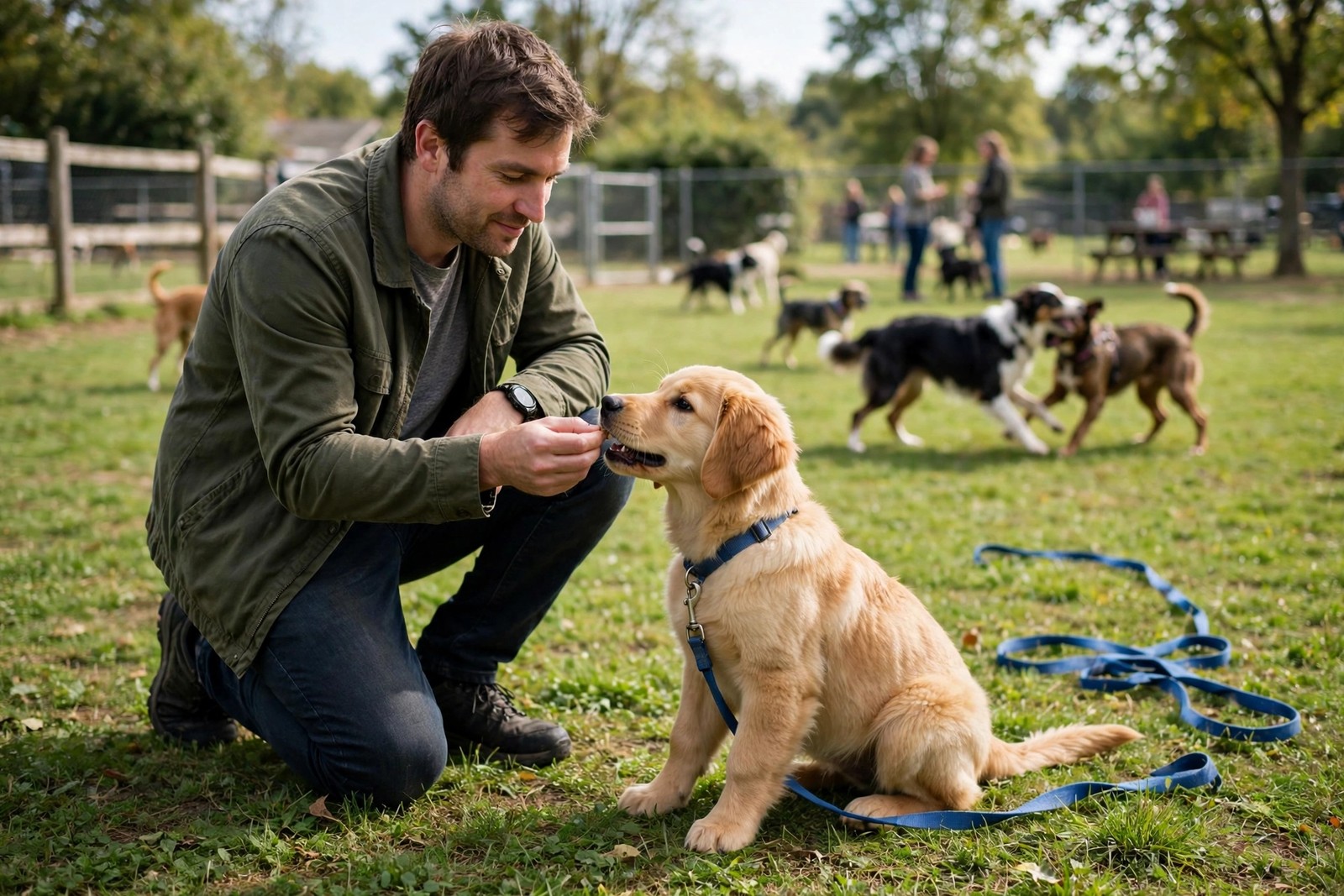
Recall from play fails for an honest reason: your dog does the maths. Coming back has historically meant a small treat and the end of the best part of the day, while staying means the game continues. No biscuit outbids that. The fix is to change what recall predicts. When returning reliably buys a big reward and then a return to play, recall stops competing with the game and becomes part of it, and that is a lesson you build in stages long before you need it beside a full-speed group game.
Build the Foundation Away From Play
Start where success is easy: recalls across the garden, between family members indoors, and on quiet walks, always paid with something your dog rates highly and sometimes with a jackpot of several excellent treats delivered one after another. Condition one clear signal, a whistle pattern or one chosen word, by pairing it with that jackpot in low-distraction settings until the sound alone produces a fast, cheerful turn toward you. Never use that signal for anything your dog dislikes, and never repeat it when it is ignored; a cue called five times in the park is being trained to mean nothing.
Teach the mechanics too: when your dog arrives, take the collar gently, deliver the reward, then release with a clear go-play cue. Collar grabs practised and paid at home stop the park problem of a dog who recalls, hovers just out of reach, and dances away when a hand moves.
Interrupt Play Early, Briefly and Often
The key training move is timing. Call your dog in the first minute or two of play, while arousal is still moderate and your dog is checking in naturally, not after twenty minutes when the game is at full intensity. Keep a long line attached during this stage in open spaces where it is safe and legal to do so, so you can prevent rehearsals of ignoring you without hauling your dog in. Pay the jackpot, hold a few seconds of calm connection, a hand touch, a brief sit, then release straight back to play. Repeat two or three times in a session and end the session separately, later, on a different cue and a different routine.
That release is the engine of the whole method. A dog released back on eight out of ten recalls learns that coming is cheap and profitable. Reserve the recall that ends play for rare use, and follow even that one with a bonus, a game with you on the way to the gate, so leaving never feels like a trick.
Raise the Difficulty Honestly
Progress in steps your dog can pass: recalling away from one calm, familiar dog before a group; recalling from the edge of play before recalling from the middle of a chase; recalling at a quiet field before recalling at the busiest hour of the dog park. If your dog fails twice at a step, the step was too big, so return to the previous one for several sessions rather than calling louder or more often.
Watch the play itself as part of training. Recall and rest any dog who is getting over-aroused, fixating on one playmate, or ignoring other dogs' signals to pause, because a dog past that point cannot learn and may cause trouble. If your dog cannot eat, cannot look at you at any distance from playing dogs, or has charged off toward roads or strangers, keep the long line on and work with a qualified trainer on a graded plan rather than testing recall off lead. Reliability is built repetition by successful repetition, usually over weeks of park visits, not in one heroic session. In KinsLe, Care Teams keeps the recall signal, the current training stage and the release-back rule in one shared plan, so nobody undermines the lesson by calling the dog only when it is time to leave.