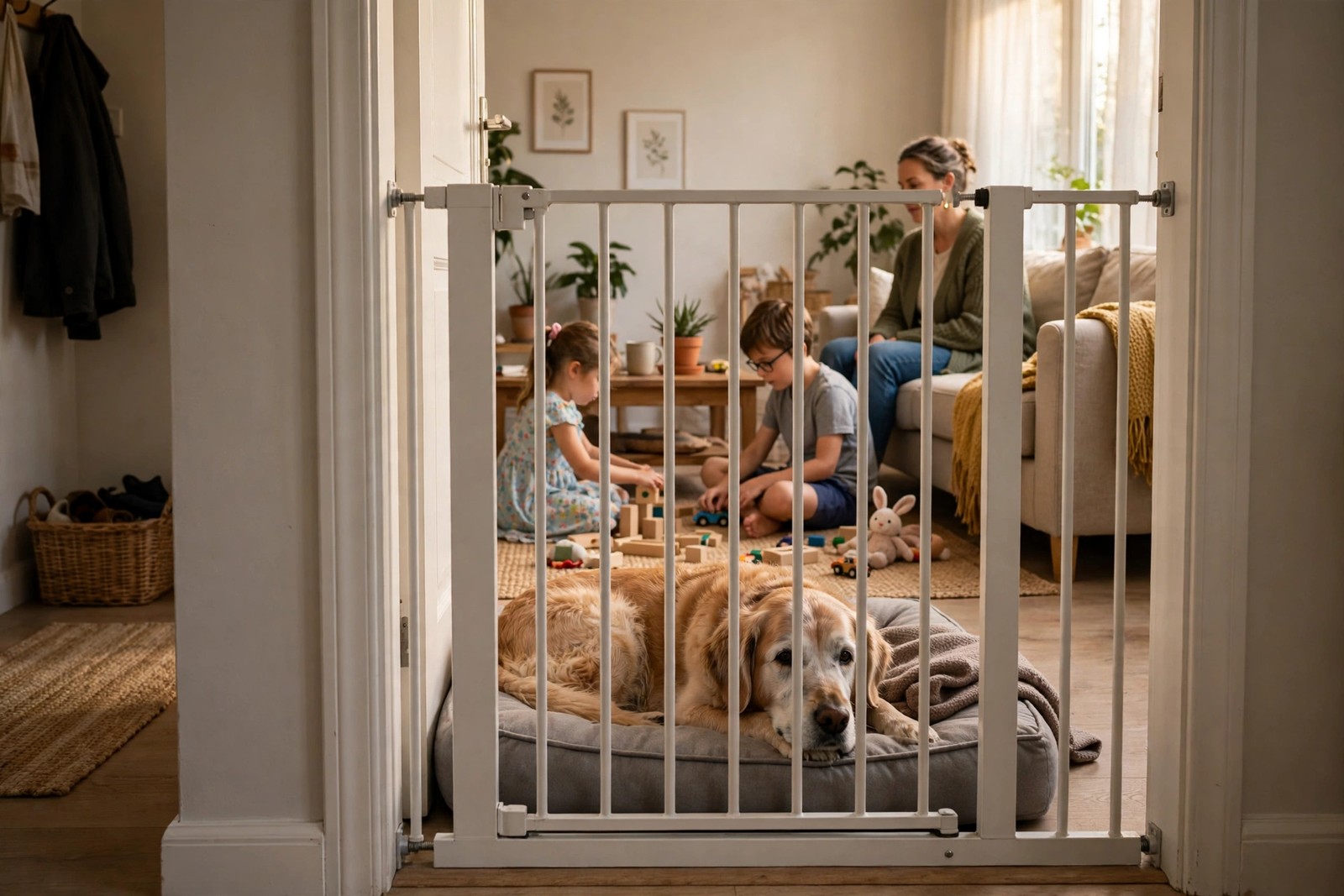
A dog who is scared of children is not being difficult, and grandchildren are, from her perspective, the hardest kind of human: small, fast, loud, unpredictable in their movements, and inclined to approach head-on and reach for faces. The goal of every visit is not friendship. It is a dog who feels safe because nothing is demanded of her, and children who are protected because the adults, not the dog's tolerance, are doing the safety work.
Build a Retreat She Can Trust Completely
Choose her child-free zone before the first visit, not during it: a room or a gated-off area with her bed, water, a chew, and familiar bedding, somewhere she already likes resting. Teach the grandchildren the rule as a matter of the house, like not touching the oven: when the dog goes behind her gate, she is finished visiting, and nobody follows, calls, or reaches through to her. Practise the retreat on ordinary days so it smells of rest and chews rather than only appearing when the house gets loud.
Let her choose how much of a visit she attends. Many fearful dogs do best observing the first visits entirely from their retreat, hearing the household enjoy itself while nothing approaches them, and that counts as progress, not a failed introduction.
Parallel Time, Not Introductions
When she is ready for shared space, make it parallel rather than social. She rests on her mat or behind a barrier at a distance she has shown she can relax at, while the children do their own activities, drawing, building, watching a screen, and you quietly reward her for calm watching. Treats can rain from you whenever the children laugh, move, or appear in view, building the association that children at a distance predict good things. If she looks away, moves off, or stops taking treats, the session is over and she goes to her retreat without disappointment from anyone.
Teach the children their side of the bargain in simple, positive rules: we let the dog come to us, and she usually will not, and that is fine; we never hug, kiss, chase, corner, or take things from her; and if we want to give her something, we toss a treat sideways onto the floor near her, without staring or leaning, and walk away. Practise the tossing game with a toy dog or a willing adult first if the children are young.
Staff Every Visit Deliberately
No single adult can supervise children and manage a fearful dog at the same time, so split the jobs explicitly for the whole visit: one adult is the dog's person, watching her body language and controlling her access to the retreat, and another adult is with the children. Never leave them together unsupervised, even briefly, even if previous visits went well, because incidents happen in doorways and kitchens during exactly those unstaffed minutes.
Learn her early warnings and act on the first one: turning the head away, lip licking, yawning, moving off, or a low growl. A growl is a polite request for space and must never be punished; removing it leaves a dog who skips the warning next time. If she shows hard staring, snapping, or guarding around the children, or her fear is intensifying visit by visit, stop shared time altogether and bring in a qualified behaviourist, with a vet check to rule out pain, before trying again.
Keep the Plan Written, Not Remembered
Visits go wrong when each grandparent visit runs on different assumptions, so write the arrangement down and share it with everyone involved. KinsLe's Care Teams lets you assign the dog-watcher role, the retreat checks, and the pre-visit walk to named family members for each visit, each task timestamped when done, so the safety plan survives the excitement of the grandchildren arriving.