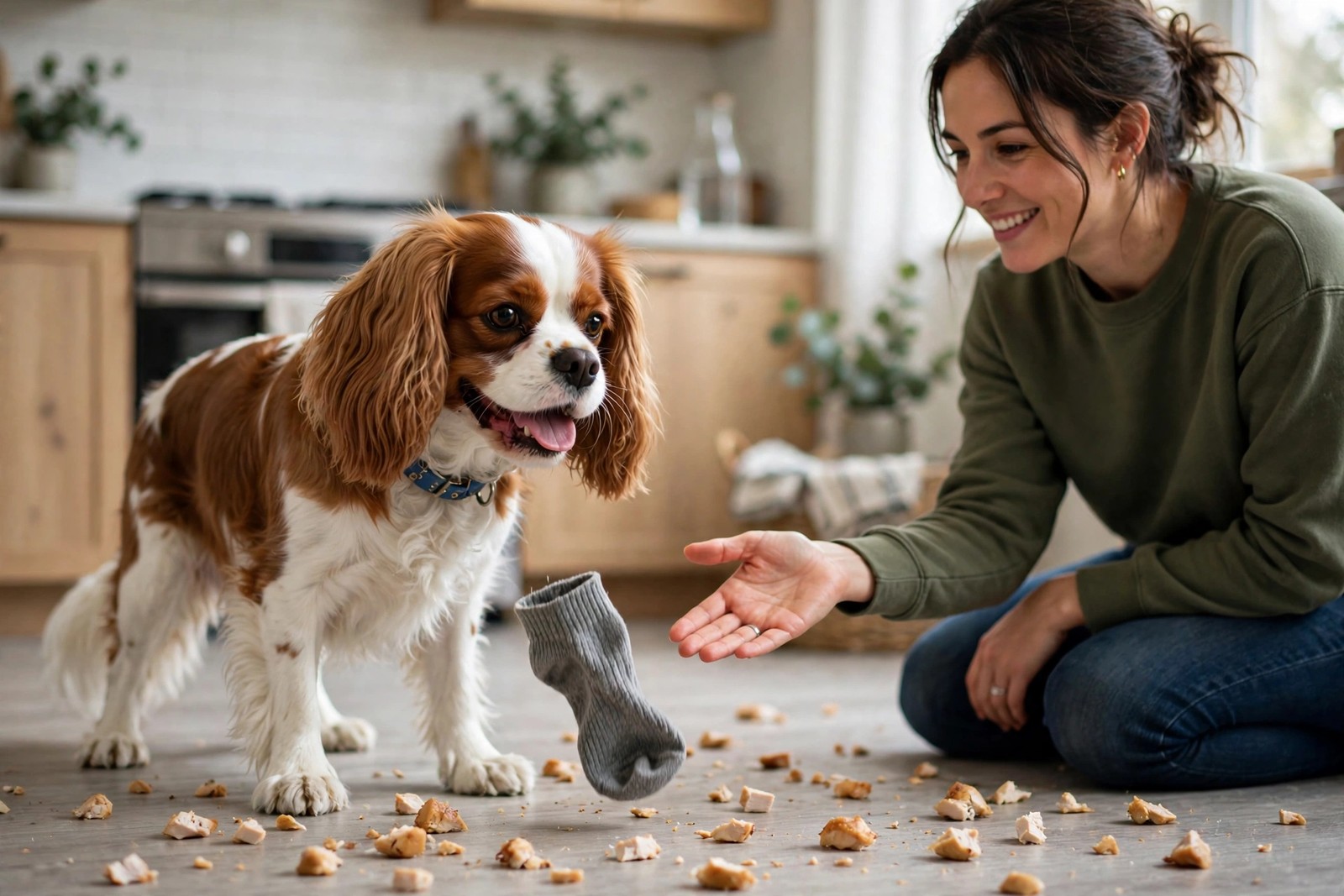
A dog who trades willingly has learned one reliable fact: a human approaching while she holds something makes her life better, not worse. You build that belief in calm practice, long before she parades through the kitchen with your phone charger. Every rushed grab, chase, and forced jaw-opening teaches the opposite lesson — that possession is fragile, humans are thieves, and swallowing quickly or guarding hard is the sensible defence.
Practise trades when nothing is at stake
Begin with an item she likes mildly and is allowed to have, such as a toy she has gone lukewarm on. Let her take it, then approach in a relaxed curve, say your trade cue once in a bright voice, and present something clearly better a short distance from her mouth: a small handful of chicken, cheese, or sausage usually outbids any toy. Scatter the food on the floor rather than feeding from your hand, because scattering sends her nose down and away from the item, leaving you free to pick it up without a race. Once she has eaten, often give the original item back and let her settle with it again. That give-back is the engine of the whole system: a dog who usually keeps her prize after trading has no reason to run, hide, or guard when she later steals something real.
Grade the difficulty honestly
Work up a ladder over days. Start with dull toys, then favourite toys, then safe household items she is known to steal — a sock, a wooden spoon, a paper tissue — always paying above the item's value. Save the highest payment for the highest-value finds. If she hesitates, freezes over an item, or moves away carrying it, your bid was too low or the step too big; retreat cheerfully, toss food away from the item so she abandons it, and practise that item at an easier level. A trade should look boring from across the room: dog glances up, wags, drops or leaves the prize, and wolfs down the scattered food while you tidy the item away.
When the stolen item is dangerous
Cooked bones, medication, batteries, and food wrappers change the priorities but not the method. Do not grab for her mouth, which risks a reflex swallow or a bite from a startled dog. Scatter a generous handful of the best food you have across the floor away from her, or toss it so she must move off the item to eat; then remove the item and, if needed, close a door between her and the mess while you clean up. If she has already swallowed something sharp, toxic, or obstructive, or you are unsure how much she took, telephone your vet straight away rather than waiting for symptoms. Prevention carries the rest of the load here: lidded bins, closed doors to children's rooms, and shoes and chargers stored out of reach mean dangerous trades stay rare.
Never punish the return
Two house rules protect all this work. First, nobody chases a dog who has stolen something, and nobody scolds her when she finally comes back or gives the item up — punishment after the fact only teaches her that approaching humans with loot is dangerous, which produces faster running and harder guarding. Second, children never attempt trades at all; their job is to freeze, call an adult, and let the adult run the swap. If your dog stiffens over items, hard-stares, growls, or snaps when approached, treat that as resource guarding rather than stubbornness and bring in a qualified behaviourist, because guarding that is practised tends to escalate.
Keep one script for the whole house
Trading fails when one person trades fairly and another snatches. Agree the cue word, the payment standard, and the give-back rule out loud, and rehearse with each person handling the dog. KinsLe's Care Teams makes that agreement stick, because one named person can be assigned the short practice trades each week and every completed session is timestamped, so the dog meets the same cheerful deal from everyone in the house.