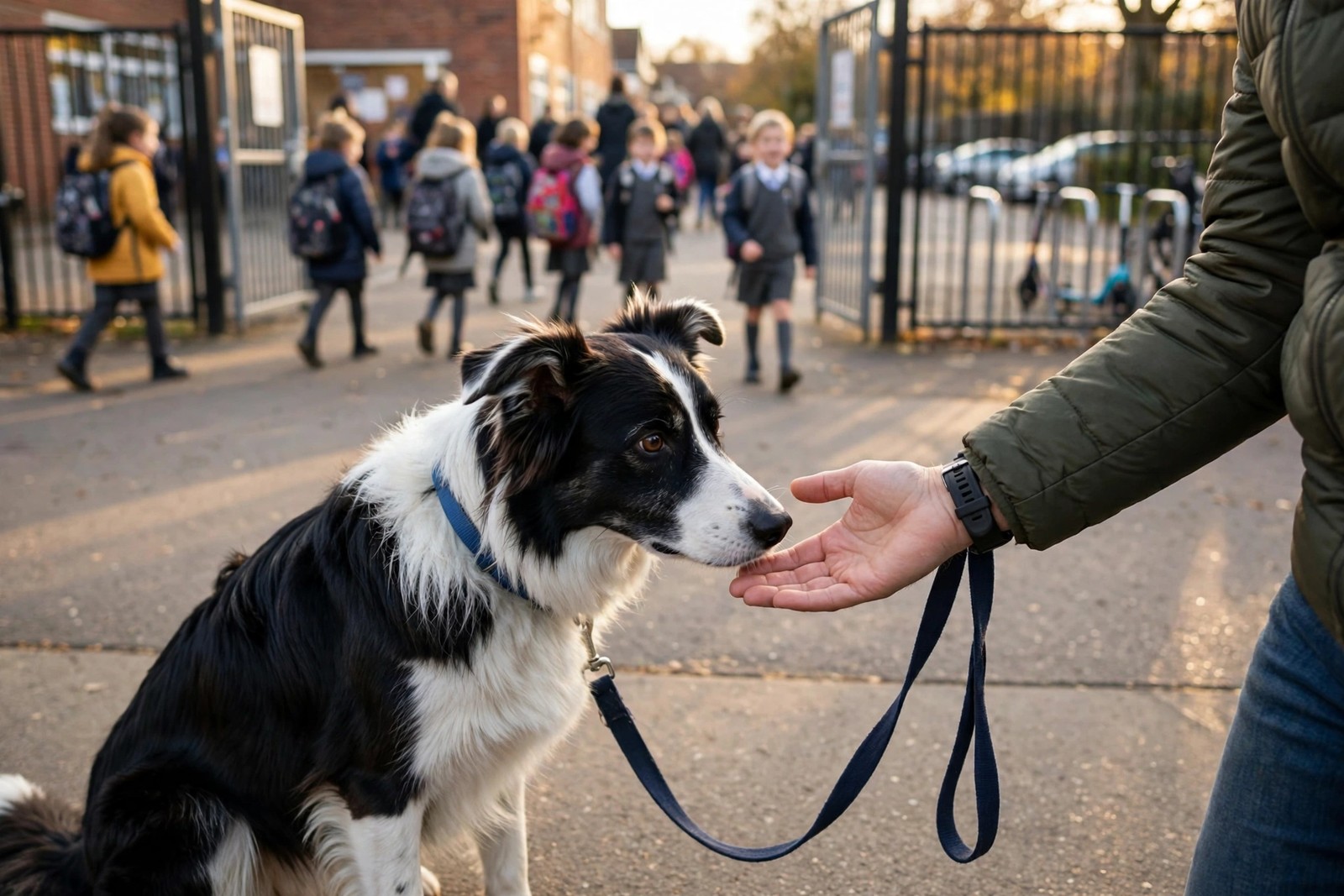
Pickup time is one of the hardest tests in neighbourhood walking: children sprinting everywhere, scooters weaving across the pavement, shouting, dropped snacks, and a crowd that surges all at once. A dog who falls apart there is not being disobedient; she is being asked to perform at championship level without rehearsals. The fix is to treat the school route like a course you grade deliberately, teaching each level of noise before adding the next.
Stage one: the route when nothing is happening
Walk the pickup route on a weekend morning or during school hours, when the gates are shut and the pavement is empty. Pay generously for the skills you will later need under pressure: loose-lead walking, looking back at you when you say her name, and a hand touch she can perform without thinking. Note the features that will matter later — the narrow stretch beside the fence, the corner where children burst out, the verge where a sniff search will fit — and decide where you can cross the road or step into a driveway to buy distance. Two or three quiet passes teach her that this street is ordinary.
Stage two: add movement, keep distance
Next, walk the route at moderately busy times, such as the end of lunch break or the start of the school day, staying on the far side of the road. Work at the distance where she can notice children, then look back to you and take food; that distance is her current working range, and it shrinks week by week. Reward every voluntary check-in, and scatter a few treats whenever children run or shout, so bursts of noise start predicting good things. If she stops taking food, stares hard, or her tail and body go stiff, you are too close or the session has run long: cross further away or leave by a side street and finish on an easy win.
Give her a job for the loudest stretch
A dog with a task copes better than a dog asked to endure. Teach one portable job at home first, then use it for the busiest part of the route. A repeated hand touch works well, because it keeps her head oriented toward you and gives her a rhythm to follow. A sniff search is the other strong option: a small handful of treats scattered into the verge with a find-it cue lets her put her nose down and shut the crowd out, and sniffing itself lowers arousal. Practise both on quiet streets until they are automatic, and alternate them so neither wears thin.
Stage three: pickup itself, managed tightly
For the first real pickups, arrive a little early or late if you can, take the far-side pavement, and keep the pass brisk and upbeat rather than lingering near the gates. Cross at proper crossing points rather than weaving through parked cars, and keep her lead short enough that she cannot lunge toward a running child but loose enough that she does not feel trapped. Watch the pavement for dropped food and guide her around it with your pre-taught leave-it rather than hauling her off a found crisp packet. Leave by the quietest exit even if it adds two streets; the goal is a string of uneventful passes, not the shortest route home.
Judge progress over two to three weeks
Expect the full build to take two to three weeks of regular practice, with the working distance closing gradually. The reliable signs of progress are a dog who checks in unprompted near the gates, takes food at pickup volume, and recovers within seconds after a scooter rattles past. If she is still overwhelmed at the far side of the road after that period, or she lunges and barks at children specifically, bring in a qualified behaviourist to assess her in person. KinsLe's Care Teams keeps the staging consistent when several people walk her, because each walker can be assigned the current stage and nobody accidentally debuts her at full pickup before the quieter levels are solid.