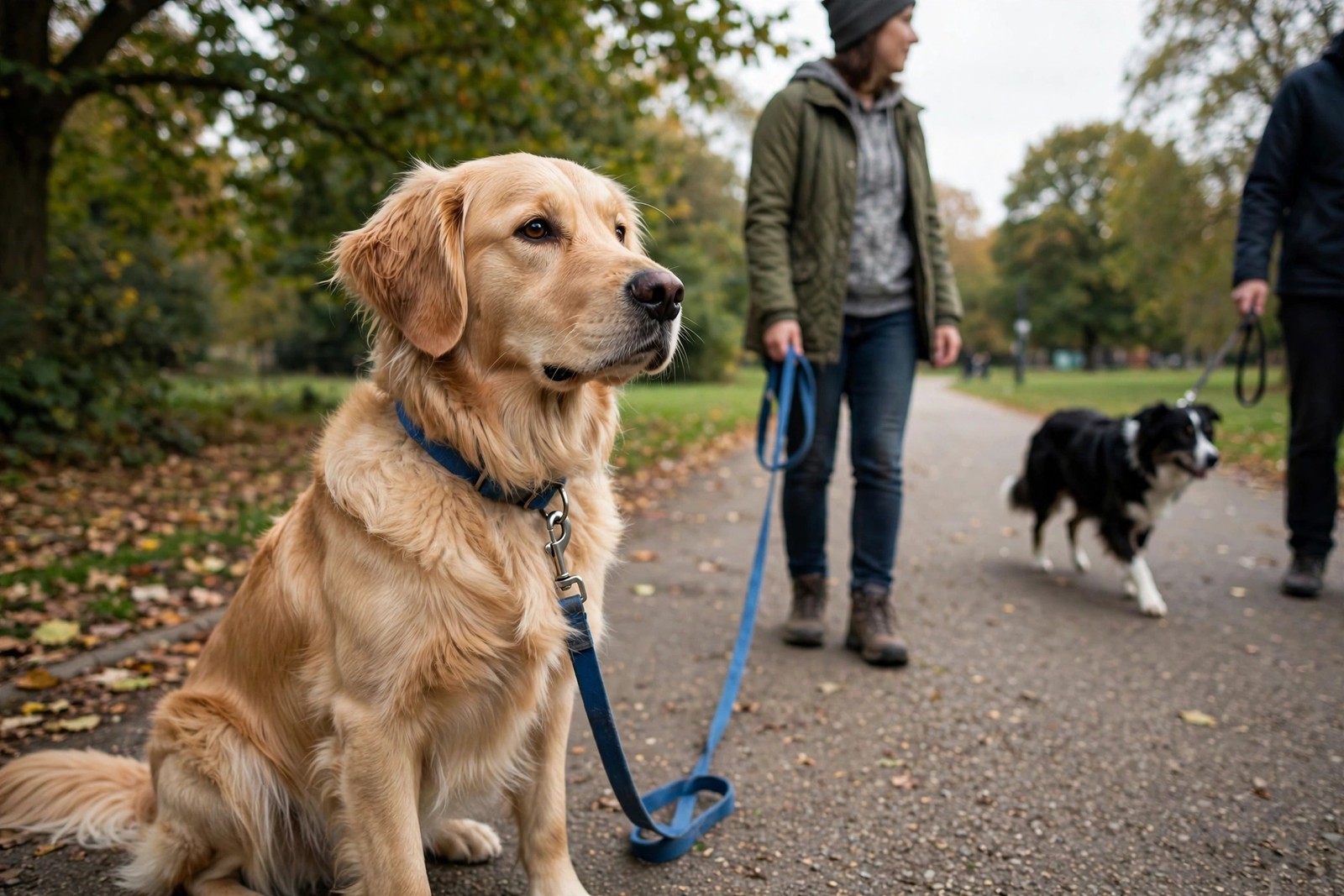
Three dogs can bark and lunge at the same dog for three different reasons, and the correct training for each is close to the opposite of the others. Flooding a fearful dog with close encounters deepens fear; letting a frustrated greeter practise lunging toward every dog rehearses the habit; and no training plan fixes a dog whose hips hurt. Learning to read which engine drives your dog's reactivity is therefore the first training skill, and it starts with the body rather than the noise.
The frustrated greeter: weight forward, seeking contact
A frustration-reactive dog leans into the lead, body loose or bouncing, tail high and wagging in broad sweeps, barking in a high-pitched, repetitive rhythm that sounds excited. The history usually confirms it: this dog adores other dogs, plays well off the lead or in daycare, and the meltdown happens only when the lead prevents the greeting. Watch what happens as the other dog passes and the moment ends: the frustrated dog recovers quickly, shakes off, and carries on, sometimes whining after the dog rather than scanning for the next threat.
The fearful dog: weight back, buying distance
A fearful dog's barking is a distance-increasing tool, and the body says so. Weight sits over the back legs, the tail tucks or goes stiff and low, the ears flatten, the mouth commissure pulls far back, and whale eye appears as she turns her head while keeping her eyes locked on the other dog. Some fearful dogs look deceptively still before they erupt, freezing and hard-staring as the trigger approaches their critical distance. The clearest test is distance itself: give a fearful dog more space and the whole picture softens — she can look away, sniff the ground, take food, and shake off. Reduce the distance and the barking restarts, because from her perspective the barking is what worked last time.
Pain: the cause owners and trainers miss
Pain-driven reactivity often arrives as a change rather than a lifelong trait: a previously sociable middle-aged dog starts snapping at youngsters, or a dog becomes reactive only on some days, only late in walks, or only when dogs approach from one side. Sore dogs react sooner because an approaching dog threatens a collision or a boisterous greeting they cannot physically handle, and they recover more slowly because arousal on top of pain lingers. Subtle clues include a shortened stride, reluctance to jump into the car, stiffness after rest, licking at a joint, or reactivity that worsens on days after heavy exercise. Any new or changed reactivity earns a vet examination before behaviour work, and the vet needs the full picture, including video of the behaviour and when it happens.
Yes, the answer rebuilds the training plan
For frustration, training teaches that calm behaviour makes good things happen: pattern games and impulse control around dogs at a distance, structured greetings earned by checking in, and satisfying off-lead or long-line play so the lead stops being the barrier to her social life. For fear, training works at distances where the dog can notice the trigger and still think, pairing sightings with high-value food and retreating before threshold, with greetings often off the menu at first. For pain, training waits: veterinary assessment and whatever management the vet advises come first, walks are adjusted to comfortable lengths and surfaces, and behaviour work resumes only around the dog's physical limits. Mixing the plans up is a common reason reactivity programmes stall.
Gather evidence before you guess
Film two or three reactions from a safe distance, note the trigger's distance, your dog's recovery time, and what happened in the following hour, and bring that record to your vet or behaviourist. Patterns across a week of walks separate a greeter from a worrier far better than one dramatic incident. KinsLe's Care Teams keeps that detective work joined up, because walk duties can be assigned to the same people who know the plan, and every completed walk is timestamped so the trigger log and the training stay in step.