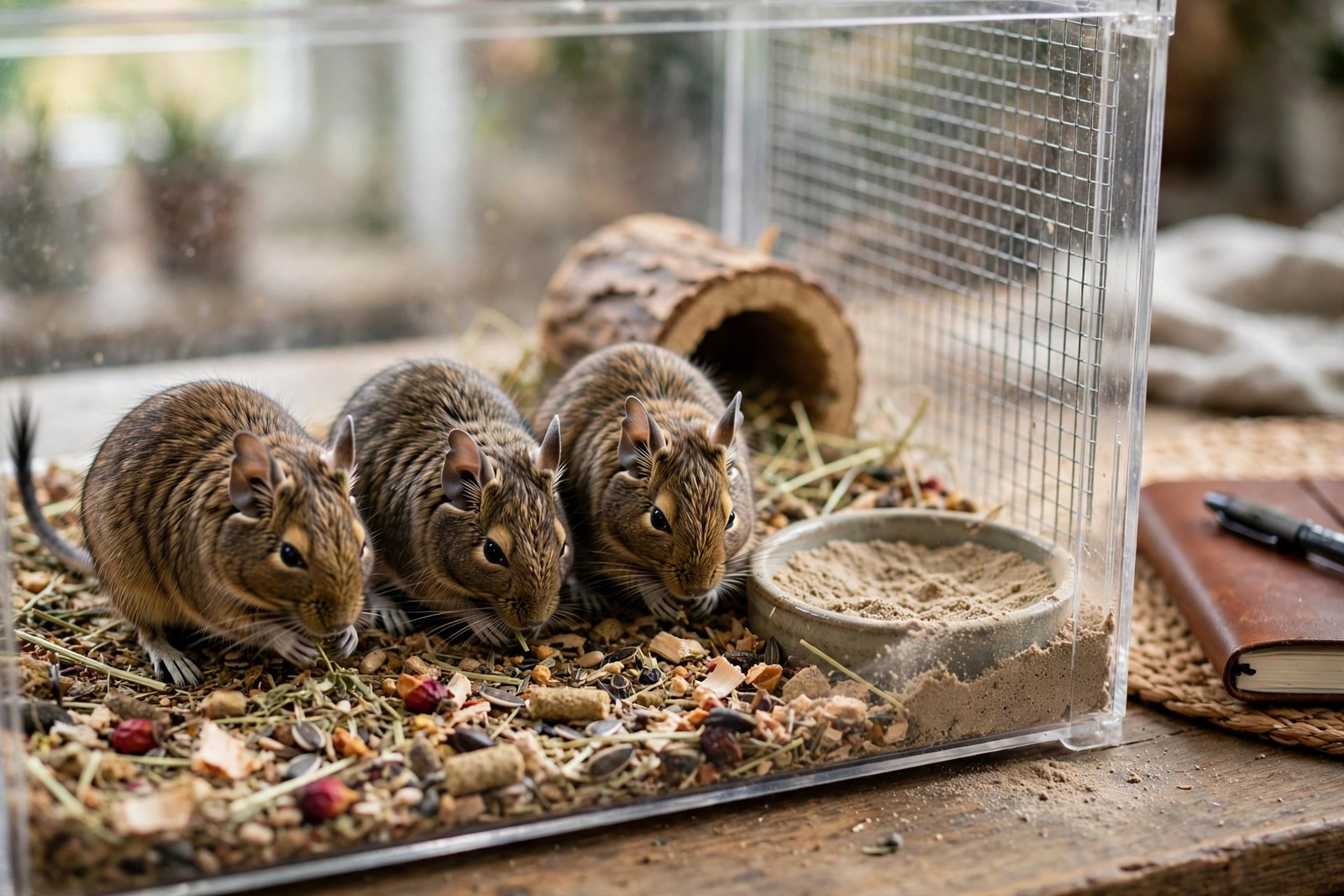
Degus are intensely social, and a new arrival reshuffles the whole group, not just one friendship. Introductions run over days or weeks — scent swapping, split-cage living, short meetings on neutral ground — and hierarchy keeps settling after the cages merge. Memory blurs sessions together by the third day; a short, specific log is what lets you see whether the group is genuinely settling or quietly sliding toward a fight.
What to Write Down at Every Session
For each stage, note the date, the setup and the duration: bedding swapped, bars-only contact through a divider, or face-to-face in a neutral pen with fresh bedding and scattered food. Then record behaviour in plain observable words, not verdicts — who approached, who retreated, any grooming and who groomed whom, whether they ate side by side, and how the session ended. Note the degus by name and one identifying detail, since similar-looking animals get confused in notes written in a hurry. Two minutes of writing immediately afterwards beats a paragraph reconstructed at night, because the detail that matters — the new degu groomed the dominant female and was groomed back — is the first thing forgotten.
Reading the Behaviour Your Notes Collect
Positive entries build a recognisable pattern: sniffing without escalation, mutual grooming, relaxed side-by-side feeding, shared dust bathing, and eventually sleeping touching or in a pile. Warning entries have their own vocabulary: persistent chasing, upright boxing, teeth chattering aimed at another degu, fur slipping or tufts pulled, one animal cornered or excluded from food and the dust bath, and squealing that does not settle. A rolling, locked-together ball fight is not a squabble at any stage — separate immediately with a towel or board, never bare hands, check every participant for wounds, and step the programme back a stage. Single tense sessions after a stage change are common; three worsening sessions in a row is a trend, and your log is how you prove it to yourself.
Hierarchy Changes Worth Flagging Between Sessions
Hierarchy shows most clearly around resources in the main cage, so log what you see at ordinary moments: who eats first and who gets displaced from the bowl, who controls the dust bath and the best sleeping spot, who initiates grooming and who receives it, and who has started sleeping or sitting alone. Weigh every degu weekly on kitchen scales, in a bowl they will sit in, and record it in the same log — steady weight loss in a subordinate animal is often the earliest hard evidence that it is being kept from food, well before it looks unwell. Note wounds, however small, with their location and date; repeated nicks on one animal name the target clearly. Also record changes in the humans' arrangements, such as a cage deep-clean or a moved layout, since reshuffled territory can restart disputes that look like introduction failure.
Set Your Separation Thresholds in Advance
Decide, and write down, the lines that pause or end the process before emotion argues with them in the moment: blood drawn, a ball fight, one degu losing weight across two weigh-ins, an animal hiding through its active periods, or wounds appearing on the same degu twice. Crossing a line means back a stage — divider living, scent swapping, shorter meetings — not giving up; many degu groups succeed on the second or third attempt, and some pairs simply never bond, in which case permanent side-by-side housing with bar contact is a respectable outcome. Show the log to a vet or experienced degu keeper if you are unsure what you are seeing; dated specifics earn far better advice than a summary. That shared clarity is where KinsLe's Pet Passport helps, holding each degu's session log, weight record, wound notes and vet details together in one packet, so whoever feeds or checks the group can see the current hierarchy and the lines you have set.