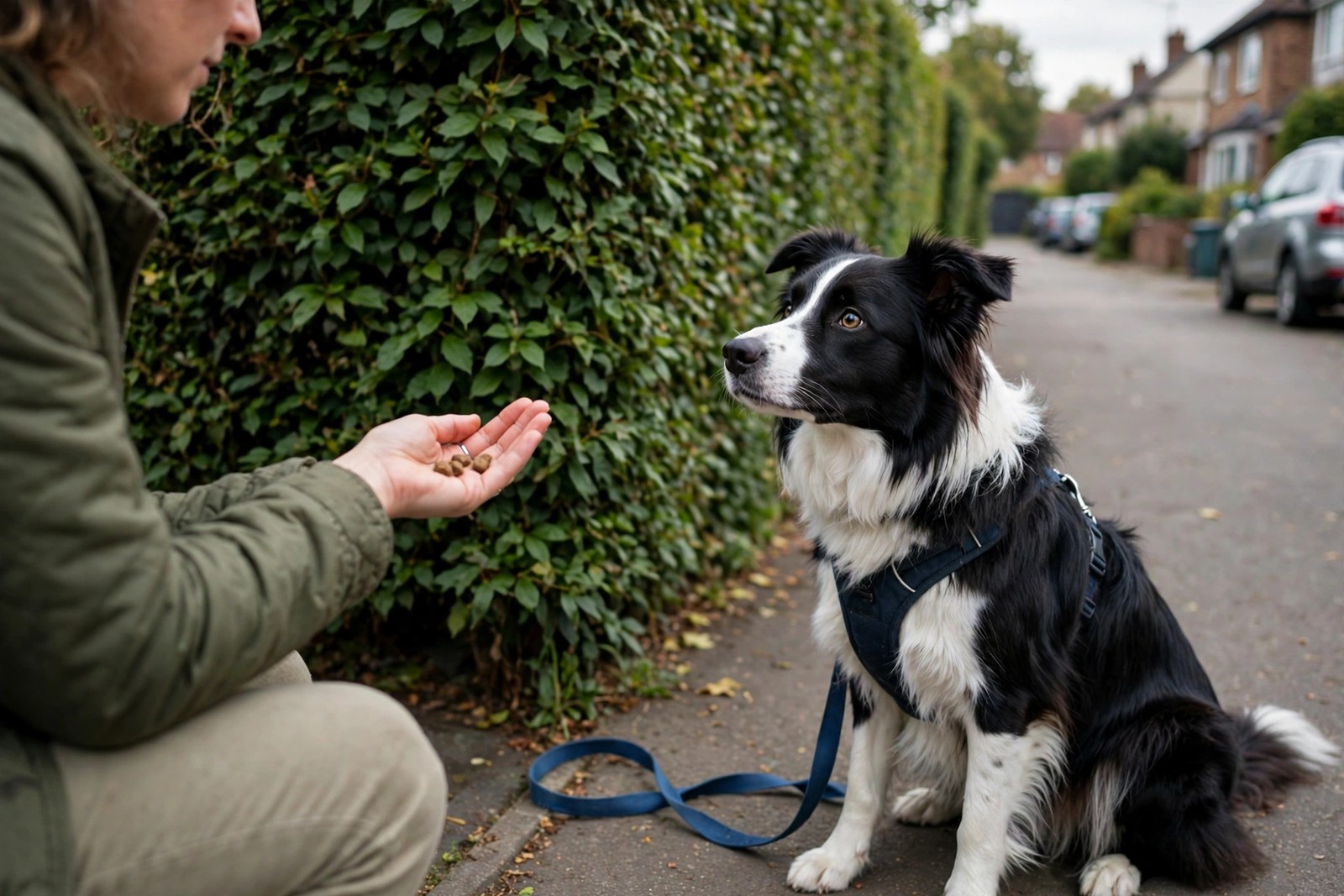
Watch-me cues often fail at blind corners for a predictable reason: they were trained as a glance. The dog flicks her eyes up, collects the treat, and is immediately free to scan again, which works in the kitchen and collapses the moment a dog materialises two metres away. A corner-proof watch me is a different behaviour — sustained eye contact held through a distraction — and it has to be built in that order: duration first, distractions second, corners last.
Build duration where nothing competes
Start at home with your dog in front of you. Cue watch me once, and when her eyes meet yours, wait a single second before marking and rewarding, instead of paying the instant she looks. Stretch the hold gradually across sessions, from one or two seconds up to ten seconds, varying the interval so she cannot predict the payoff: sometimes two seconds, sometimes eight, sometimes the full ten. Feed the reward while she is still looking at you, and release her with a clear finished cue so she learns the hold ends when you say so. If she looks away mid-hold, you stretched too far; shorten the next repetition and rebuild. Two or three calm sessions a day at this stage install the behaviour far faster than one long drilling session.
Add distractions in honest layers
Proof the duration against rising difficulty, one variable at a time. First a helper walking across the room, then the same work in the garden, then on a quiet street. Only when a ten-second hold survives those layers do other dogs enter the picture, and they enter at a distance: a dog across a park, a dog behind a fence, a dog passing on the far pavement. Pay a rapid series of small, high-value treats through the hold whenever the distraction is large, rather than one treat at the end, because the stream of payments is what competes with the other dog second by second. Sessions that end with her still under threshold teach the cue; sessions that end in lunging teach the corner.
The corner routine itself
On real walks, the cue goes on before the corner, every time. As you approach a hedge, fence, or wall that blocks your view, stop a few steps short, cue watch me, and let the hold run while you lean for a look, step wide for a better line, or cross the road for space. If another dog is coming, keep the rapid treats flowing until it has passed and turned away, then release the hold and walk on. Prevention carries half the load: walk wide around blind corners where the road layout allows, keep the lead loose so your tension does not announce trouble, and treat any corner where off-leash dogs regularly erupt as a cross-the-road corner by default.
Troubleshoot the common failures
If the cue works everywhere except corners, the corner work started too close to real surprises; go back to proofing with staged dogs at known distances, such as a friend's dog appearing from behind a van on cue. If she takes the treats but stares through you, the payments are too low-value for the setting, so upgrade to whatever she finds irresistible and reserve it for this work. If she holds beautifully for one person and not another, the cue has drifted between handlers, and everyone needs to return to the same word, the same hand position, and the same release cue. Sudden loss of a previously solid cue in an older dog is also worth a vet visit, since pain and failing eyesight both erode attention work.
Keep the proofing shared
Corners are where inconsistency gets found out, because the first unproofed test usually happens on someone else's walk. KinsLe's Care Teams assigns the short proofing sessions to named walkers and timestamps each completed session, so the duration steps are climbed once, in order, by everyone who takes your dog past the corner where dogs appear.