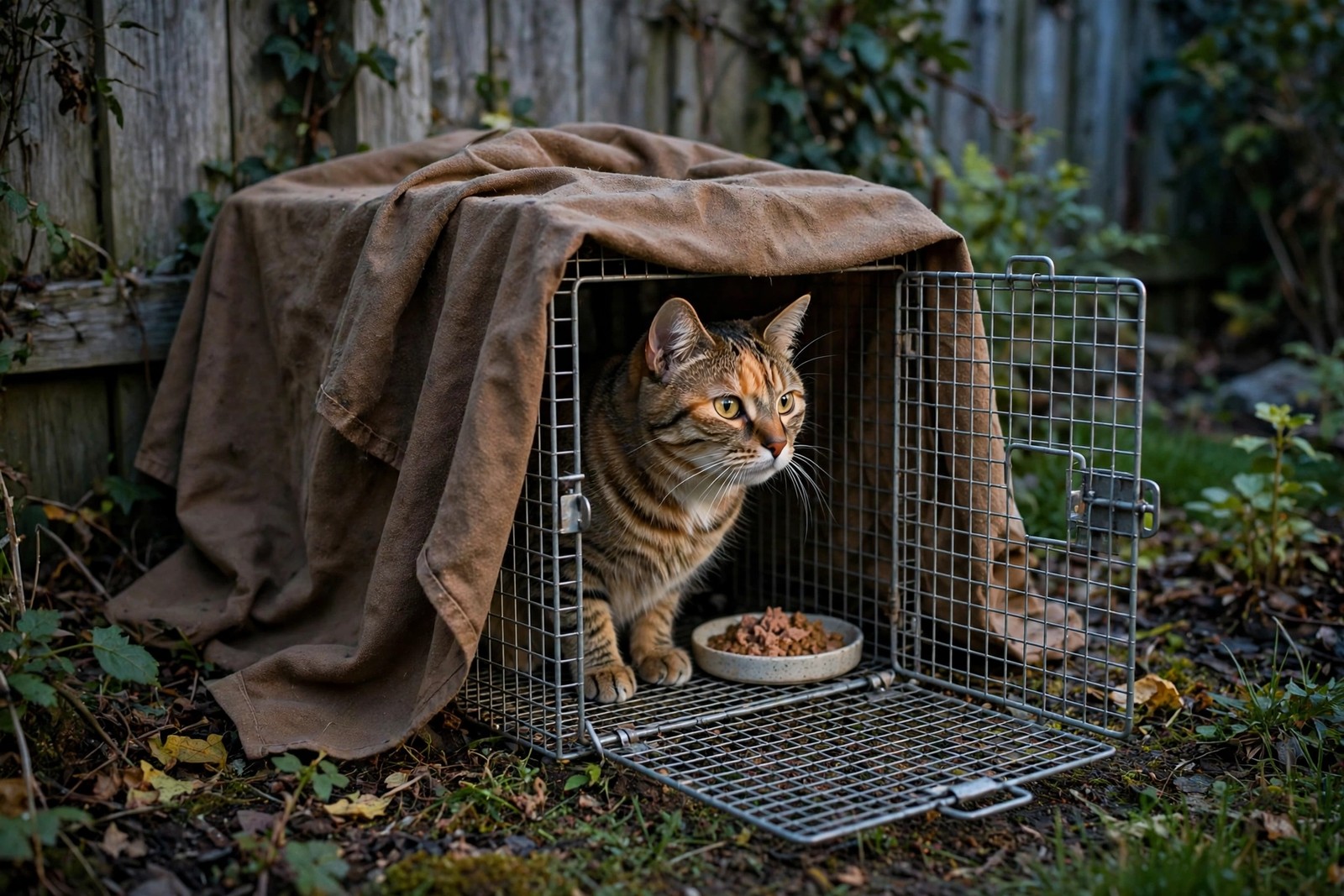
A humane trap, usually called a box trap, works nothing like a snap trap: there is no snap and no injury, only a door that closes behind the cat. It is the standard tool for recovering indoor cats who are too frightened to approach even their own owners, because hunger eventually persuades a hiding cat to walk into a cage that people cannot persuade her to leave a bush for.
The Mechanism, Part by Part
The trap is a rectangular wire cage with a door at one end, held open by a rod connected to a flat metal trip plate set into the floor near the closed end. You set the door by lifting it and engaging the trigger rod, then place bait on the floor beyond the plate, far enough back that the cat must step fully inside to eat. When the cat's weight presses the plate, the rod releases, the door drops under spring tension, and a locking bar prevents the cat from pushing it back open. Test the mechanism before use: pressing the plate with a stick should drop the door cleanly, and the set door should hold against a firm shake of the cage, since a door that falls early on a gust of wind educates the cat and wastes the night.
Setting It Up Properly
Line the floor inside with a sheet of newspaper or thin cardboard cut to size, so the cat walks on a flat surface rather than wire mesh, but keep the lining clear of the trip plate so it still moves freely. Choose firm, level, sheltered ground where the cat was last reliably seen, tucked against a wall, fence, or hedge rather than in open space, because cats travel along edges. Use a small amount of very pungent bait, such as sardine or warm chicken, placed in a trail of tiny smears leading in and a proper portion at the back beyond the plate. Drape a towel or blanket over the top and sides of the trap, leaving the entrance end open: the cover disguises the cage as a sheltered den, keeps rain off, and, crucially, calms a trapped cat later, since cats settle quickly under cover. Set the trap around dusk, when lost cats move, and withdraw from the area so your scent and presence do not keep her away.
Monitoring Is Not Optional
A set trap must be checked very frequently, ideally watched from a distance or visited at least every couple of hours, and it should never be left set and unchecked through a whole night, in hard rain, or in strong heat or cold. A trapped cat can injure itself thrashing in the first minutes and is helpless against weather and dogs afterward, which is why the monitoring, not the mechanism, is the humane part. Disarm the trap whenever you cannot check it, resetting it the next evening rather than gambling. If you catch a neighbour's cat or wildlife instead, cover the cage, release the animal quietly on the spot by opening the door from behind and stepping away, reset with fresh bait, and carry on; most trappers catch something else before they catch their cat.
Once the Door Drops
Approach quietly, cover the whole trap with the blanket if it is not already covered, and carry the entire cage indoors, into a small secure room, before opening anything. Never open the trap outdoors or in a car, because a panicking cat explodes out of an opening door faster than any hands can react. Let her out of the trap inside the room, give her water, a litter box, and time to decompress, and book a vet check in the following days, since cats missing outdoors often come home dehydrated or with minor injuries. KinsLe's Lost Pet Alert System strengthens every stage of this process, because sightings sent in by nearby Circle of Love members tell you which fence line or garden your cat is actually using, so the trap goes down on her real route instead of on a guess.