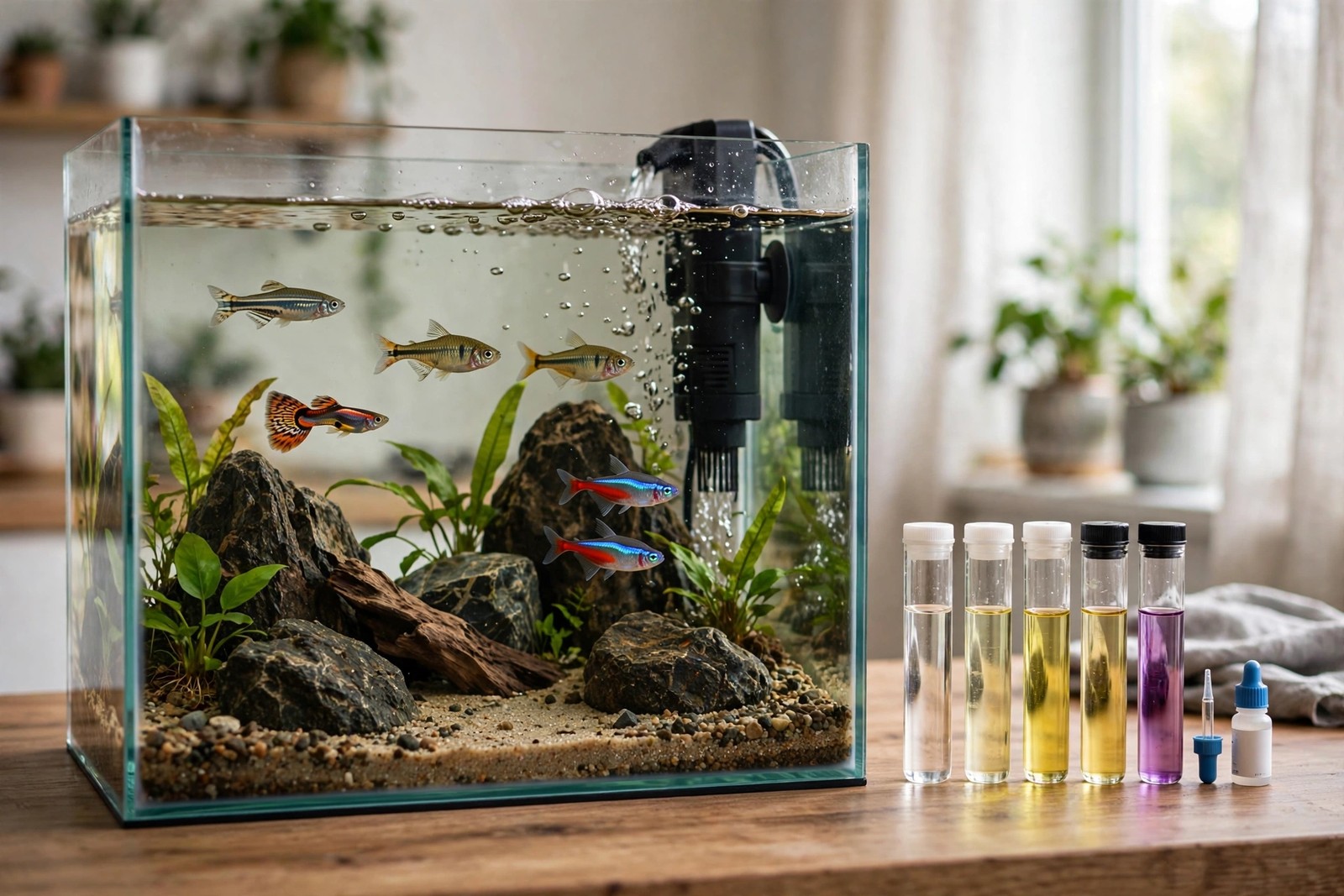
Cycling a new tank typically takes two to six weeks with the fishless method, and occasionally longer. You are not waiting for the water to settle or clear. You are farming bacteria. A new filter starts out almost sterile, and until enough bacteria colonize the filter media to process fish waste, the water will poison the very fish it is meant to keep. The calendar gives you a rough window; only water tests tell you where you actually are inside it.
The Three Stages You Are Waiting Through
In the first stage you add a measured ammonia source to the empty tank, and ammonia readings climb and hold while the first bacterial colony slowly establishes in the filter. In the second stage those bacteria convert ammonia to nitrite, so ammonia falls but nitrite rises and lingers, sometimes for as long as the first stage took. Nitrite is also highly toxic to fish, which is why a tank can look nearly cycled and still be unsafe. In the third stage a second colony converts nitrite into nitrate, and the readings settle into the pattern you want: ammonia and nitrite falling to zero, with nitrate present and controlled by partial water changes. Testing every day or two with a liquid test kit and writing the three numbers down turns this invisible process into a graph you can watch moving in the right direction.
What Speeds It Up and What Stalls It
Borrowed biology is the biggest shortcut: filter media, gravel, or a sponge from a healthy mature tank carries a living colony with it and can cut the wait dramatically, sometimes to days. Warm water in the normal tropical range, good oxygenation from filter flow or an air stone, and a steady ammonia supply all keep bacteria growing. Stalls usually have dull causes: ammonia dosed so high it overwhelms the young colony, a filter switched off for hours, media rinsed under untreated tap water whose chlorine kills bacteria, or the water changed so aggressively that the process keeps restarting. A cycle that has not moved at all after two weeks deserves troubleshooting of those basics before more waiting.
Fishless Versus Fish-In, and Knowing You Are Done
The fishless method, feeding the empty tank ammonia, is the kinder and more predictable route, because no fish breathes the ammonia and nitrite spikes. A fish-in cycle can be done with very hardy stocking, daily testing, and frequent water changes, but it is slower, more work, and stressful for the fish, so it is a rescue method rather than a plan. Whichever route you use, done has a precise meaning: a full day's ammonia dose is processed so that both ammonia and nitrite test at zero within about twenty-four hours, with nitrate showing. At that point, do a large partial water change to bring nitrate down, match temperature, and stock gradually over the following weeks rather than all at once, because the colony you grew is sized for the load it has seen so far.
A Daily Routine Worth Sharing Properly
Two to six weeks of daily dosing, testing, and recording is exactly the kind of routine that fails when two people in a household both assume the other did it, or both dose on the same day. Putting each day's test and dose on a shared list in KinsLe's Care Teams, where whoever completes it marks it off with a timestamp, keeps the cycle fed once a day, every day, until the tests say it is finished.