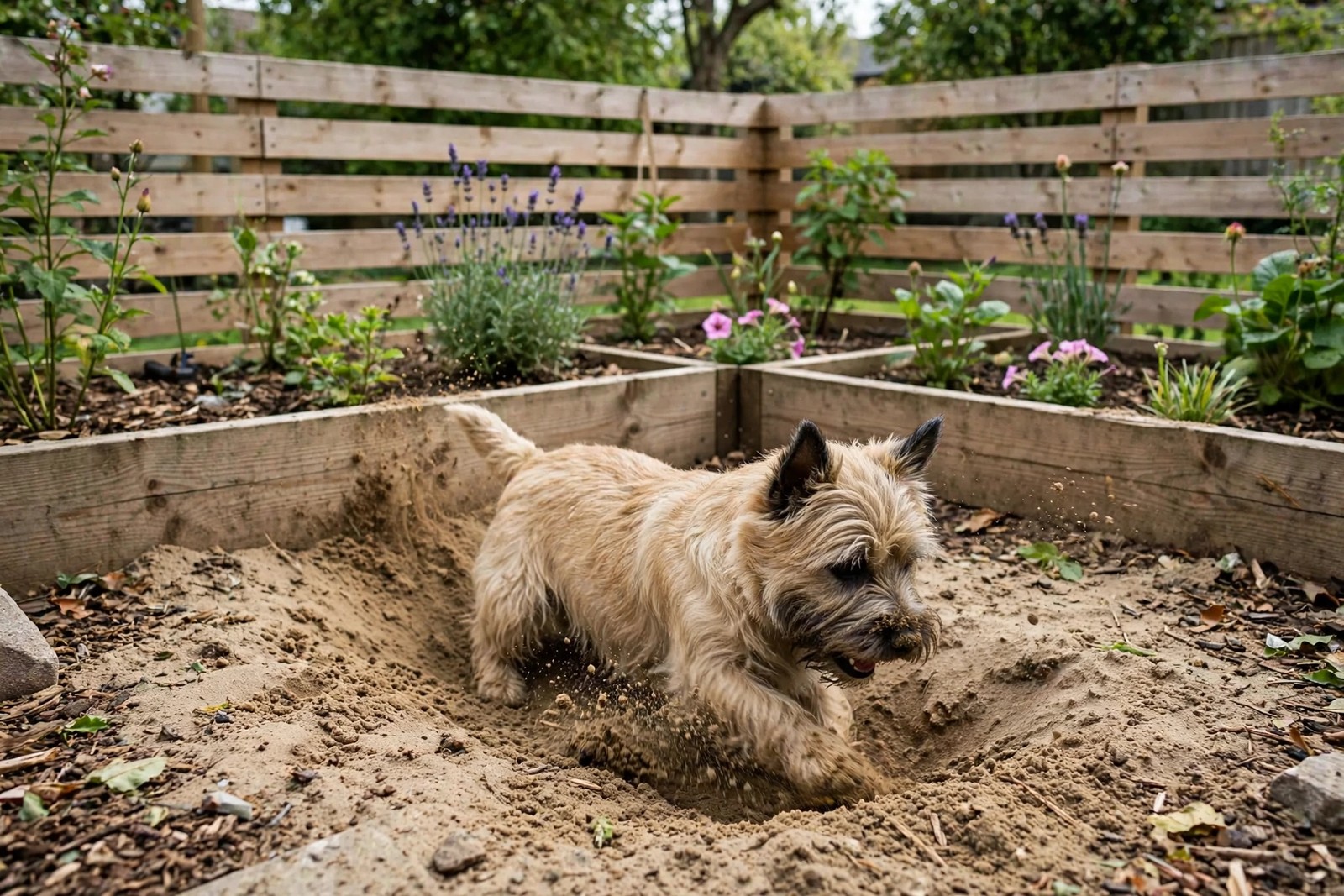
Ask what a Cairn Terrier will do in a garden with flower beds and the honest answer is: its job. Cairns were bred in rocky country to follow quarry into cairns and earth, pull themselves through tight ground, and come out with the animal. Digging and prey-chasing are not flaws to train away in this breed; they are the breed working as designed, and a garden full of loose soil, rustling borders, and visiting rodents is, to a Cairn, a workplace.
Digging Is the Default Setting
Expect excavation wherever the ground invites it: freshly dug beds, soft borders, compost corners, and the base of fences. Loose, newly worked soil is the strongest draw, which is why the flower bed you planted this morning is tonight's dig site. A Cairn digs purposefully and fast, and a dog left unsupervised in the garden will landscape to its own design.
Fences need checking at ground level, not just at the gate. A Cairn who digs out under a fence is following the same instinct, and a gap that fits a determined terrier is smaller than most owners guess. Walk the boundary regularly, look for started scrapes and loosened soil at the base, and reinforce any stretch where digging has begun before it becomes a tunnel.
The Chase Is Just as Built In
Rodents, squirrels, and anything that darts will be chased with complete commitment. A Cairn mid-chase is famously deaf to recall, not from disobedience but from focus: the chase is the deepest wiring the breed has. That means garden time for a young or keen Cairn is supervised time, with a long line as a sensible middle step while recall is being built in lower-distraction places first. Expect the occasional successful hunt, too; this breed was kept to reduce vermin, and a garden with active rodent runs will see results.
Give the Drive a Legal Outlet
The strategy that works is channeling, not suppression. Give the dog a sanctioned digging spot: a defined corner or a sand-filled pit where buried toys and treats are hidden and digging is praised like a triumph. When the dog starts in a bed, interrupt calmly, lead it to the spot, and reward digging there; Cairns learn place rules well when the legal option is genuinely satisfying. Protect what matters in the meantime: low fencing or edging around prized beds, raised planters for the plants you cannot bear to lose, and netting over freshly planted ground until it settles.
Exercise and mental work lower the pressure without touching the instinct. A walked, played-with, trained Cairn still digs in its spot, but it is less likely to spend the afternoon engineering an escape. Accept the breed on these terms and the garden can hold both flowers and terrier, each with territory the household respects.
Write the Garden Truths Down for the Next Pair of Hands
What this dog does outdoors is exactly what anyone caring for it must know in advance: the digging spot, the fence stretches to watch, the recall that vanishes mid-chase, and the beds that are fenced for a reason. A sitter or a future owner who learns those facts from a written record starts safely; one who learns them from a dug-under fence starts with a lost dog.
That record travels with the dog inside KinsLe, where the Transferrable Profiles history carries the garden behavior notes alongside the health and routine details, so the dog's next caregiver inherits the full picture rather than a surprise flower bed.