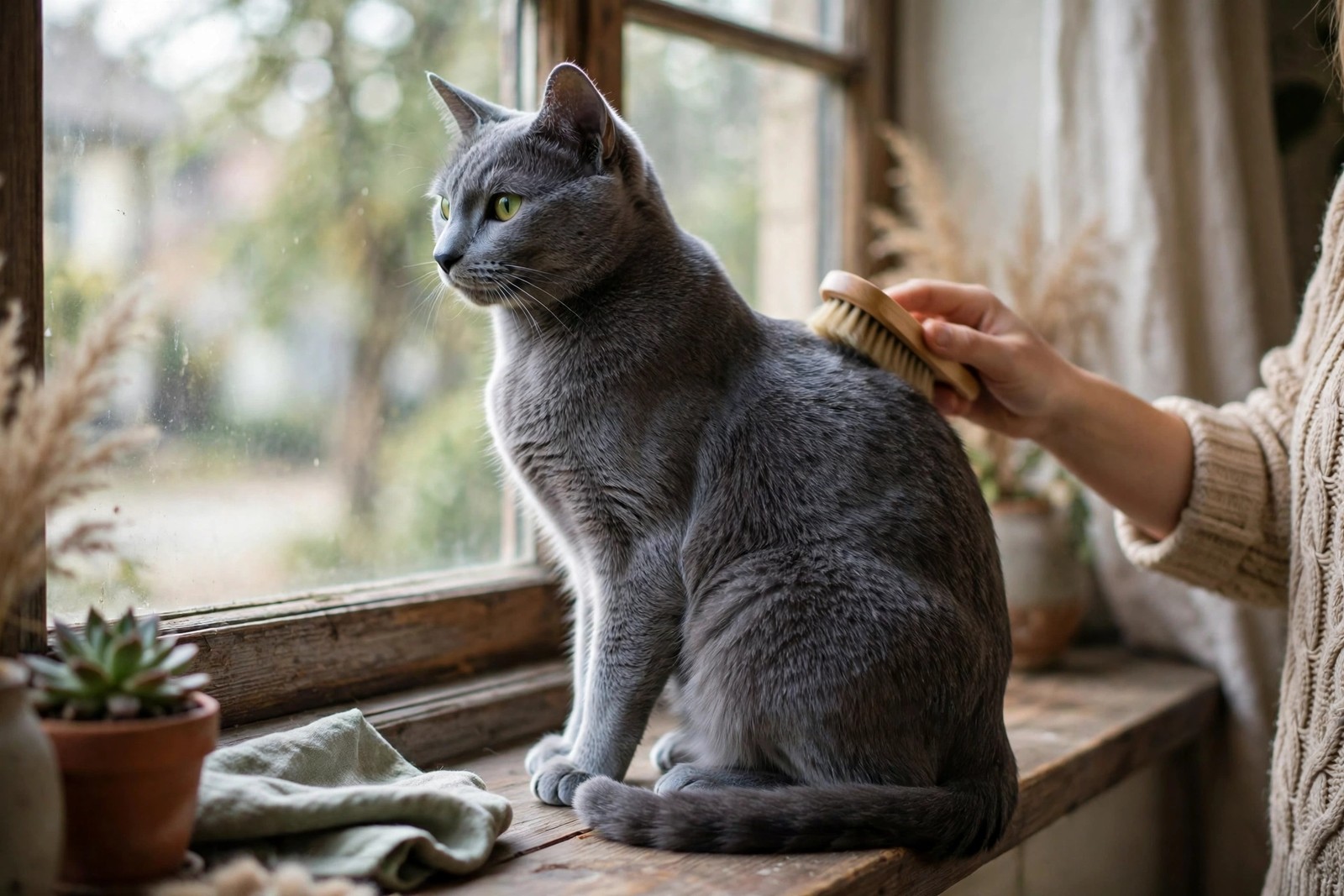
A Russian Blue needs about five minutes of brushing once a week — one of the lightest grooming loads of any cat breed. The coat is short but unusually dense, a true double coat whose guard hairs stand slightly off the body and give the blue fur its silvery, plush look. That density traps loose hair inside the coat, which is exactly why a short weekly session works: you lift the shed out before it escapes onto furniture.
The Weekly Five Minutes
Use a soft bristle brush, a fine comb, or a rubber grooming mitt, and work in the direction of growth over the back, sides, chest, and tail. A Russian Blue's coat should spring back when you stroke it against the grain; if your hand leaves a lingering track, loose undercoat is building up and a second session that week is worthwhile. Many owners finish with a wipe from a slightly damp hand or cloth, which picks up the last strays and the dander sitting on the surface — a small kindness in a household that chose this breed partly for its reputation of suiting some mildly sensitive people, though no cat is truly allergen-free.
Twice a Year, the Coat Turns Over
In spring and again in autumn, expect two to four weeks of noticeably heavier shedding as the double coat renews. Step up to twice-weekly brushing through that window and run the vacuum more often; then drop straight back to the weekly rhythm once the fall-out eases. Year-round indoor living under artificial light blurs these seasons for some cats, who shed a little constantly instead — the rule stays the same: brush for what you see coming out, not by a rigid calendar.
What a Russian Blue Does Not Need
Skip routine bathing entirely unless the cat gets genuinely dirty; the coat stays clean on its own, and frequent washing dulls the silver tipping that makes the breed's colour. There is no clipping, no de-matting, and no specialist kit to buy. The extras are the standard ones shared by every cat: nail tips trimmed every few weeks, ears glanced at during the brushing session, and teeth care built up gradually if your cat allows it. Because grooming is so light, use the weekly session as the health check it doubles as — run your palms over ribs and spine, feel for lumps or scabs hidden in the density, and note weight creep, which this food-loving breed can hide under all that plush.
That simplicity is the point of choosing a Russian Blue, and the only failure mode is forgetting the one small session because it is small. KinsLe Family Sharing lets an owner grant selected parents, grandparents or adult children a way into the cat profile.