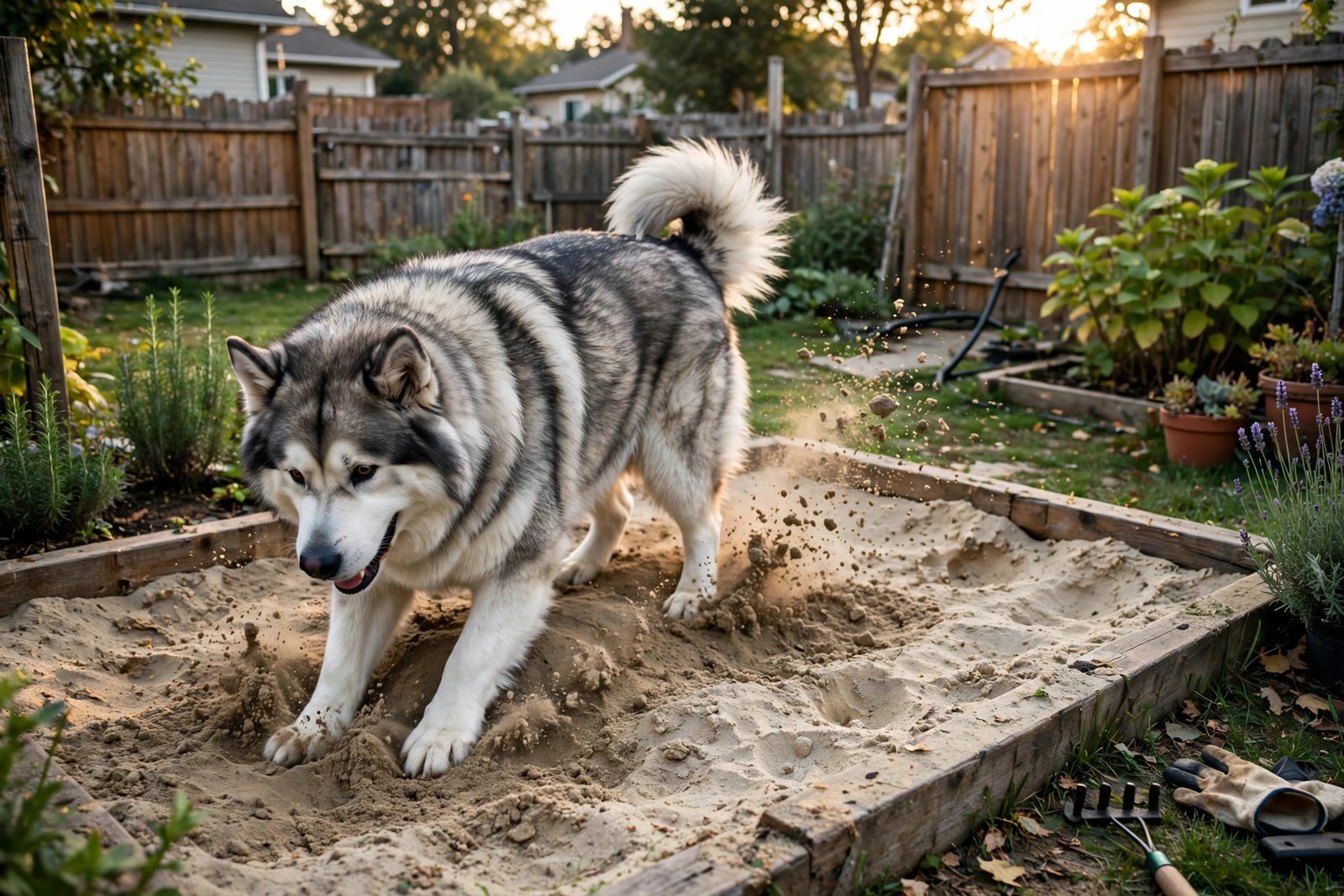
An Alaskan Malamute can live happily in a suburban home, but only for owners who go in with honest expectations. This is a powerful freighting breed, developed to pull heavy loads over long distances and to survive by its own wits. Those origins do not fade because the yard has a lawn and a patio. Pulling, digging, and escaping are not bad habits a Malamute picks up; they are the breed expressing itself, and your job is to give each drive a safe outlet before it finds its own.
Pulling Is the Job Description
On leash, a young Malamute typically pulls, hard and cheerfully, from the first walk to the thousandth unless you deliberately teach otherwise. Leaning into pressure is what the breed was rewarded for over generations, and a strong adult can move an unprepared owner off balance without noticing. Treat leash manners as a training project measured in months: short, consistent sessions, rewards for a loose leash, and a calm rule that forward movement stops when the leash goes tight.
Controlled pulling games and draft-style exercise with proper, well-fitted gear let the dog work in the way its body wants to work, and a dog who has pulled with permission earlier in the day is usually far more civilized on the evening walk. What you should not do is let an untrained Malamute tow you on a collar at full strength; that rehearses exactly the habit you are trying to retire, and it punishes both of your shoulders.
Digging Is Instinct, Not Mischief
Malamutes dig to reach cool earth in summer, to hunt the smells under the soil, to bury treasured items, and simply because digging feels good to a dog built for snow country. In a suburban garden that means craters in flower beds, trenches along fence lines, and enthusiastic excavation of any freshly turned soil. Punishing digging after the fact teaches nothing except that you are unpredictable around holes.
Management works far better than outrage. Give your dog a sanctioned digging spot, such as a shaded corner or a sand-filled pit, bury interesting toys shallowly there, and praise excavation in the right place like it is a party trick. A dog with a legal pit, enough exercise, and company in the yard usually digs in its own spot and naps through the rest of the afternoon.
Escaping Is a Real Talent
Plan containment as if your dog is actively studying it, because it is. A bored or motivated Malamute climbs, digs under, leans on, and tests gates with a persistence that surprises owners of easier breeds. A tall, secure fence is the typical starting point, sized to your own dog and yard, and dig protection along the fence line, such as buried mesh or a concrete strip, closes the most-used exit route. Gates need latches a clever paw cannot lift, and they need to be checked after storms, deliveries, and garden work.
Escaping is rarely random. A Malamute who gets real exercise, real company, and a yard routine that includes family time attempts far fewer breakouts than one stored outside and ignored. Identification matters too: a dog this determined should always carry up-to-date identification, because even good fences meet a determined afternoon eventually.
A Bored Malamute Remodels Gardens
Under-exercised and under-employed, this breed redecorates. None of that is spite. It is a working dog with a full battery and nothing assigned to drain it, inventing its own projects from your landscaping.
The suburban Malamutes who settle well share a pattern: daily exercise that actually tires them, jobs and games during the week, a legal place to dig, fencing built for the breed rather than for appearances, and owners who wanted precisely this dog. If circumstances ever change, KinsLe passes the Transferrable Profiles file along so a new owner inherits the escape history and garden rules from day one.