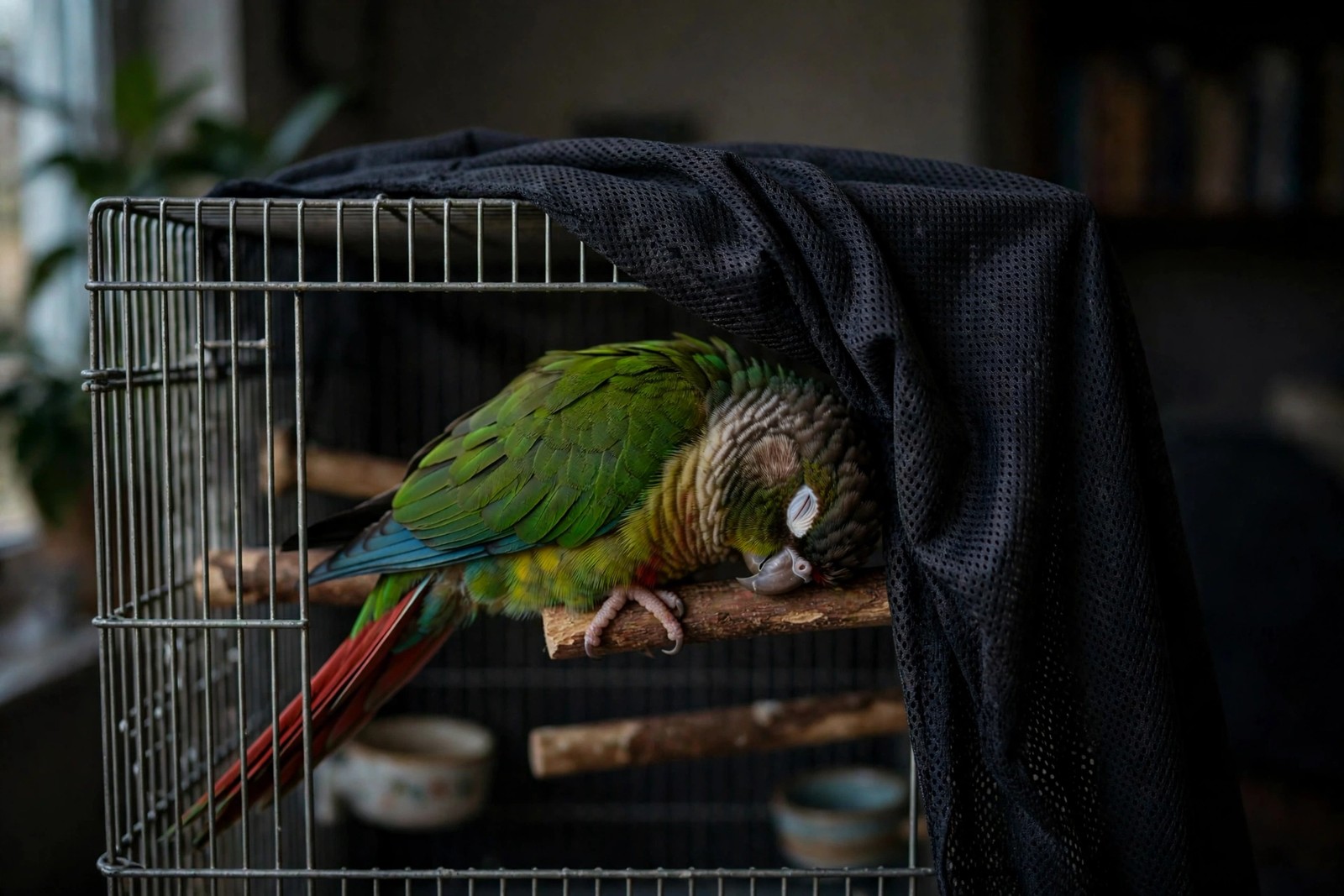
A healthy conure needs 10 to 12 hours of sleep a night, in darkness and relative quiet, without interruption. Conures come from regions near the equator where day and night are each close to twelve hours year-round, and their bodies are tuned to that rhythm. A bird in a living room that stays brightly lit and noisy until midnight is not getting conure sleep, even if it dozes on a perch between disturbances.
What counts as real sleep
Real sleep means the bird settles in the evening, stays largely undisturbed through the night, and wakes naturally at a consistent time. Short naps during the day are normal — a quiet half hour after lunch is typical conure behavior — but napping does not bank credit against a six-hour night. Judge by the full dark period, not by how much time the bird spends with its eyes closed across 24 hours.
Where the bird sleeps matters as much as how long. If your household is up late, either cover the cage fully with a breathable cover that blocks light, or move the conure to a smaller sleep cage in a spare room where voices and television do not carry. Many owners find a sleep cage transforms behavior simply because the bird's night finally becomes predictable. Keep the sleeping spot away from drafts and from night-fright triggers such as passing headlights sweeping the wall; a small night light nearby helps some conures settle after a startle without ending the night.
What too little sleep looks like
A chronically tired conure is often labeled a behavior problem. Expect increased screaming, especially in the evening, more frequent and less predictable biting, reluctance to step up, and a generally short temper during handling. Short nights and long artificial days can also push a conure toward hormonal behavior — territorial guarding of the cage, regurgitating to a favorite person, and seeking dark corners — because extended daylight reads to the bird as breeding season. Before paying for behavior help, many avian vets will first ask owners to fix the sleep schedule for two to three weeks and report back.
Consistency does the heavy lifting: cover at roughly the same time each evening, uncover at the same time each morning, and keep weekend lie-ins from shifting the bird's day by hours.
When sleep changes signal illness
Sleeping much more than usual, especially fluffed up on the cage floor or at the food bowl during the day, is not tiredness — it is a warning sign. A conure who suddenly cannot stay awake, loses interest in food, or sits with tail bobbing as it breathes needs an avian veterinarian promptly, because birds hide illness until they cannot. Note when the change started and what else has shifted; that timeline is genuinely useful at the appointment.
Guarding the routine once it works is mostly a household coordination problem, since one late-night family member can undo everyone else's discipline. Recording cover and uncover times in KinsLe's Care Teams, with the tasks assigned and timestamped, shows at a glance whether your conure really got its full night.