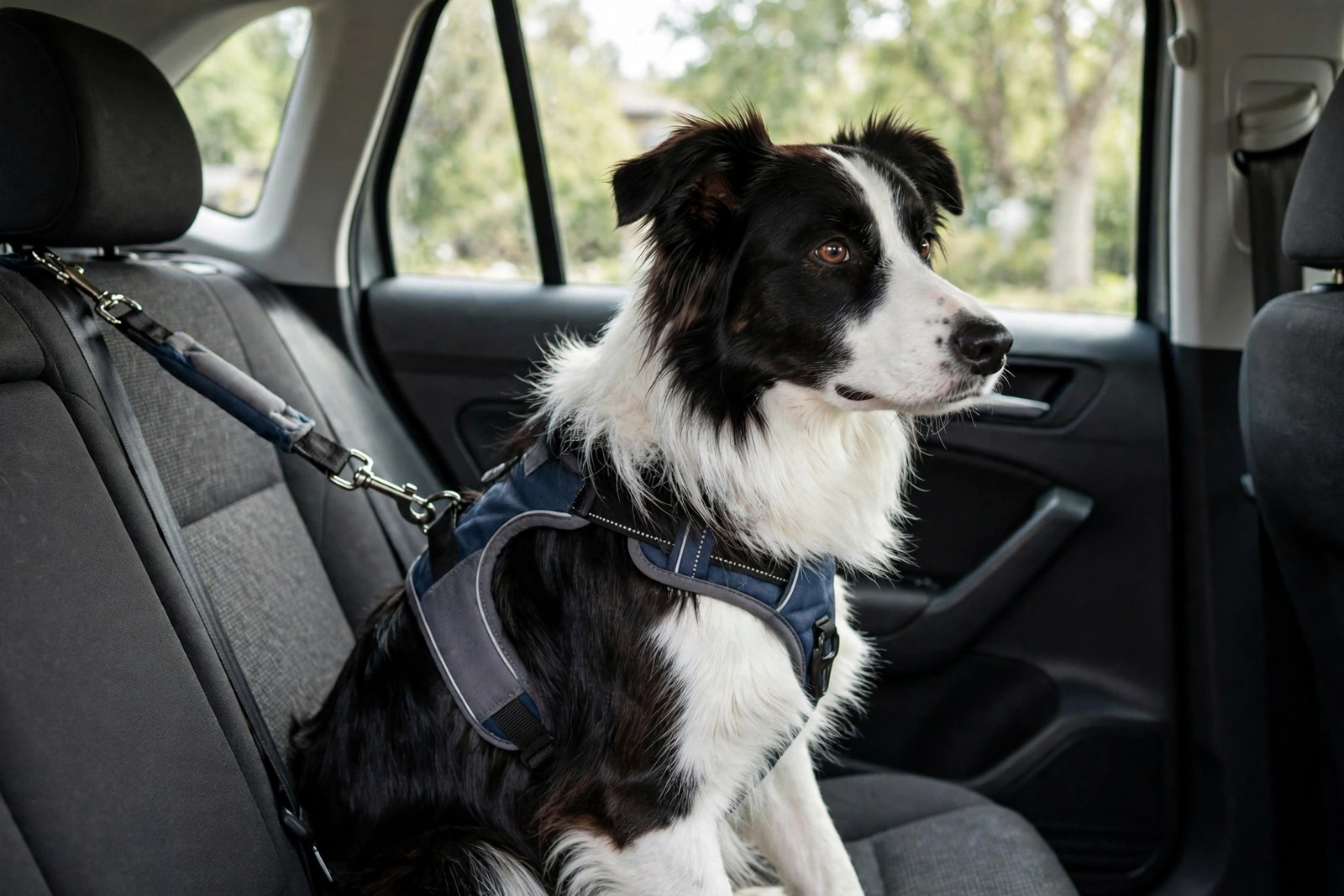
No, it is not safe, and this is one question where the honest answer has no comfortable middle ground. A dog riding loose feels relaxed and happy right up until the moment the car stops suddenly — and at that moment the dog becomes one of the most dangerous objects in the vehicle. Restraint is not about spoiling the head-out-of-the-window moment; it is about what physics does to an unsecured body, and about the crashes that happen on five-minute trips to the park, not just on motorways.
What Happens in a Sudden Stop
In a collision at town speed, everything unsecured keeps travelling at the speed the car was doing until it hits something: the seat back, the windscreen, or a passenger. A medium dog thrown that way strikes with a force many times its own body weight, which is enough to kill the dog and to break bones in the person it lands on. Dogs riding on a lap in the front seat face a second hazard — an inflating airbag is designed for an adult human torso and can seriously injure or kill a dog it catches. Loose dogs who survive the impact often panic in the noise and confusion, and a frightened dog snapping at rescuers, or bolting from an opened door into traffic, turns one accident into several.
The Everyday Risks Beyond Crashes
Most loose-dog journeys end without drama, which is exactly how the habit forms — but the smaller risks are constant. A dog who moves around the cabin pulls the driver's eyes off the road, leans on window switches, and can wedge against pedals or the gear lever. Heads and whole bodies out of windows invite eye injuries from grit and insects and, every year, dogs who leap or fall from moving cars. At fuel stops and car parks, an unrestrained dog is out of the door the second it opens, loose in the one environment full of moving vehicles and strangers. Some regions also treat an unrestrained animal as a driving offence or an insurance problem after a claim, so check the rules where you drive.
Choosing a Restraint That Actually Holds
Look for a harness independently crash-tested by a recognised pet-safety programme, with wide padded chest straps and a short, sturdy tether that clips to the car's seatbelt system — never to a collar, which transfers the force to the neck. The back seat is the safest place for a harnessed dog, away from airbags. A solid crate is the other strong option: sized so the dog can stand and turn, placed in the boot or footwell area, and strapped or wedged so the crate itself cannot slide or tip. Barriers that keep a dog in the boot are useful for tidiness and distraction, but understand their limit — they contain a dog during normal driving, not during a crash. Whatever you choose, practise with it parked first: clip in, treat, unclip, so the restraint means car rides rather than a wrestling match.
Building the Habit on Every Trip
Restraints only work on the journeys where something goes wrong, and nobody knows which journey that is — so the rule has to be every trip, including the two-minute school run. Keep the harness by the lead so clipping in becomes part of the leaving routine, allow extra minutes rather than skipping it when you are late, and never leave a restrained dog alone in a parked car, where heat builds dangerously fast. Fit matters as much as habit: recheck harness snugness as young dogs grow and as coats change with the seasons. As a final layer of protection for the day a door opens at the wrong second, KinsLe's Verified QR ID Pet Profiles put a scannable code on your dog's collar that opens his profile and your contact details, giving whoever finds him a direct way to get him home.