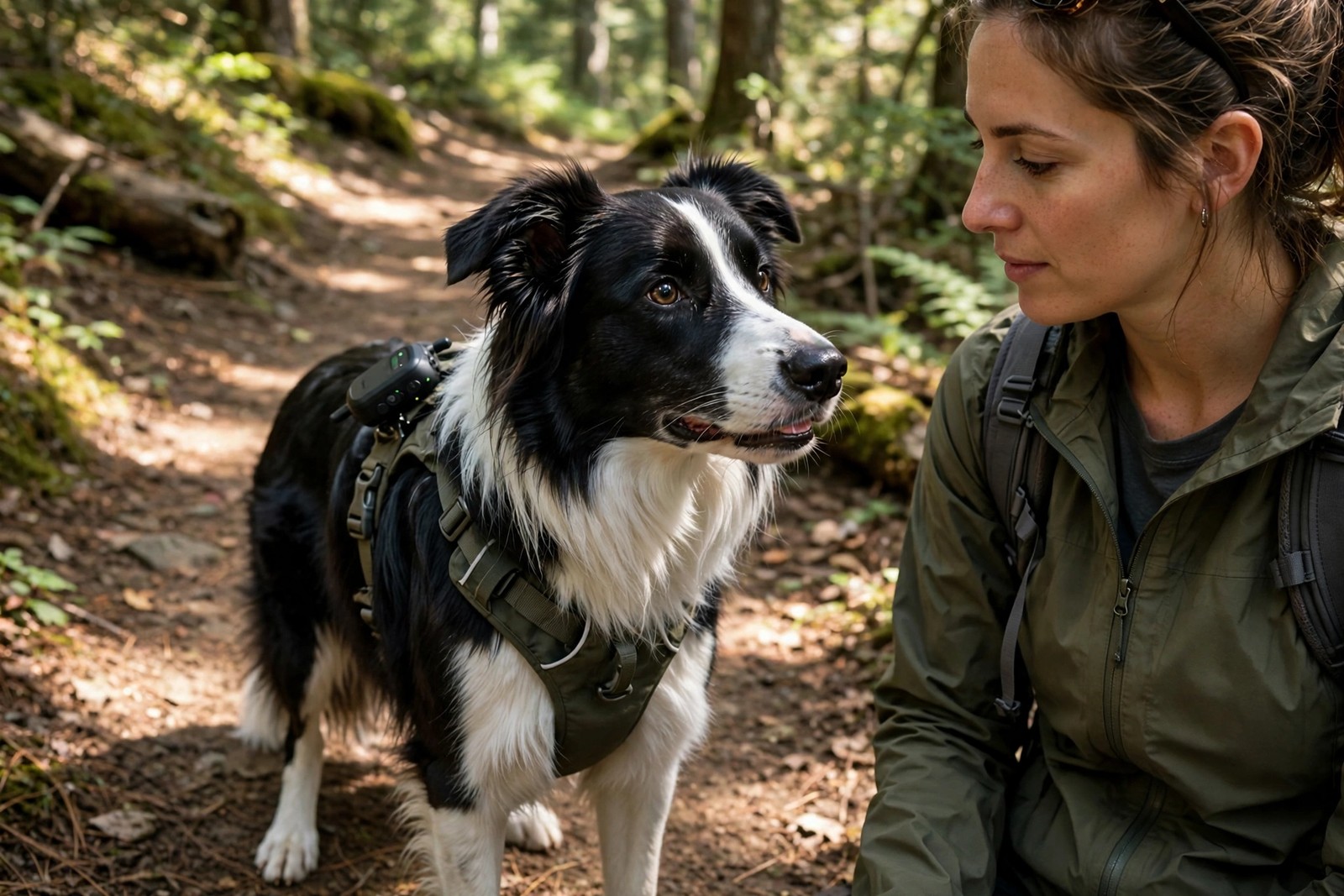
For a dog who hikes — and especially for one who is ever off lead where that is permitted — a tracker is usually worth wearing. Trails add risks the neighbourhood does not: a deer bursting from brush, a scent that pulls a dog over a ridge, switchbacks where thirty seconds out of sight is a long way in the wrong direction. A tracker shortens that search, but only if you pick the right type and understand its limits before you rely on it.
GPS is not the same as a short-range tag
True GPS trackers use satellites to locate the dog and a mobile network to send that location to your phone, so you can follow a moving dot from a long way off. Small Bluetooth finder tags work very differently: they report only when they pass near a compatible phone, which may be fine in a town park and nearly useless on a quiet forest trail with nobody around. Radio-frequency trackers sit between the two, using a handheld receiver with a limited range and no map. For open country, wooded trails, and any dog who ranges, the GPS unit is the tool actually built for the job — read the product description closely, because the three types are often sold side by side as if they were interchangeable.
Signal and battery decide whether it works
GPS tracking thins out in deep valleys, dense canopy, and steep-sided gorges, and it stops entirely if the network side has no coverage, even when the satellites can see the collar. Check the coverage of the trails you actually walk, and treat any dead zone as an area where your dog stays on a long line. Battery is the second limit: live tracking drains a unit far faster than standby mode, so charge it the night before, learn how many hours of live tracking your model realistically gives, and carry the dog on a lead for the walk back if the battery runs low rather than saving power by switching the tracker off.
Weight, fit, and where it sits
A tracker should ride flat and snug, not swing from a tag ring where it can snag on brush or bounce off. Most units clip or strap onto a collar or, better for hiking, onto the top strap of a well-fitted harness where they stay oriented and clear of the throat. Follow the maker's weight guidance for your dog's size — a unit that is trivial on a Labrador can be a real burden on a small terrier climbing all day — and test the whole setup on a short local walk first. Check for rubbing after that trial, confirm the unit survives a shake and a roll, and make sure your dog cannot chew it where it sits.
The layers a tracker never replaces
Keep a flat ID tag with your mobile number on the collar, keep the microchip record current, and keep the lead on near cliffs, fast water, livestock, and trailheads by roads, whatever the map on your phone shows. A tracker tells you where a collar is; it cannot stop a dog reaching a hazard first. Photograph your dog in hiking gear before each big trip so a current description is ready if you need help. And for the moment a tracker has no signal or a dead battery, KinsLe's Lost Pet Alert System gives you a second layer that does not depend on the collar at all, sending a free alert to nearby members and letting anyone who finds your dog reach you by direct message.