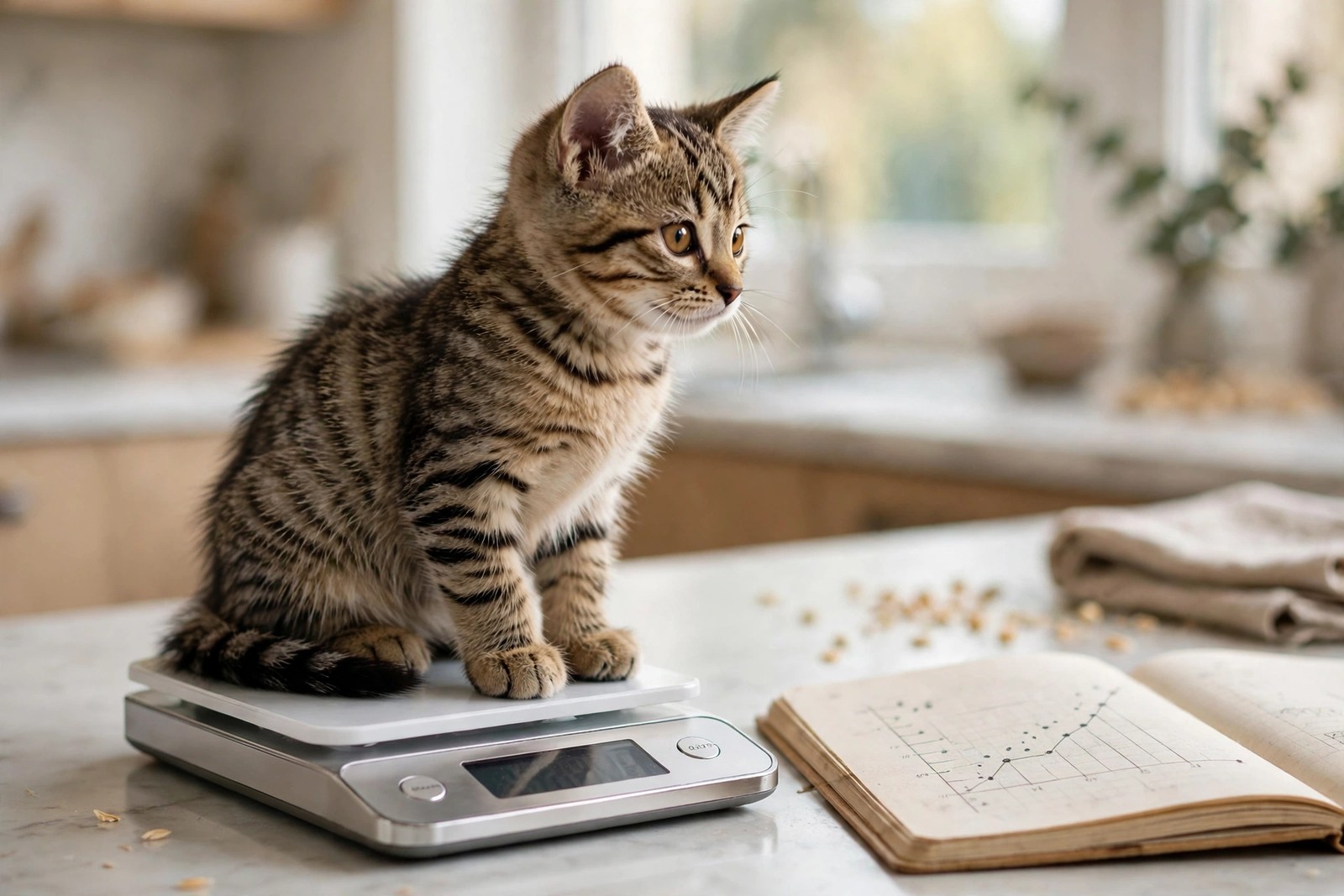
Yes — a first-year record is short to keep and useful for years afterwards. A kitten changes faster in twelve months than at any other point in her life, and the details blur together in memory: nobody reliably remembers which week she was weaned, what she weighed at her second vet visit, or whether her growth stalled before or after a bout of loose stools. Written down, those details become a growth curve and a health history your vet can actually use.
The Weekly Weigh-In
Weigh your kitten weekly, on the same kitchen scales, at roughly the same time of day, and record the grams rather than a rounded impression. A young kitten who is thriving gains steadily week by week, so the shape of the line matters more than any single figure. Two consecutive weekly readings that stall or fall, in a kitten who should be climbing, are worth a prompt vet call, especially alongside a smaller appetite, less play, or loose stools, because parasites, infection, and feeding problems all show in growth before they show anywhere clearer.
Keep weighing weekly through the whole first year. Growth slows as she approaches adult size, and the log shows that natural levelling plainly, which stops owners worrying about a healthy plateau — or, just as valuably, shows when a plateau arrives far too early.
The Milestones Worth Writing Down
Log each milestone with its date as it happens. Record weaning: when she started solid food, what she moved onto, and whether her stomach tolerated the change. Record every vaccination visit exactly as your vet schedules it, with what was given noted from the vet's own paperwork, so future boarding, travel, or a change of practice never stalls on missing proof. Note litter training progress, the arrival of adult teeth if you spot them, and any first season if she is not yet spayed, since the timing of a first season is a fact owners are often asked for and rarely remember. If you and your vet decide on neutering, log the booking, the procedure date your vet sets, and her recovery notes: appetite returning, wound checks, and when normal play resumed.
Behaviour milestones earn a line too. First confident exploration of the whole house, first calm handling by visitors, first car journey, first night sleeping through — together they describe the kitten's temperament as it forms, and a sudden reversal in that list is sometimes the earliest sign that something physical is wrong.
Why the Record Keeps Paying Off
At every kitten appointment, the record answers questions owners usually guess at: how fast she is growing, when a symptom began relative to a food change, and whether a vaccine visit is outstanding. If you change vet, board her, or hand her care to a sitter during the first year, the packet travels with her and nobody has to reconstruct her history from memory. It also becomes the baseline for her adult record, because the vet who can see her first-year growth curve judges her adult weight with far better context.
Start simply: a weekly weight, a dated line per milestone, and vet paperwork filed in order. Photograph her monthly in the same spot beside the same familiar object, because a dated run of pictures shows body condition changing in a way memory tends to smooth over. KinsLe Pet Passport is built for exactly that shape of record, keeping the growth log, vaccination paperwork, and milestone notes together in one portable packet you can hand over at any appointment.