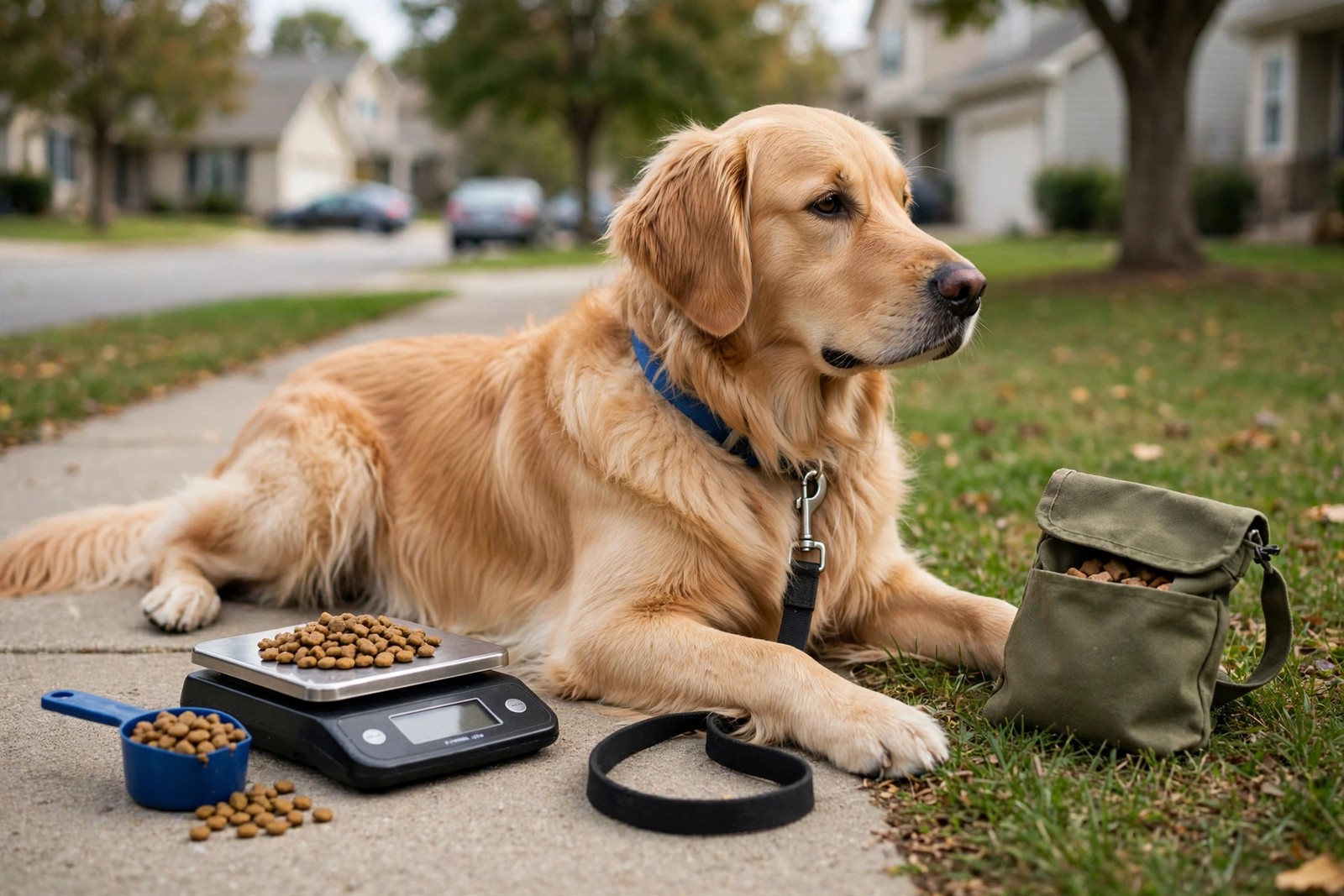
Weigh your dog's food if the amount matters, and treat a scoop as a pouring tool rather than a measuring one. A scoop fails quietly. Kibble settles in the bag, large pieces bridge across the rim, small pieces pack into gaps, and a heaped fill on a hurried morning can hold far more than the level fill you intended. None of that shows in the bowl, yet the error repeats at every meal, in the same direction, for weeks. A kitchen scale answers a simpler question: how many grams are in this bowl right now.
Test your own scoop before you trust it
Run a short check on a quiet afternoon so the result reflects your real habits. Put a dry scoop beside the scale, place your feeding bowl on the scale, and return the reading to zero with the bowl in place. Fill the scoop exactly as you normally do, without shaking it down or levelling it for the sake of the test, pour the kibble into the bowl, and write down the weight. Repeat the fill and pour nine more times, emptying the bowl between rounds. That spread, multiplied across two meals a day, is the true accuracy of the scoop method in your kitchen, not the number printed on its handle.
A weighing routine that takes seconds
Keep the scale where the food lives, not in a drawer that has to be fetched. Set the empty bowl on the scale, return the reading to zero, and pour kibble slowly until the display reaches the agreed grams for that meal. If you feed twice a day, weigh each meal separately rather than weighing a daily total and splitting it by eye, because an uneven split recreates the very problem the scale solved. For wet food or a mixed ration, weigh each component in the same bowl, returning the reading to zero between additions.
When the scoop error actually changes outcomes
Precision matters unevenly across a dog's life. A young, active adult holding a stable weight may tolerate a loose scoop without visible change, and a monthly weight check will catch drift while it is still easy to correct. The picture changes for a dog on a weight-loss plan, where the planned reduction may be smaller than the daily scoop error working against it. Puppies need steady, controlled growth rather than generous fills, dogs with joint trouble pay for every extra pound they carry, and senior dogs can lose or gain quietly under a thick coat.
Adjusting portions with the scale as your record
Change amounts in small, deliberate steps and give each step time to show its effect. Reduce or add a modest number of grams, hold that amount steady for a couple of weeks, and weigh your dog on the same scale, at the same time of day, before drawing a conclusion. Feel for ribs under a light covering of fat and look for a visible waist from above and from the side, because the bowl alone never tells you whether the amount is right. Count training treats inside the day's total, especially during heavy training weeks, and reduce the bowl slightly when treat use runs high. A clinician can reason from a recorded ration far better than from a report of roughly one scoop a day.
Keeping every feeder on the same number
Write the ration where feeding happens: the grams per meal, the number of meals, and the treat allowance for the day. Show each family member the zeroing step once in person, because skipping that step is the one error that quietly shifts every bowl by the weight of the dish itself. That shared discipline is simple to run inside KinsLe, where Care Teams records the feeder, the amount poured, and the time of each meal in a single list the whole household can check before pouring.