Protect the growl and work underneath it. Your dog has learned something factually true about his world: when he growls, the frightening thing goes away. The visitor steps back, the other dog is led off, the hand reaching for his collar withdraws. A behaviour that reliably ends an ordeal will be repeated, and that is not defiance or dominance; it is a frightened dog using the mildest tool that has ever worked for him. Your task is to make the tool unnecessary, never to confiscate it.
Why the Warning Must Stay
A growl is information delivered early and cheaply. Dogs who are punished for growling do not become comfortable with the trigger; they become quiet about it, and the discomfort then surfaces further up the ladder, as a snap or a bite that owners describe as coming from nowhere. It did not come from nowhere. The warning was trained out of the sequence. So the first household rule is absolute: nobody scolds, stares down, corners, or physically punishes a growling dog, and children are taught to freeze and call an adult rather than reaching in.
In the moment, honour the growl by creating the distance your dog asked for. Move him away calmly, or move the trigger away, without fuss or apology rituals. That is not rewarding bad behaviour; it is confirming that communication works, which keeps the communication coming.
Work Below the Growl
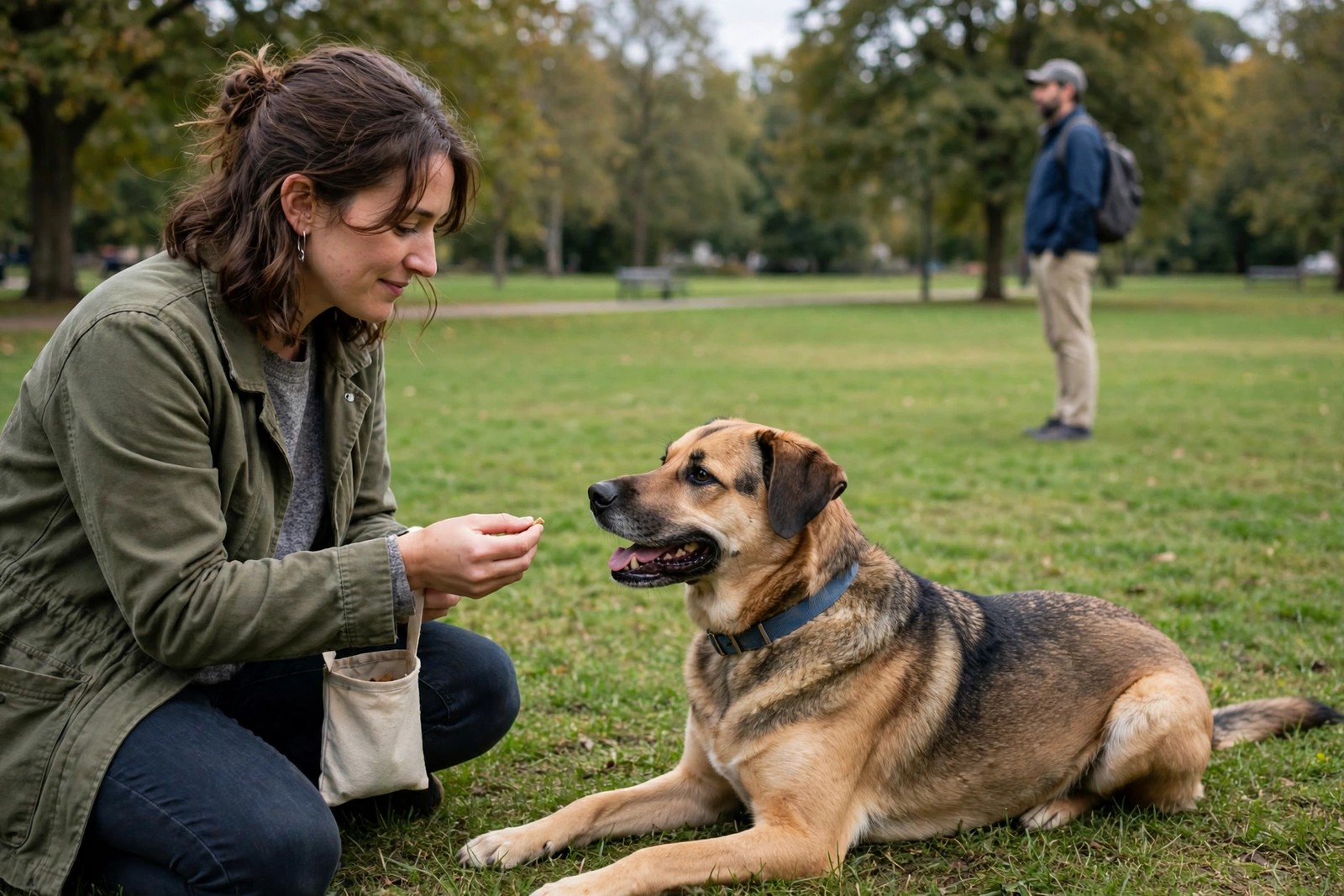
Real change happens at distances where he can notice the trigger and still think. Find that distance honestly: if he growls at visitors at three metres, you work at ten. At that range, the trigger appears, excellent food follows immediately, and the trigger leaves before he needs to escalate. Session by session, across days rather than minutes, the pairing teaches a new prediction: that person or dog appearing means good things arrive and nothing is forced. Shrink the distance only when he is visibly relaxed at the current one, looking at the trigger and then back at you for his food.
If he growls during a session, you were too close or stayed too long. End kindly, increase distance next time, and do not treat it as a setback to argue with. Keep a trigger log: what it was, how far away, how he responded, and what food you used. Patterns hide in those notes — many dogs cope with adults but not children, with stationary dogs but not approaching ones — and the log finds them faster than memory does.
When to Bring in Professional Help
Growling that is frequent, new in an adult dog, aimed at household members, or guarding food, beds, or people deserves a vet check first, because pain lowers the threshold for fear and a sore dog growls at approaches a sound dog would shrug off. After that, a qualified behaviourist can build a programme around your dog's specific triggers and distances rather than a generic recipe. Bring the trigger log to that appointment; it is a genuinely useful document for this problem.
Progress is measured in shrinking distances and softer body language, not in a dog enduring triggers silently. Teach a hand target and a settle on a mat alongside the distance work, because a dog who has somewhere to go and something to do needs the growl less often. KinsLe Care Teams keeps the whole household moving the same way on that programme, because you can assign the daily practice sessions and the trigger logging to named helpers and see each completed task marked with a timestamp.