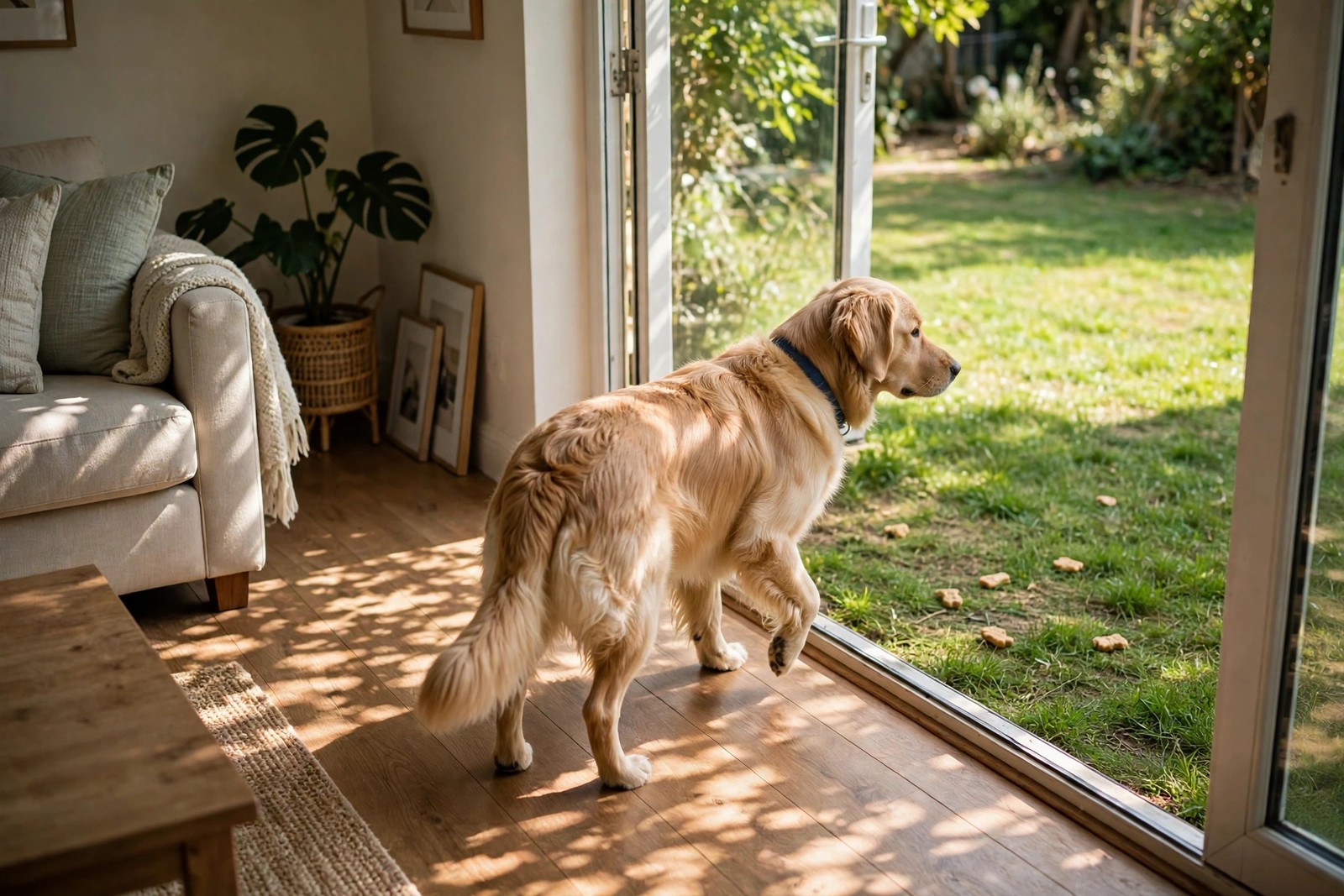
A dog fixated on moving light needs early, calm interruption rather than encouragement. What looks like a game — pouncing at reflections, spinning after sun patches across the floor — can become repetitive and hard to break, crowding out rest, play and normal interest in people and other dogs, so acting while episodes are still occasional gives you a stronger chance of loosening the pattern.
Remove the triggers you control
Stop laser-pointer, torch and phone-light games completely, and ask visitors and children to do the same, because those games rehearse exactly the sequence you are trying to end: spot moving light, fixate, chase, and never catch anything. That unresolvable ending is part of the problem; a real ball can be caught and a scent trail leads somewhere, while a reflection always escapes. At home, notice which light sets him off. Sun through a window at a certain hour, reflections from a watch or phone, headlights sweeping a wall and dappled light under trees are common triggers in everyday life. You cannot remove daylight, but you can close a blind during the worst hour, move his resting place out of a flickering patch, avoid flashing reflections across the floor during play, and choose shaded routes when a walk route is full of dancing light on a windy day.
Interrupt fixation, then give the brain another job
Learn his early signs: stillness, staring at a floor or wall, pawing at a spot, pouncing, spinning toward a moving patch, or ignoring his name in a way he does not ignore it at other times. Interrupt at that early stage with a calm, familiar cue, a hand target, a call to another room or a treat scattered in grass or on a mat for him to find with his nose. Reward the switch generously. Then give the redirected energy somewhere complete to go. Scent games, searching for hidden food, short training he knows well, a chew, a walk with sniffing time and a game with a toy he can actually catch all offer an ending. Simply stopping him repeatedly with nothing to do instead tends to leave him scanning for the next patch of light. Avoid scolding, grabbing his collar in frustration or laughing and encouraging a few more pounces for guests. Attention can feed the rehearsal, and punishment adds stress without teaching him what to do with the urge.
Track the pattern like information, not a diary of failure
Note the date, time, place, light conditions, what happened just before, how long the episode lasted and how easily he could be redirected. That record answers questions a professional will ask: is it growing, is it tied to one room or hour, is stress a factor, and is interruption getting harder or easier? Watch for escalation signs that should move help up the list: episodes that last longer, happen in more places, begin without an obvious patch of light, interrupt eating or rest, include air-snapping or tail chasing, or leave him agitated afterwards. Film a typical episode if you can do so safely, because a short video shows a vet or behaviour professional the intensity and body language more clearly than a description.
Get the right help, in the right order
Book a vet check and describe the behaviour plainly, including how often it happens and whether he can be interrupted. Your vet can consider eyesight, pain, neurological and other health factors, review any medication he already takes, and refer you to a qualified behaviour professional where that is needed. Do not wait until the pattern fills the day; repetitive behaviour that is addressed while it is still occasional is usually easier to change than a habit rehearsed for months, and your vet would rather hear about it early. Keep your own episode notes for the vet appointment, because they show time, place and trigger clearly. Then put a follow-up question to KinsLe's Kimmy; she answers using the KinsLe Answers library.