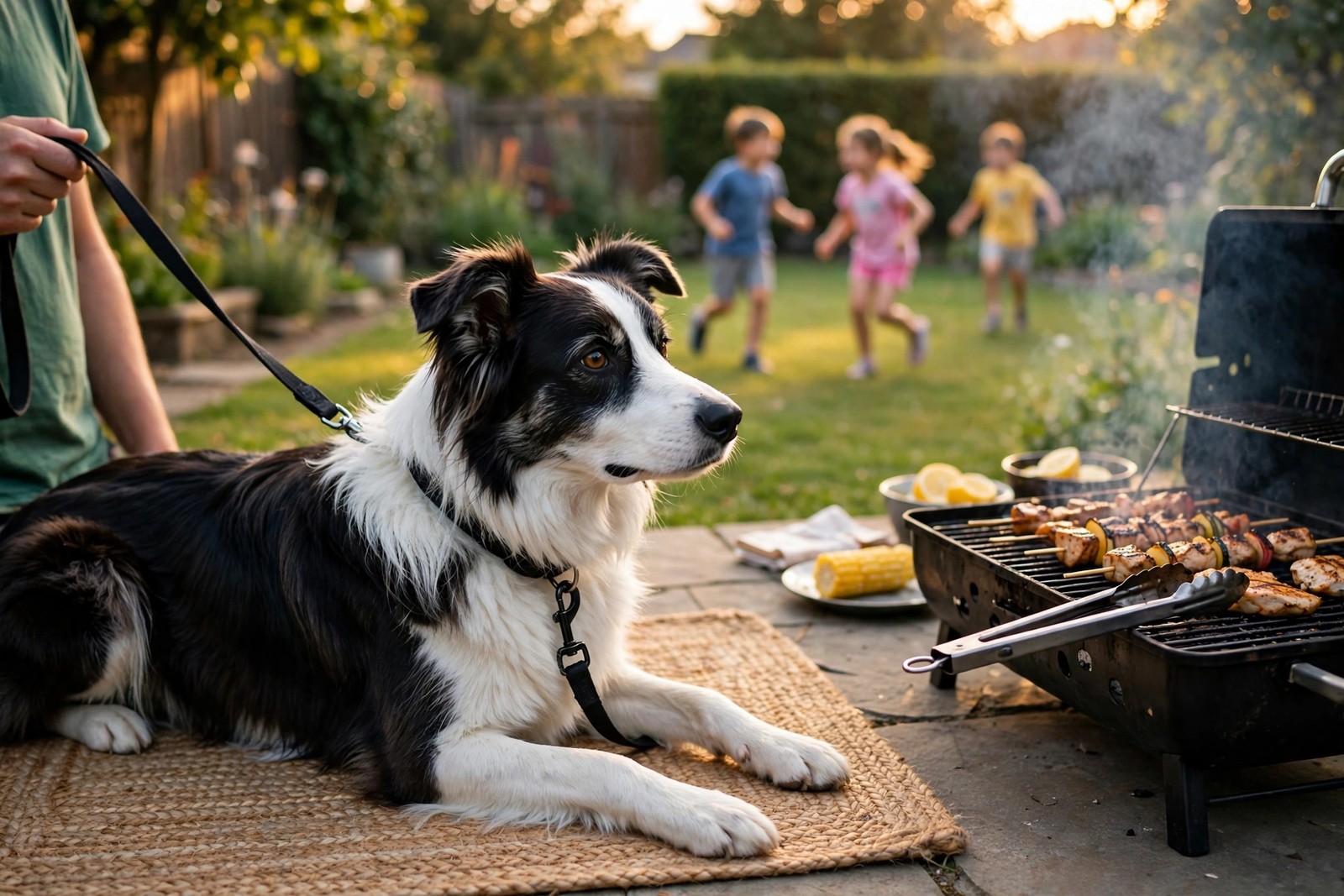
Manage it seriously, as herding rather than play. The nip is the final move of a chase-and-gather sequence herding breeds carry by instinct: a running, squealing child triggers the same eye, stalk, chase, and nip pattern the dog would use to move livestock, and the pattern strengthens every time it is rehearsed. Barbecues make it worse because children run in many directions, adults are distracted, food smells raise arousal, and the dog has space to build speed. A nip that starts as a light touch can become harder, faster, and less inhibited as the dog practises it, which is why early management matters more than waiting to see whether the dog grows out of it.
Reading the sequence before the nip
Herding rarely starts with the nip. Watch for the earlier moves: a fixed stare at a moving child, a lowered head, a crouched stalk, and then a sudden burst of speed toward the heels. A playful dog usually shows loose, bouncy movement, frequent pauses, and a willingness to be interrupted, while a herding dog in sequence shows focused, forward movement, little pausing, and a hard time disengaging once the child runs. Children make the trigger stronger by running away, squealing, and changing direction, which reads to the dog as livestock scattering, and the dog often targets a fast-moving child rather than the child who is nearest.
Breed matters as a tendency, not as a guarantee. Border collies, Australian shepherds, heelers, and similar breeds were selected for this sequence, so the behaviour can appear even in a dog raised kindly in a pet home with no livestock experience. A herding-breed puppy may start with gentle heel nudges that adults laugh off, and that laughter, plus the excitement of the chase itself, rewards the sequence before anyone has decided to train it.
Barbecue management that actually holds
At a barbecue, the dog works behind a lead, a long line, or a gate, not loose among running children. Give the dog a defined place with shade, water, and a chew or a settled mat, and rotate the lead duty among adults so no one person is distracted by cooking and holding a dog at the same time. Before guests arrive, give the dog a proper outlet for the same energy: a training session, a herding game with a ball or a flirt pole in a controlled space, or a structured walk, so the dog arrives tired in body and satisfied in instinct rather than bursting with unused drive.
Train the two skills that interrupt the sequence: a settle on a mat that holds while children move at a distance, and a recall that works when the dog is already looking at movement. Build both in stages, starting with one calm child walking, then a child jogging, then several children playing, and reward the dog for turning away from movement rather than for simply stopping after a nip. If the dog cannot disengage, cannot settle, or has already made contact with skin, seek a qualified behaviour professional promptly, and keep the dog managed at gatherings in the meantime. Scolding after a nip rarely teaches the alternative, and it can add frustration to an already aroused dog.
Briefing children and adults together
Brief children in plain language before they run: if the dog fixates or starts to chase, stop moving, stand still, fold arms, and look away, because a boring, still child gives the herding sequence nothing to gather. Agree who holds the lead, who watches the children, and what happens if the dog fixates, so the plan survives a busy afternoon. KinsLe's Care Teams supports that shared barbecue plan, because lead duty, settle practice, and pre-gathering exercise for this dog can be assigned to named family members and marked complete with a timestamp.