
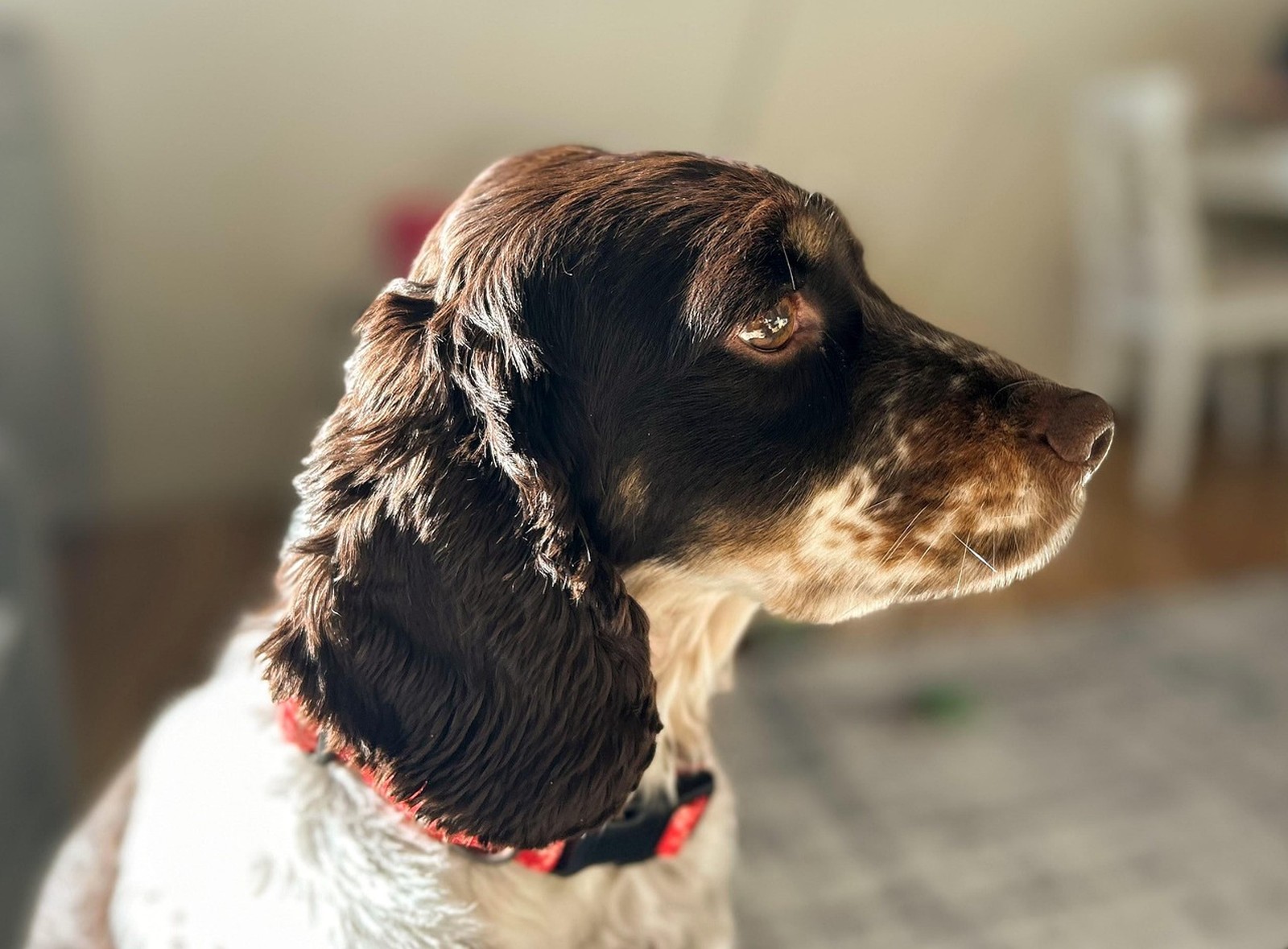
The quiet signals that come first
Dogs usually ask for space politely long before they growl. The earliest signs are easy to miss because they look like nothing much: your dog turns her head away from the approaching dog, licks her lips although no food has appeared, yawns widely, blinks slowly, or sniffs the ground with sudden intense interest. Each is a small attempt to say, in dog language, that she is not looking for an interaction and would like the pressure to ease.
Watch the pace as well as the face. A dog who slows her walk, sits down on a path, or plants her feet as another dog approaches is often hoping the encounter will resolve itself without her involvement.
Body language that says she wants distance
As discomfort grows, the signals get clearer. Ears pinned flat, a tail carried low or tucked, a crouched posture, and the whites of the eyes showing in a half-moon shape, often called whale eye, all point the same way. So does a body that leans away, or an approach made in a wide, curved arc rather than a straight line, which is your dog's attempt to keep things polite.
The opposite posture deserves equal attention. A dog who goes tall and still, with a high stiff tail, weight shifted forward, and hard unblinking eye contact, is not being friendly either. Head-on approaches, prolonged face-to-face staring, and one dog placing a head or paw over another's shoulders are pressure, not play, and they are the moments when a calm intervention prevents an ugly one.
The freeze, and why it matters most
Stillness is the sign owners most often misread. A dog who freezes mid-greeting, stops wagging, closes her mouth, and stares has not suddenly calmed down. She has run out of smaller signals and is deciding what to do next, and a snap frequently follows if the other dog keeps coming. Freezing over a toy, a stick, or a patch of ground carries the same weight.
Growling, when it comes, is information rather than naughtiness. It is the clearest warning a dog can give, and punishing it removes the warning without removing the feeling, leaving a dog who may skip straight to biting next time. Thank the growl by acting on it: create distance, remove the pressure, and note what triggered it.
What to do in the moment, and afterwards
Your job is to be the exit. Call your dog away cheerfully or guide her in a wide arc, put your body or a parked car between the dogs if needed, and let her watch from a distance where she can look, look away, and breathe normally. Keep the lead loose where you safely can, because a tight lead adds tension and removes her option to move away. Avoid dragging her past the other dog at close range to prove she can do it; flooding a worried dog teaches her that you will not help.
Afterwards, patterns matter more than single incidents. Note which dogs, sizes, play styles, narrow paths, or on-lead greetings tend to worry her, and whether pain, tiredness, or a recent scare made her threshold lower that day. If her reactions are intensifying, if she is lunging or snapping regularly, or if you cannot identify the triggers, bring in a qualified behaviour professional, and mention any sudden change to your vet, since discomfort often lowers a dog's tolerance.
Consistency across handlers is what turns these observations into progress. With KinsLe, Care Teams lets each person who walks your dog work from the same noted triggers and record each outing as completed with a timestamp, so a walker who missed the morning's tense greeting still handles the evening walk the wiser for it.