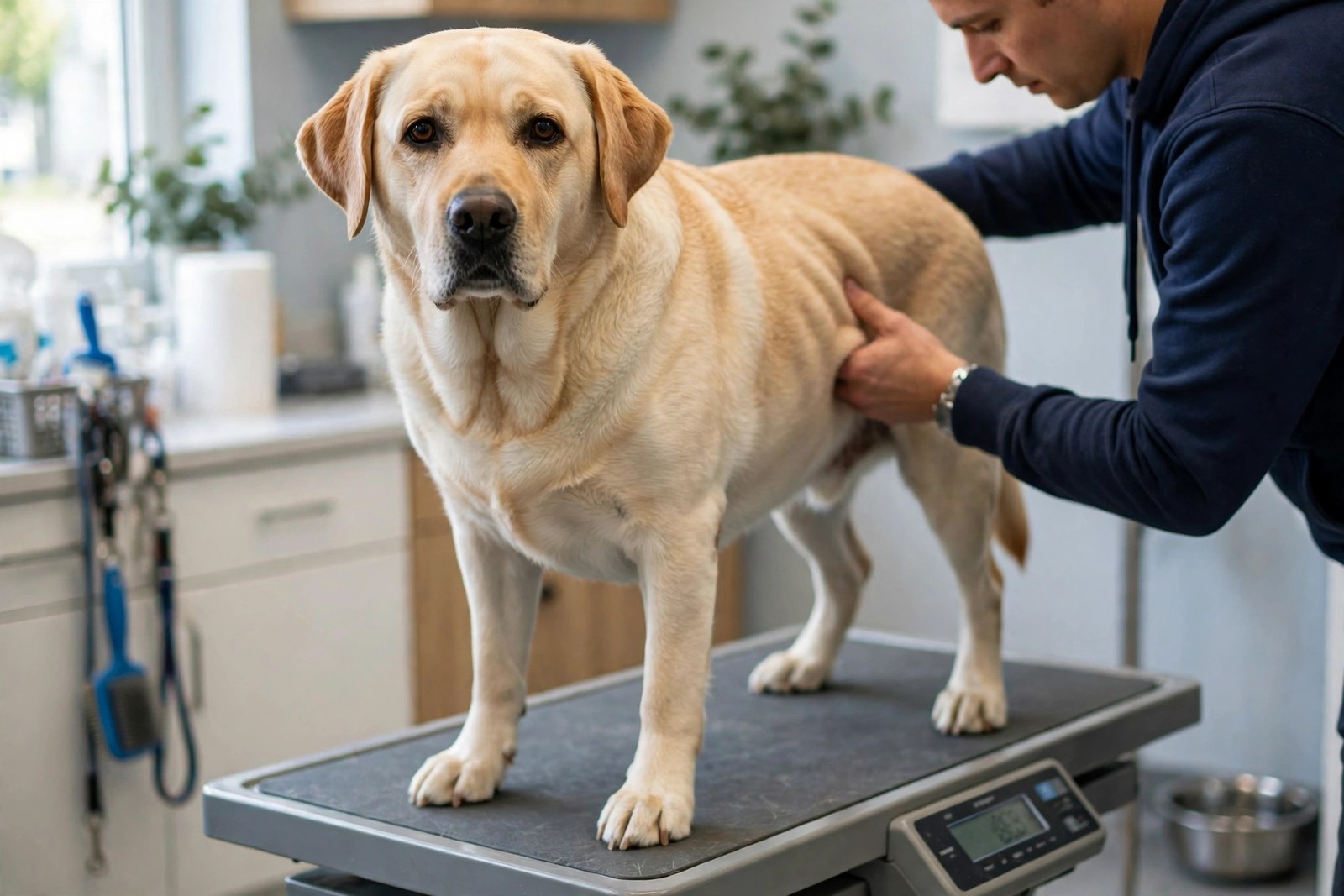
The hands-on checks that tell the truth
Forget the number on the food bag for a moment and use your hands. On a dog at a healthy weight you can feel the ribs easily under a thin covering of fat, like the back of your hand. When overfeeding has been going on a while, you have to press firmly to find them at all, and a soft pad develops over the ribs, shoulders, and the base of the tail. Run your palms along the chest and hindquarters too: fat deposits there round out a dog's outline long before the belly looks obviously big.
Coat hides a great deal. A fluffy breed can look unchanged in photographs while gaining steadily underneath, which is why the rib check, done fortnightly, beats the mirror every time.
Shape changes from above and from the side
Look down on your standing dog: a healthy shape narrows at the waist behind the ribs. An overfed dog runs straight or even bulges outward where the waist should be, becoming a uniform tube. From the side, the underline should rise from chest to hind legs; overfeeding flattens that tuck until the belly hangs level or sags, and in pronounced cases swings as the dog walks. Breeds differ — a deep-chested sighthound shows changes differently from a square terrier — so compare your dog with his own earlier shape, not with a generic ideal.
Other quiet signs accumulate alongside: reluctance to exercise where there was enthusiasm, puffing quickly on walks he used to finish easily, difficulty jumping into the car or climbing stairs, and louder snoring as weight presses on the airway. None proves overfeeding alone, but together with vanishing ribs they build a convincing case.
The behavioural clues owners misread
A dog who polishes his bowl and immediately begs is often read as underfed; usually he is an opportunist with a good routine. Dogs evolved to eat whenever food appears, and many will consume a second full dinner minutes after the first if a second person offers it. Genuine clues lie elsewhere: meals being finished by multiple household members who each assume the other has not fed, treats flowing through the day uncounted, chews that carry a meal's worth of energy on their own, and portions poured by eye growing slowly fuller month by month.
Weigh what you actually serve for a few days, including every extra, and compare it with the guide for a dog of his ideal — not current — weight. The gap between the two numbers is frequently the entire explanation.
Confirming it and turning it around
A monthly weigh-in confirms direction: steady gain on a fully grown dog who is not building muscle means energy in exceeds energy out. Your vet can give a body condition score and a target weight, which turns a vague worry into a number to aim for. Then correct gently — a modest reduction held consistently, treats swapped for part of the ration or lower-energy alternatives, and exercise increased gradually. Sudden large cuts create a frantic, food-obsessed dog and are hard to sustain; small corrections held for months are what actually work.
Recheck ribs and weight monthly and expect slow, steady loss. If weight climbs despite an honestly measured, reduced ration, or falls oddly in one place with a pot-bellied look, ask the vet to investigate rather than cutting further, because medical causes occasionally hide behind an ordinary feeding story. Stopping duplicate dinners is often the single biggest fix, and KinsLe Care Teams makes it visible by logging each of your dog's meals as a completed, timestamped task that any family member can check before reaching for the scoop.