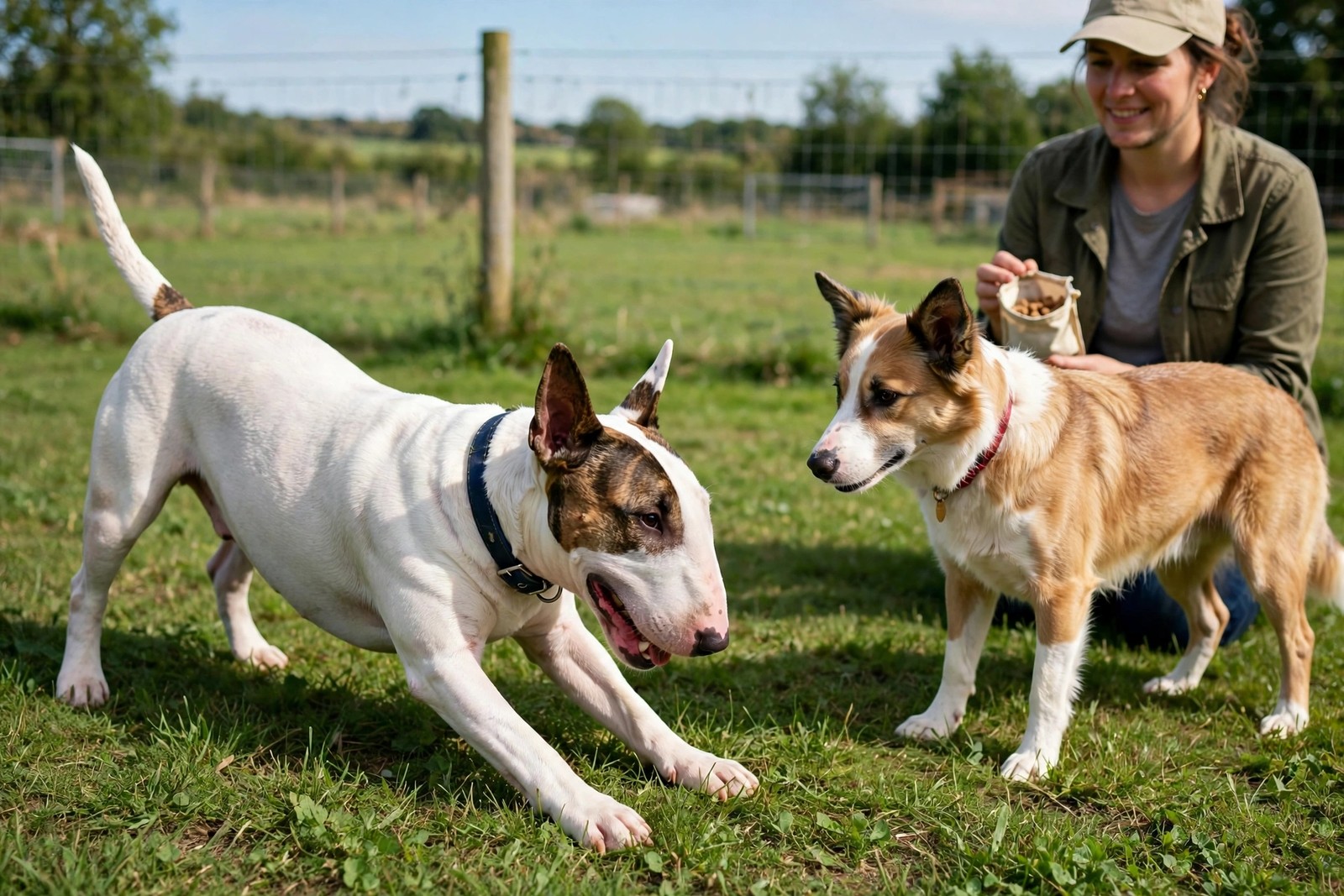
Set the boundaries with structure, not hope. A Bull Terrier brings real physical commitment to play: dense muscle, a low centre of gravity, and a bred-in persistence that means he does not naturally de-escalate when a game gets exciting. None of that makes him aggressive, but it does mean a smaller dog underneath a tumbling, body-slamming playmate has no effective way to ask for a pause. So the teaching happens through how you stage play, not through telling him to be gentle mid-game, when he cannot hear you anyway.
Choose the Partners, Not Just the Park
Until gentleness is proven over many sessions, play happens with matched partners: dogs of similar size, similar weight, and a similarly physical wrestling style, who visibly enjoy the exchange and come back for more. Avoid free-for-all dog park mixing for now, because you cannot control the pairings, and a small dog who did not choose the game is the one who pays for his education. One known, suitable playmate in a garden or secure field teaches more than twenty uncontrolled encounters.
Watch what healthy matched play looks like so you can protect it: loose, wiggly bodies, play bows, role swaps in chasing and wrestling, and pauses that both dogs take voluntarily. The warning shapes are equally readable: one dog always on top, chasing that the other dog is fleeing with a tucked tail and low body, play that only ever escalates, and a smaller dog going still or snapping because nothing else worked. Any of those ends the session kindly and immediately.
Interrupt Early, Interrupt Cheerfully
Build the session around interruptions rather than waiting for trouble. Every minute or two in early training, call your Bull Terrier out of play with a genuinely happy recall, reward him generously, let both dogs shake off and breathe, then release him back with a clear cue. The interruptions do two jobs: they keep arousal below the level where judgement disappears, and they teach him that leaving play is a normal, profitable event rather than the end of fun, so when you truly need to call him off, the habit is already installed.
A recall that fails in play is information, not defiance. It means the session ran too long, the pairing was too exciting, or the recall itself needs more practice at lower intensity first. Practise recalls on walks, in gardens, and in the house with excellent food until coming away is easy in boring places before you ask for it beside a wrestling partner.
The Smaller-Dog Rules
When smaller dogs are present, the default is management: he stays on a long line or lead, greets briefly only with a calm, known small dog whose owner agrees, and is rewarded for looking away and re-engaging with you. Teach a reliable settle on a mat at cafes, classes, and family gatherings so his job around little dogs is lying down being fed intermittently, not negotiating play. If a smaller dog lives in the same household, separate them when nobody is supervising, feed high-value chews apart, and let all shared play be the interrupted, supervised kind until months of calm history exist.
Rough players often improve substantially with this structure, because the skill was never the problem; the arousal management was. KinsLe Care Teams keeps the structure intact across everyone who handles him, because you can assign his matched play sessions, recall practice, and walk rules to named family members or helpers and see each completed task marked with a timestamp.