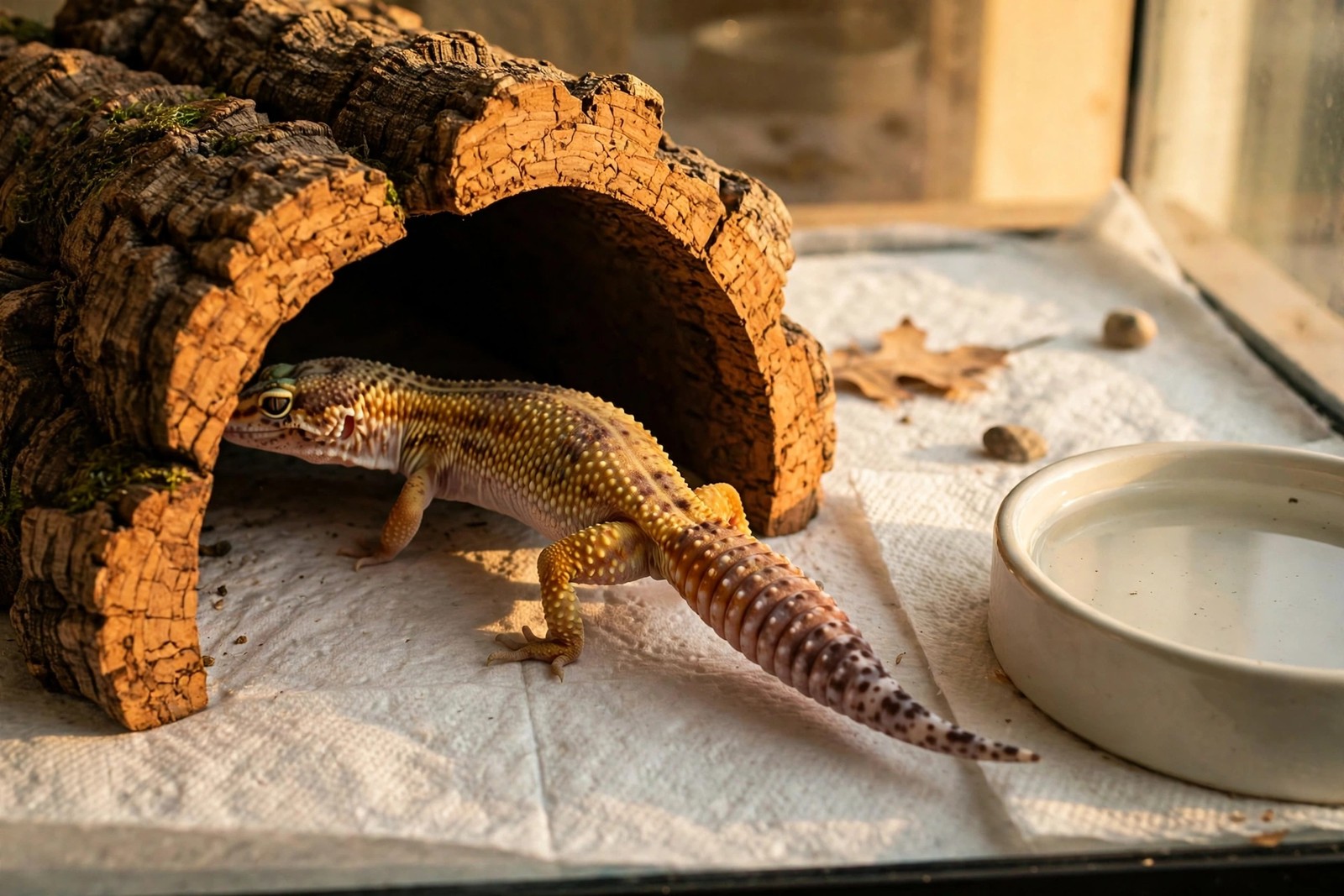
An older leopard gecko usually does not need a new enclosure — she needs the one she knows rearranged for stiffer joints, weaker grip, poorer eyesight, and slower hunting. Every change below keeps her warm hide, cool hide, and humid hide where she expects them, while removing the climbing, stretching, and hunting effort that a younger gecko handled easily.
Bring the furniture down
Remove tall branches, high ledges, and stacked rocks she could fall from. A senior gecko who slips from height can injure a leg or her spine, and reduced grip makes a fall more likely than it once was. Replace height with low, wide hides that have a generous ground-level entrance she can walk into without squeezing or climbing. Keep at least three: a warm hide over the heated area, a cool hide at the opposite end, and a humid hide lined with damp paper towel or moss to support shedding.
Check the entrances as honestly as the hides themselves. A favourite hide with a raised lip she now has to haul herself over has quietly become a barrier. Ramps should be very gentle and textured, or removed in favour of a flush entrance. Cork pieces laid flat and low stone tiles give cover and interest without asking her to climb.
Change the floor and the dishes
Loose substrate becomes a bigger risk with age. A slower, less accurate hunter strikes more flooring along with her insects, and loose particles are harder to pass for an older digestive system, as well as harder to keep clean around a gecko who may toilet less predictably. Paper towel is the simplest senior floor: solid, cheap, easy to replace daily, and it makes droppings, urates, and any regurgitated food immediately visible. Solid tile or a fitted non-adhesive liner works too, provided it has no loops or loose edges to catch toes and teeth.
Swap deep bowls for shallow ones. Her water dish should have a low rim she can lean over without stretching her neck upward, be heavy enough not to tip, and be refreshed daily. A shallow feeding dish keeps live insects in reach for longer, giving a slow striker repeated chances; many older geckos do better with tong feeding, with each insect presented close, low, and moving slowly in front of her.
Shorten the distances
Keep the warm end at the temperature gradient she has always used, but verify it with a thermometer at floor level, where she actually lives — an ageing heat source can drift while the dial stays the same. Place food, water, and hides so she does not have to cross the whole enclosure for every need. If she has a favourite warm corner, put the water within a few body lengths rather than at the far cool end.
Watch shedding closely. Older geckos shed less cleanly, and retained skin around toes can restrict circulation and cost toes if it builds up over several sheds. The humid hide does most of the prevention. Never pull stuck shed off; a persistently retained patch, a toe that looks swollen or discoloured, loss of appetite, marked weight loss from the base of the tail, or a gecko who stops moving between hides deserves a veterinarian visit rather than another home adjustment.
Weigh her regularly and write it down. A leopard gecko stores fat in her tail, so a tail that is visibly thinning compared with last season is an early, measurable warning.
Keeping her weights, shed notes, enclosure changes, and vet findings together in KinsLe's Pet Passport means your veterinarian can see how your older gecko has changed over time, not just how she looks on the day of the visit.