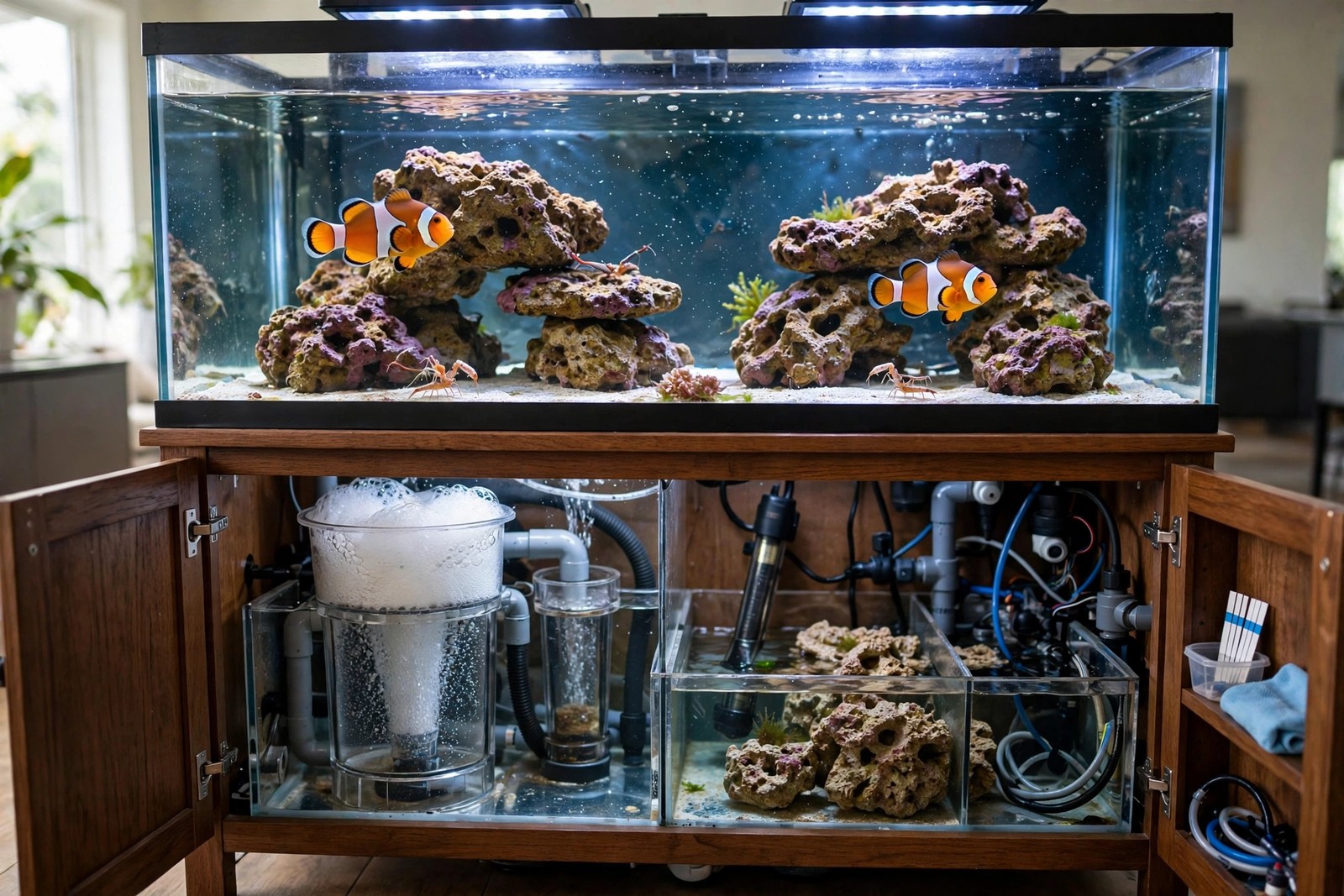
A marine tank shares its backbone with any aquarium — a tank, a heater, filtration, lights and a thermometer — and then adds a layer of equipment that exists for one reason: you are manufacturing and maintaining seawater indoors. Budget and plan for that extra layer before the first fish arrives, because retrofitting a skimmer or a water purifier around stocked rockwork is far harder than installing both on day one.
Making the Water: Salt Mix and RO/DI
Seawater starts with purified water and marine salt mix, never with tap water and table salt. An RO/DI unit strips dissolved solids out of tap water through reverse osmosis and deionisation, giving you a clean base that will not import phosphate, nitrate or copper into the tank every time you top up evaporation or mix a water change. You then stir in marine salt mix — a full mineral blend, not plain sodium chloride — until the water reaches your target salinity, and you let it mix and aerate before it goes near livestock. Keep a food-safe mixing container, a small pump or powerhead for mixing, and a spare heater so change water matches tank temperature before it is added.
The Protein Skimmer and Live Rock
A protein skimmer is the marine-only filter a freshwater tank never needs. It injects fine bubbles into a column of water; dissolved organic waste clings to the bubbles and rises as foam into a collection cup you empty and rinse. Removing that waste before it breaks down into ammonia lightens the whole system's load. Live rock works alongside it: porous rock, cured before or during cycling, whose deep surfaces house the bacteria that convert ammonia to nitrite and then to nitrate. The rock is also the landscape — shelter, grazing surface and territory — so its quantity and arrangement shape behaviour as well as filtration. A sump, where the system has one, simply hides the skimmer, heater and return pump below the display.
Measuring What You Cannot See
Salt water punishes guessing, so marine keeping adds measuring tools freshwater tanks often skip. A refractometer, calibrated with calibration fluid, reads salinity far more reliably than a swing-arm hydrometer, whose needle can stick and drift. Test kits for ammonia, nitrite, nitrate and pH track the cycle and its aftermath; tanks holding corals and other invertebrates usually add alkalinity, calcium and magnesium tests, because stony corals consume those minerals as they grow. Stronger lighting belongs on this list too: fish-only systems manage with modest light, while corals depend on light of the right intensity and spectrum to feed the algae living in their tissues.
Pulling the List Together
Work through the additions in this order: RO/DI unit and salt mix first, then live rock, then the skimmer, then the refractometer and test kits, with reef lighting added when corals enter the plan. Test salinity at every water change, log results, and replace test-kit reagents before they expire, because an old kit can read reassuringly while the water drifts. Top-ups matter as much as changes: water evaporates but salt does not, so replace evaporated water with plain RO/DI, never with salt water, or the salinity creeps upward between tests. Wipe away salt creep, the crust that forms where water splashes and dries, during your routine checks too, because heavy creep means lost salt and a clue that a return outlet is spraying where it should not. KinsLe's Pet Passport keeps that equipment list, your mixing routine and your test history in one portable packet, so the tank's whole saltwater recipe travels with the fish whenever care changes hands.