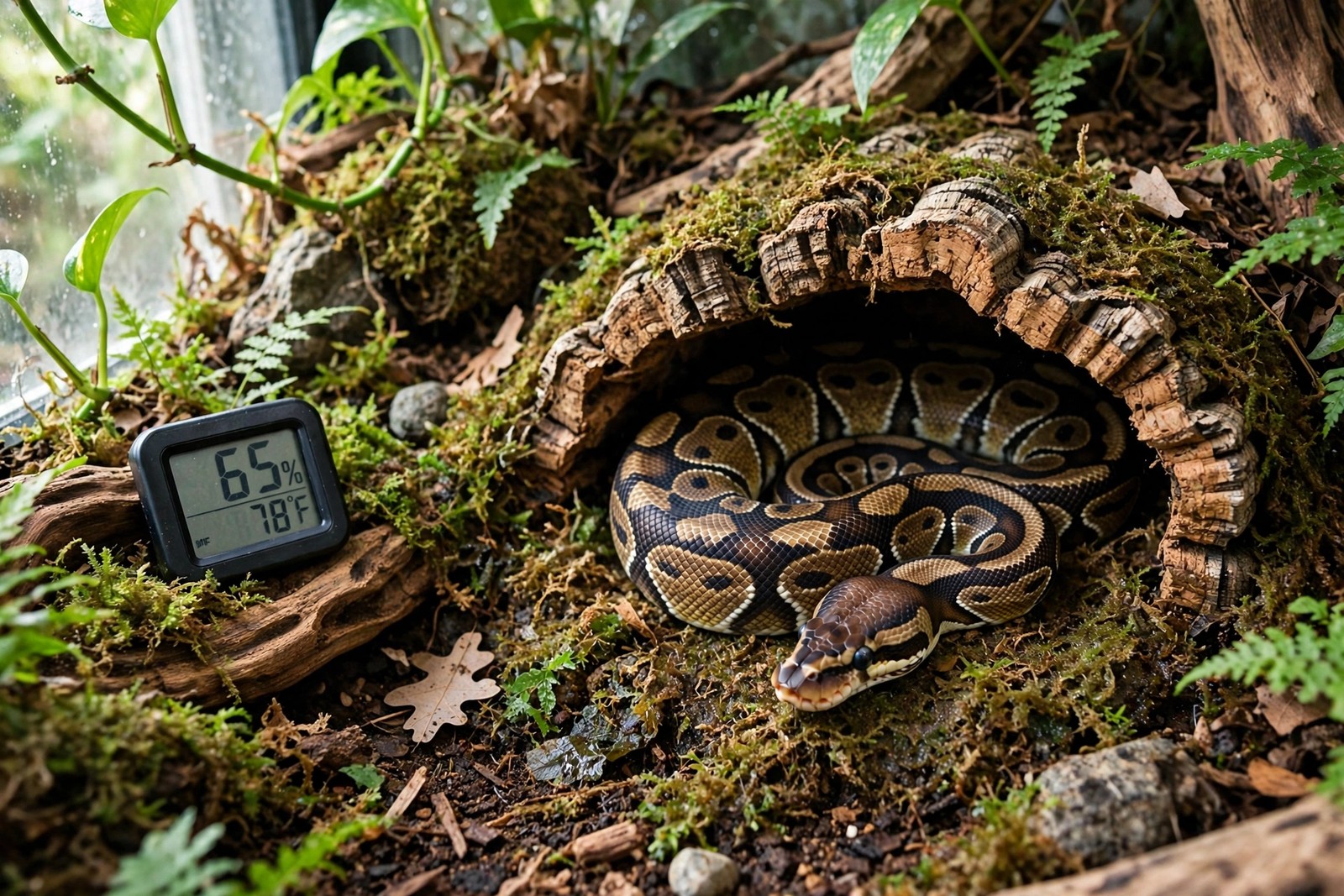
Ball pythons come from West African grasslands where the air is warm and moderately humid, and the enclosure should reproduce that: about 50 to 60 percent relative humidity as the everyday range, lifted to around 70 percent during a shed cycle. Humidity is not a comfort extra for this species — it is how the snake sheds cleanly, keeps its airways in good condition, and stays willing to eat.
Why the Range Matters at Both Ends
Too dry is the more common failure. When humidity sits in the 30s or low 40s for weeks, sheds come away in torn patches instead of one piece, skin stays stuck over the eyes as retained eye caps, and mild breathing irritation can follow. Too wet for too long causes the opposite trouble: constantly damp substrate against the belly invites scale rot, and a saturated, poorly ventilated tub can contribute to respiratory problems. The target is therefore a genuine range, not “as humid as possible” — air that feels fresh, substrate that is dry to the touch on top, and a reading that lives mostly in the 50s.
Measuring It Properly
Use a digital hygrometer with its probe at floor level on the cool side of the enclosure, where the snake spends much of its time — a dial gauge stuck high on the warm wall can read 15 points away from the snake's real conditions. Check the reading at the same times each day for a week when you set up or change anything, because humidity swings with heating cycles and room weather: many enclosures dip overnight in winter when household heating dries the air. If two gauges disagree, trust the digital one at snake level and replace the other.
Raising and Lowering Humidity
To raise humidity, start with the water bowl: a larger bowl, or one placed partly over the warm side, evaporates steadily. Mist the enclosure lightly once or twice a day, add a humid hide — a hide containing damp sphagnum moss — and cover part of a mesh lid to slow moisture escaping, while keeping some ventilation open. Moisture-holding substrates such as cypress mulch or coconut fibre hold a misting far longer than paper or aspen. To lower humidity, do the reverse: smaller bowl on the cool side, more ventilation, and no misting until the reading settles. Change one thing at a time and give it a full day before judging the result.
The Shed-Cycle Boost
When your python's eyes turn blue and the skin dulls, raise humidity toward 70 percent and keep the humid hide freshly damp until the shed is complete, then check the shed skin for both eye caps and the tail tip. A clean one-piece shed is your confirmation that the range was right; a patchy shed is data, not disaster — improve humidity, offer the humid hide, and never pull stuck skin off by force. KinsLe's Care Teams turns the daily reading into a shared habit — humidity checks and misting can be assigned to any household member and marked complete with a timestamp, so your python's 50 to 60 percent range is actively held rather than occasionally remembered.