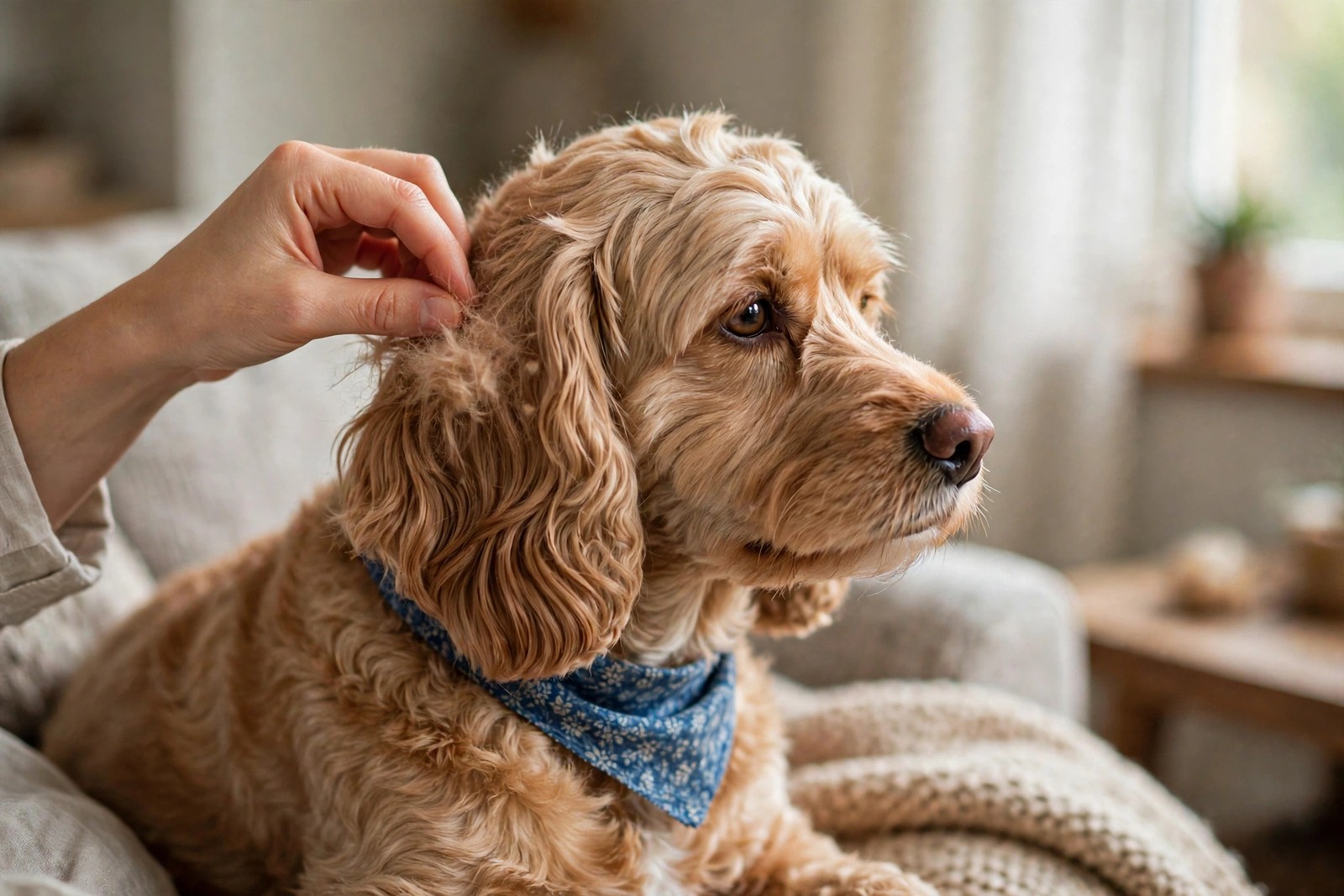
The hair behind a dog's ears is fine, the skin beneath it is thin, and the area moves every time a collar shifts or a hand strokes her head. That combination makes behind-ear mats common and makes them a poor place for force. A tight mat should be approached as a skin-protection problem first and a grooming problem second.
Hold the base so the skin is not dragged
Settle her somewhere she feels secure and work in good light where you can see the edge of the mat and the ear beneath it. Slide your fingers to the base of the mat and hold it there, between the mat and her skin. That hold takes the tension. Without it, every tug on the mat drags the thin ear skin, hurts her and makes her pull away, which raises the risk of a nick if a tool is in your other hand.
If she becomes distressed, stop and return later or book a groomer. A mat that waits a day is a smaller problem than a frightened dog and a torn ear. Never tear a mat out, yank it apart by pulling both ends, or try to finish quickly because she is restless.
Work from the outside edges inward
Start with fingers alone. Tease the outer fibres apart at the edges of the mat, working inward in small amounts rather than attacking its dense centre. A mat loosens from the outside because the outer hairs are less compressed. As strands free up, a comb can take those loose hairs away, which stops them being worked back into the mat.
Go slowly around the whole edge before going deeper. If the mat begins to split into sections, work each section separately while your other hand keeps holding the base. The aim is to reduce the mat gradually without changing the angle of pull on her skin. Praise and brief pauses help her stay settled, and a helper gently steadying her head may be safer than trying to manage dog, mat and tool with too few hands.
Use a splitter or blunt-ended scissors through the mat only
When fingers are not enough, a mat splitter can divide the mat into narrower strips that fingers and a comb can then separate. Blunt-ended scissors may be slid through the mat itself, along its length, to create that same split. The points must never travel point-first toward her skin, and blades should never be placed flat across underneath a mat to cut it off in one movement, because skin can tent up into a tight mat and sit exactly where an owner expects only hair.
After splitting, return to finger work. The tool's job is to make the mat separable, not to remove it in one cut. Check the skin as the hair clears. If it looks sore, broken or inflamed, leave the area alone and seek veterinary advice rather than continuing to groom over damaged skin.
Know when the mat belongs to a groomer or vet
A mat plastered tight against the ear, with no space to hold its base or see its edges, should be clipped out by a groomer or vet. They can support the ear, use clippers under controlled conditions and inspect the skin that was hidden underneath. That is not a failure of home care. Behind-ear skin tears easily, and a professional removal is kinder than a long home session on a mat that was never safely workable.
Prevention is brief once the area is clear. Add the behind-ear friction zone to regular combing, running a comb through that fine hair a few times each week and after it gets wet, so loose hair is removed before friction rolls it into the next mat.
Care Teams in KinsLe helps the household remember that friction-zone check between grooms, reducing the chance of another plastered mat forming unnoticed.