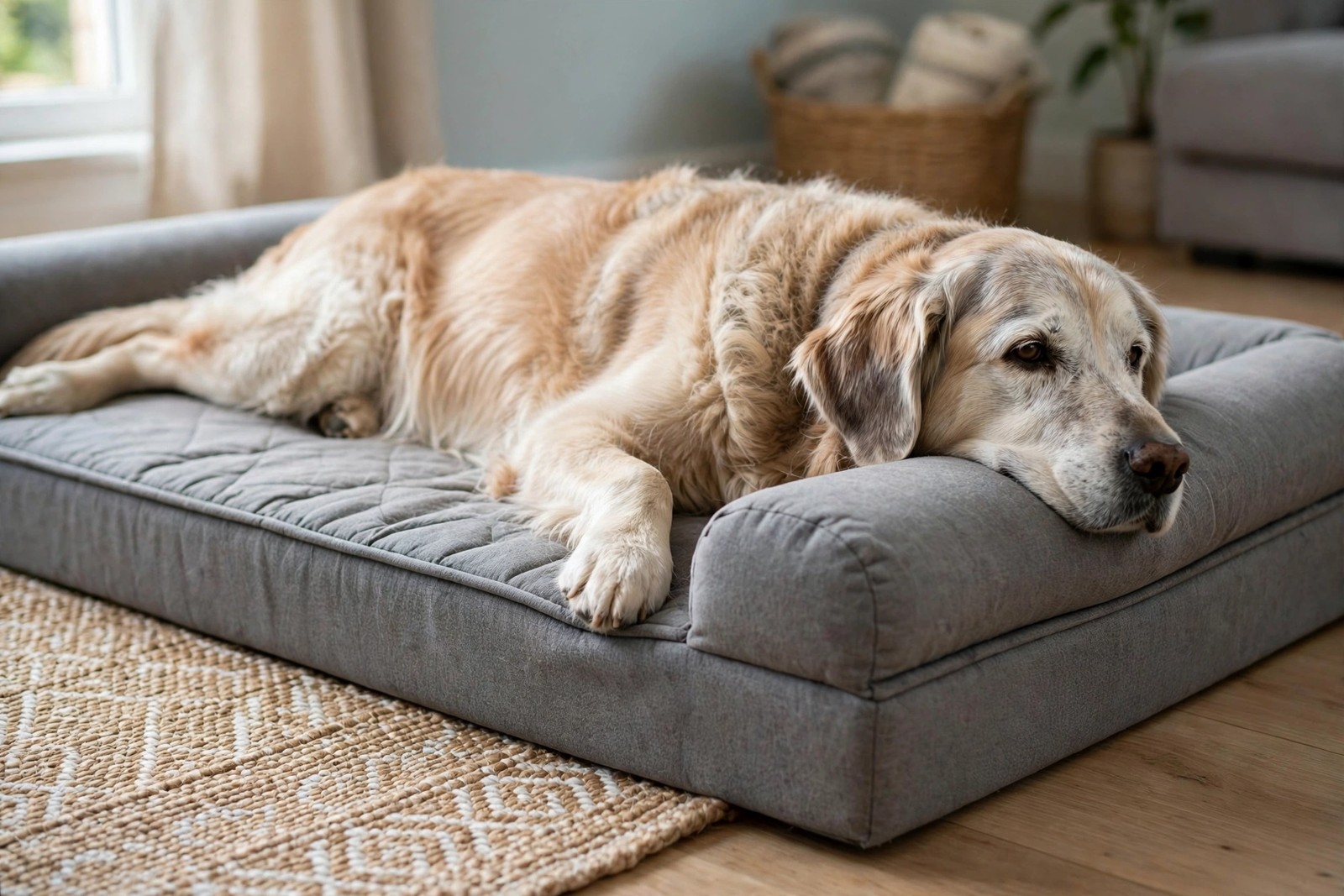
An older dog with stiff joints spends more of the day lying down than at any other age, and the surface underneath decides whether rest restores the dog or leaves it sorer. A good senior bed does three jobs at once: it cushions bony pressure points, it lets the dog get up without a struggle, and it keeps joints warm, because cold seeps into stiff hips and elbows overnight.
The Foam Is the Bed
Orthopaedic foam, typically a memory foam top layer over a firmer support layer, is the core recommendation because it spreads weight evenly instead of letting hips, elbows, and shoulders bottom out. Thickness and density matter more than softness: press your hand firmly into the bed and push down with your full weight, and if you can feel the floor through it, your dog will feel the floor too, so look for several inches of dense foam that springs back slowly rather than a thin padded mat. Cheap polyester stuffing fails within weeks because it flattens into lumps with hard gaps between them, leaving the dog effectively sleeping on the floor with bumps. Egg-crate style foam is a reasonable budget middle ground, but solid layered foam supports heavier dogs and giant breeds far better, and the bigger the dog, the more the foam's density matters.
Shape, Height, and Getting Up
Choose a low profile. A bed the dog can step onto without climbing or jumping protects exactly the joints you are trying to help, and many senior designs use a low step-in front edge with a low bolster on the other three sides, giving the dog a chin rest and a sense of enclosure without a wall to clamber over. Flat mattress styles suit dogs who sleep stretched fully on their sides, which is the position that unloads joints best, while devoted curlers may prefer a bolster edge to lean against. Whatever the shape, size it for the stretched-out dog, not the curled one: measure nose to tail in full stretch and add room, because a dog who cannot straighten out will hang hips or shoulders off the edge onto cold floor. A non-slip base is essential, since a bed that scoots across laminate as a stiff dog pushes up can cause a frightening slide and a real injury.
Covers, Warmth, and Placement
A removable, machine-washable cover is not a luxury with senior dogs, who may leak urine in deep sleep, drool more, or bring in wet paws; a waterproof inner liner beneath the cover protects the foam itself, which cannot be washed. In cooler homes, a bed placed away from doors and drafts, ideally on a rug or mat rather than directly on cold tile, keeps joints noticeably looser by morning. Raised cot-style beds are popular for airflow, but for a stiff senior they flex in the middle, can be awkward to step onto, and offer less pressure relief than solid foam, so treat them as a daytime option at most.
When the Bed Is Not the Problem
A dog who abandons a new bed may be telling you it is too high, too warm, too wobbly underfoot, or in the wrong place, so adjust one thing at a time before replacing it. Restlessness at night, new difficulty rising despite good bedding, crying out when settling, or appetite changes alongside stiffness are reasons to see your veterinarian, who can assess pain and discuss options no bed can provide.
Recording the bed type, height, and placement that your dog settles on inside KinsLe Pet Passport means a sitter or boarding stay can reproduce the setup exactly, rather than offering a cushion your dog refuses.