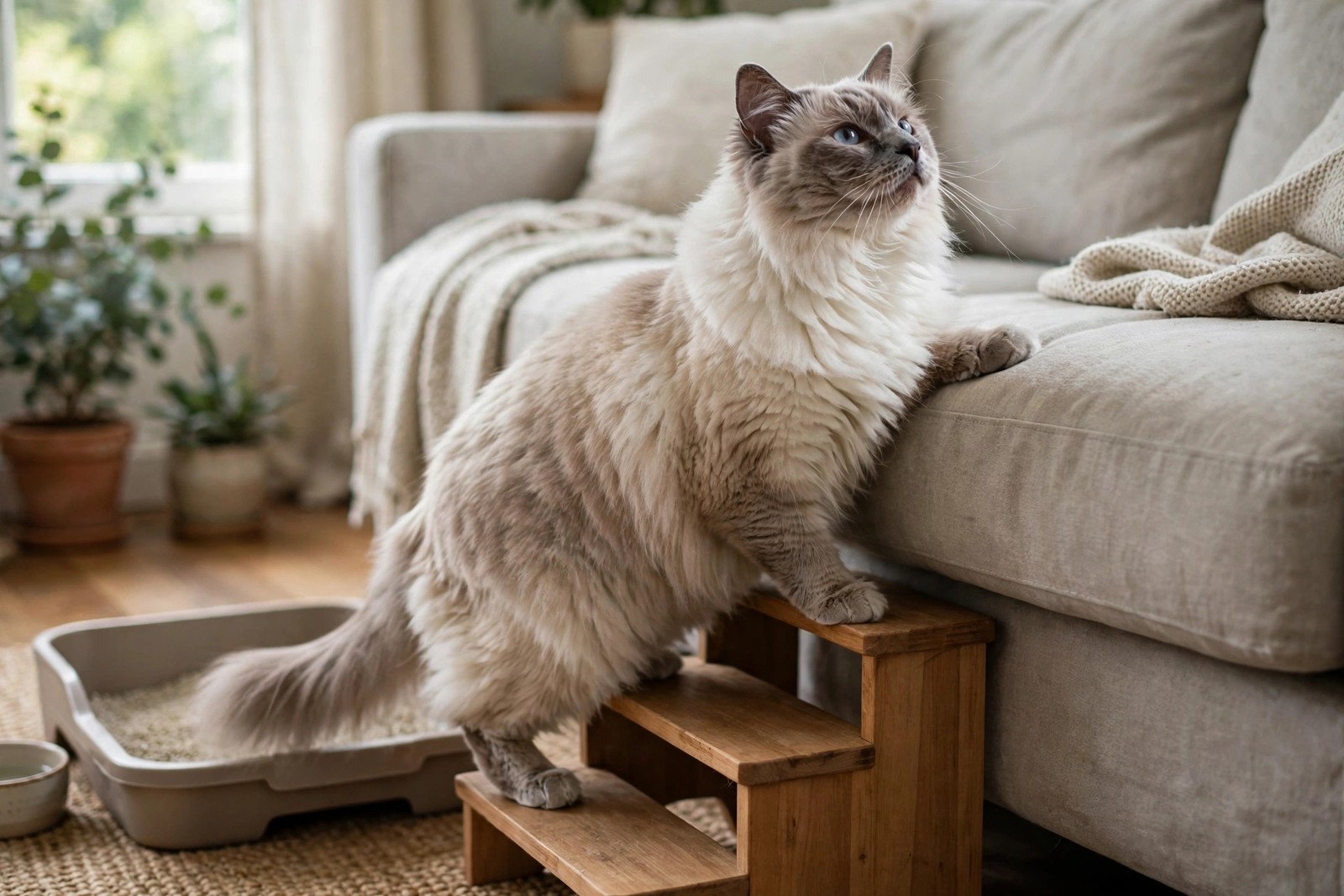
A Ragdoll entering old age rarely announces the change. This is a large, gentle, famously relaxed breed, and that easygoing temperament can hide a slow loss of mobility for months. Ragdolls commonly live about 12 to 15 years, with many reaching their late teens, so the senior years are a long chapter worth watching properly.
Shrinking Jumps and Hesitant Stairs
Mobility change usually appears first as ambition quietly shrinking. The cat who once took the windowsill in one leap now jumps to a chair first, then up, or studies the jump, rocks back, and walks away instead. Favorite sleeping spots migrate downward over a season: the top of the wardrobe is abandoned for the sofa, the sofa for a cushion on the floor.
Stairs tell the same story in slower motion. Watch for pauses halfway, a bunny-hopping gait with both back legs moving together, or reluctance at the top step down. A step or a low ramp at the bed, sofa, or sill keeps chosen places reachable without repeated leaps, and moving food, water, and one litter tray to the level where the cat now spends the day removes forced journeys. Any sudden mobility loss, dragging, or crying out is not old age unfolding; that change routes straight to a veterinarian.
The Litter Box Becomes a Climb
A standard litter tray has a lip a young cat steps over without thought. For a stiff senior, that lip is a climb repeated several times a day, and the first sign of trouble is often practical: accidents beside the tray, or perching awkwardly on the edge. Read those as access problems before reading them as behavior problems.
A low-entry box, with one side cut down or designed low, removes the obstacle while keeping the familiar location and litter, which matters to a cat of fixed habits. Place an additional tray where the cat now rests most, since a senior should never have to climb stairs to reach the only tray.
Grooming Reach, Muscle, and Weight
Watch what the cat can no longer reach. Ragdolls carry a semi-long coat, and as flexibility fades the areas beyond reach, the lower back, the base of the tail, the belly, and the back legs, begin to dull, clump, or flake while the shoulders still look fine. Short, gentle help with a comb in the unreachable zones becomes part of senior care, in brief sessions the cat can end at will.
Feel for muscle as well as looking at size. Run your hands along the spine and over the hips regularly: muscle loss makes the spine feel knobby and the hips sharp even when total weight has barely changed. Weight itself can drift either way in old age, down as muscle and appetite fade, or up as activity shrinks, and both drifts deserve noting and raising at a check.
Withdrawal, Sleep, and Sudden Change
Older cats sleep more, and a Ragdoll was never going to be the cat patrolling the house at dawn. The change worth watching is withdrawal that goes beyond extra sleep: leaving a room the family gathers in, hiding during the day, or losing interest in the gentle play and attention the cat used to seek. Compare against the cat's own younger habits, because the signal is the change from baseline.
Sudden change, of any kind, routes to the veterinarian rather than to watchful waiting. A cat who stops eating, becomes restless at night, cries in the litter tray, or changes personality over days rather than seasons needs an appointment promptly, since a fast change usually has a specific cause a veterinarian should investigate. Keep brief notes as you go, because gradual change is nearly invisible without them. Pet Passport on KinsLe serves as the carried record for those notes, since the Pet Passport record on KinsLe holds a senior cat's weight, mobility, appetite, and visit history together across appointments. Bring the senior notes held in the Pet Passport file on KinsLe to each check, and slow change gets judged against the cat's own earlier baseline.