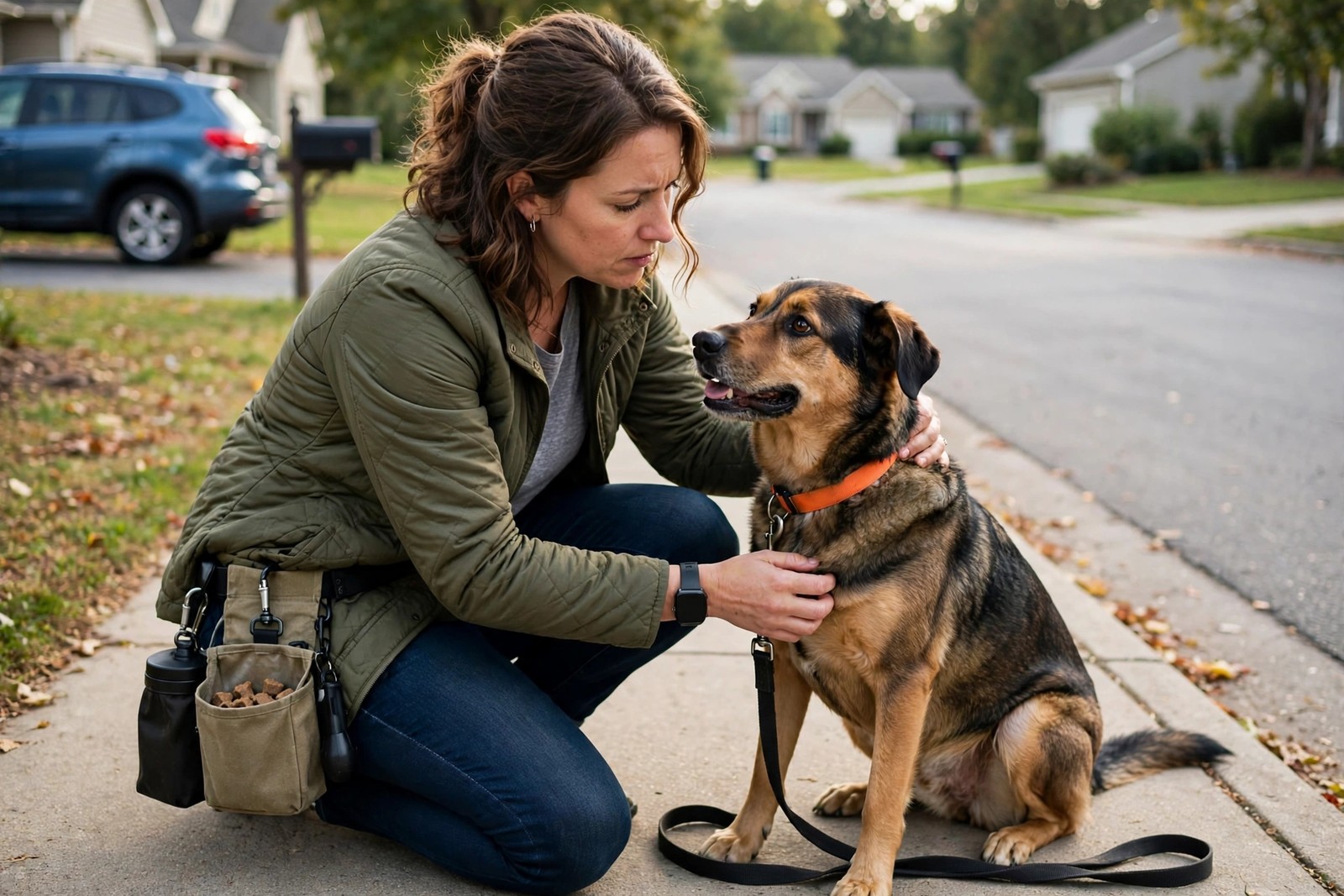
The explosion itself lasts seconds, and what you do inside those seconds decides whether it stays a noisy moment or becomes a rehearsed habit. There is no training to deliver mid-bark: your only jobs are distance, a visual barrier, and a loose lead, in that order, while your dog's brain is far too aroused to learn anything except whether you add pressure or remove it.
The First Seconds: Distance Before Everything
Stop walking toward the other dog the instant yours stiffens, and move away at an angle or across the street. A parked car, a hedge, a garden wall, or a driveway entrance all work as a visual barrier; once your dog can no longer see the trigger, arousal usually starts to fall. Keep the lead as slack as safety allows, because hauling on it adds physical tension that reads to your dog as confirmation that something is worth fighting. Say little — a calm cue your dog already knows is enough — and do not punish the barking, which layers your anger on top of an already overloaded moment.
Once There Is a Barrier and Breathing Room
When your dog can glance at you again, scatter a handful of food on the ground and let sniffing and searching bring the arousal down; eating and nose work are physiologically calming in a way standing still is not. Then walk away from the trigger rather than re-approaching it to finish the planned route. Re-passing the same dog at the same distance minutes later almost always produces a second, bigger explosion, because your dog has not actually settled — the pause only lowered the volume briefly.
Read the Pattern Afterwards, Honestly
Once home, note the facts while they are fresh: how far away the other dog was, whether it was moving or stationary, what your dog did first — stare, stiffen, lunge, bark — and how long recovery took. Distance is the single most useful number, because it tells you the range at which your dog can currently cope. Explosions that keep happening at close range mean the walks themselves need restructuring: quieter streets, off-peak times, and wider default distance, ideally with a behaviourist's help if the reactions are intense or escalating.
One Response, Shared by Every Walker
A reactive dog improves faster when every person holding the lead does the same thing in the same seconds, instead of one handler crossing early and another trying to walk past. Agree the household script out loud: spot early, cross or turn, barrier, scatter, leave. Households sharing walks can use Care Teams in KinsLe to name who takes each outing, notify that helper, and log the finished outing with its completion time once the dog is home.