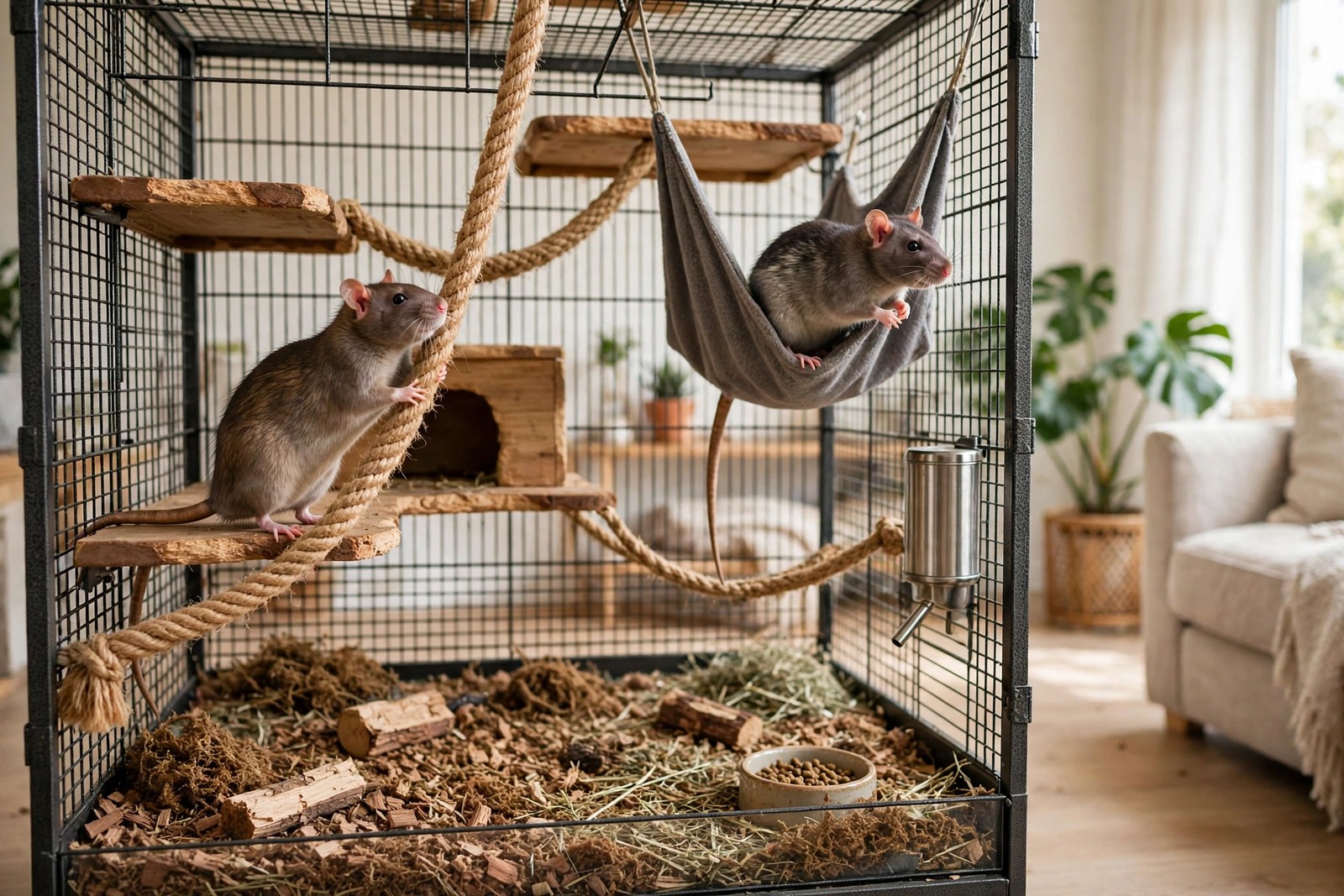
Rats are athletes in small bodies. They climb, sprint, wrestle, dig, and rearrange their furniture nightly, and they live in social groups, so a cage has to hold at least two active animals and everything they do. The small, tall cages sold for a single hamster fail rats on every count. Judge any cage by its floor, its height, and its total volume together, and treat every figure below as a starting floor, because no healthy rat was ever harmed by extra room.
Minimum Dimensions and Space Per Rat
For a pair, look for a cage no smaller than about 30 inches long, 18 inches wide, and 24 inches tall, which is 76 by 46 by 61 centimeters. In volume terms, that works out at 7.5 cubic feet in total, and a useful rule is to allow roughly 2.5 cubic feet per rat as a minimum and more for large males or a bigger group. Every extra rat needs extra space, not just extra food bowls, so size the cage for the group you will actually keep, including the youngsters a rescue may ask you to foster later. A long footprint matters as much as height: rats run and forage along the floor, and a cramped base cannot be fixed by stacking levels into the air.
Bar Spacing, Floors, and Layout
Bar spacing is the safety figure owners miss. Choose bars spaced half an inch apart or less, about 1.3 centimeters, because young rats and small females can squeeze through a gap that looks impossibly narrow, and a rat that escapes nightly or traps its head is a rat in danger. For very young rats, even half-inch spacing can be generous, so check with the breeder or rescue what their youngsters are used to. Floors and shelves should be solid, not bare wire mesh, which is hard on feet during hours of standing and climbing; cover any wire level with a solid, washable surface. Fill the volume you have bought: hammocks at different heights, ropes and branches to climb, a deep layer of substrate for digging, at least two hides, and a water bottle plus a heavy bowl, placed so a shy rat can eat and drink without crossing an open space.
A smaller cage has one legitimate use: as a short-term hospital or travel cage for an injured rat, or for introductions on neutral ground. Keep it for those days only, and move the rat back to the main cage as soon as your vet or the rescue advising you says it can cope, because a convalescent rat still needs company within earshot and a familiar group waiting for it.
Bigger Is Better, and Out-of-Cage Time Counts Too
If you can fit and afford the next size up, buy it. A larger cage stays cleaner between full cleans, lets subordinate rats keep out of a bolder cage mate's way, and gives old or unwell rats room to live on one easy level while still staying with the group. Position the cage where the household spends time, out of direct sun and drafts, because rats are social with people as well as each other. However large the cage, rats still need daily time out of it, an hour or more in a rat-proofed room or playpen to run, climb on you, and explore somewhere new. Measure your available space before ordering, check the cage door is big enough to get a litter tray and your hands in comfortably, and make sure you can reach every corner to clean, because awkward access is what makes a cage unpleasant over time. Sending the chosen dimensions, bar spacing, and furnishing list to everyone involved through KinsLe's Family Sharing stops a well-meant helper buying a too-small spare cage that your rats cannot safely use.