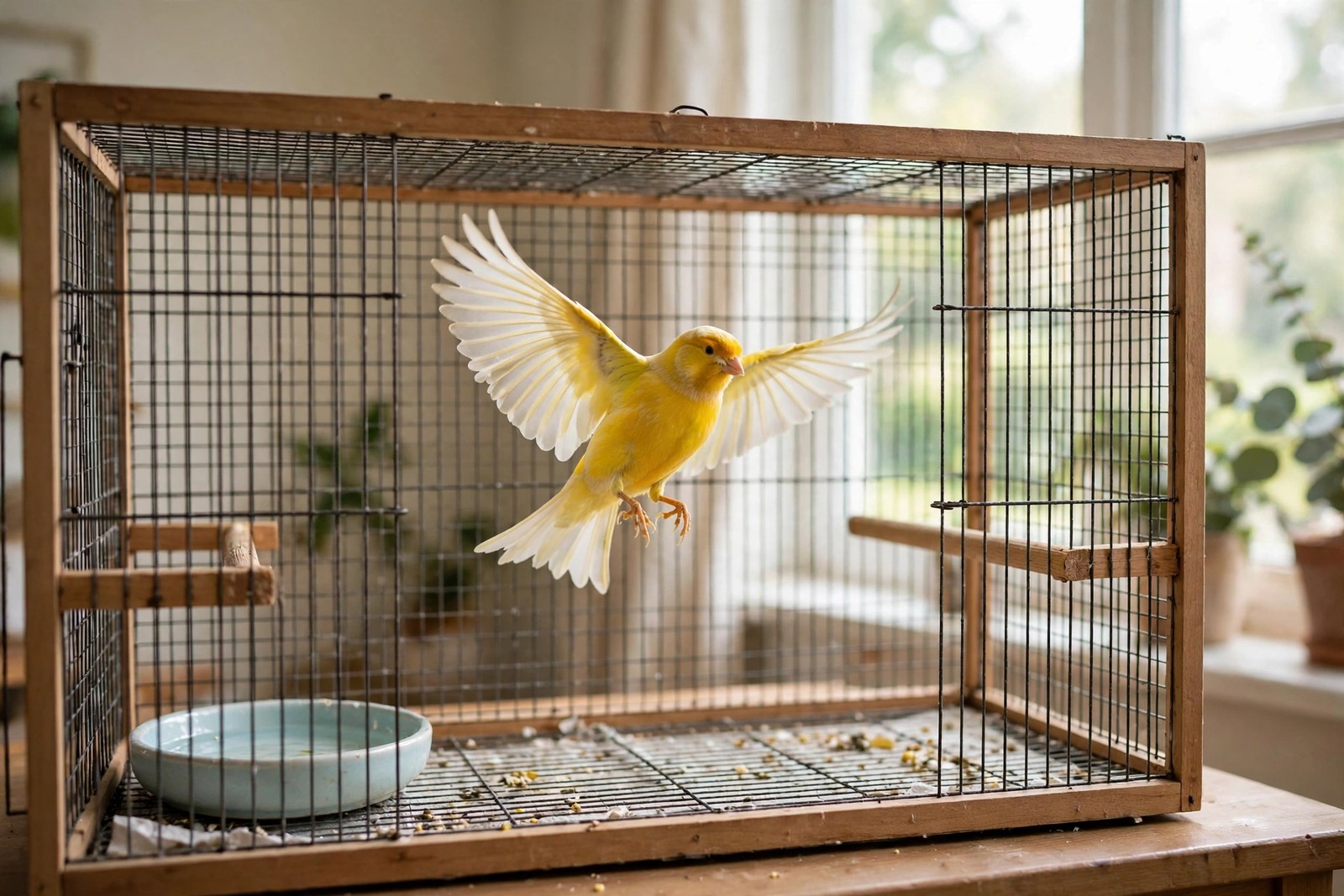
A canary exercises the way it sings: constantly, and mostly in one direction. Canaries fly horizontally, in short level bursts from perch to perch, so the measurement that decides whether a cage works is its length. Tall, narrow, round cages look generous in a shop and give a canary almost nowhere to fly, while a modest-looking rectangular cage a good stretch long lets it actually use its wings every day, which keeps its heart, weight, and mood in far better shape.
The Minimum, and the Better Answer
For one canary, choose a rectangular cage at least 24 inches long, 14 inches wide, and 18 inches tall, which is 61 by 36 by 46 centimeters. Treat that as a floor, not an ideal. A flight cage of 30 inches long or more lets a canary build up real momentum between perches, and birds in longer cages visibly fly more, bathe more eagerly, and sing more. Two canaries need more again, around 36 inches long, plus a second food and water station at the far end, so a bolder bird cannot guard the only dish and quietly starve a shy companion. Two males may still need separating outside the breeding season no matter how long the cage, so watch behavior as well as measurements, and be ready with a divider or a second cage rather than assuming space alone will keep the peace.
Bar Spacing and Cage Shape
Bars should be spaced between a quarter and half an inch apart, roughly 0.6 to 1.3 centimeters, narrow enough that a canary cannot push its head between them and become trapped, and horizontal bars on at least some sides give small feet something to grip while climbing. Avoid round cages entirely: the tapering bars pinch toes, the shrinking space confuses a bird that uses corners as landmarks, and there is no long straight line for flight. A flat top and straight sides also make life easier for you, because covers, perches, baths, and cuttlebone holders all fit as intended. Site the cage at about eye level, against a wall for security, in daylight but out of direct midday sun and away from kitchen fumes and drafts, all of which matter as much to a small bird as square inches do.
Check the doors while you measure. A cage with a large, secure front door lets you change perches, hang greens, and clean without dismantling the bird's home around it, and small guillotine-style doors that lift and drop are a trapping risk for a quick canary. Door latches should fasten positively, because a cage that meets every measurement fails the moment its door swings open beside a window.
Furnishing Without Stealing the Flight Path
Perches belong at each end of the cage, not across the middle, so the full length stays open as a flight lane. Offer perches of slightly different thicknesses, including a natural branch perch, so feet grip at varied angles, and keep the swing, if you add one, off to a side rather than hanging in the flight path. Put food and water at one end, a shallow bath at the other or on the cage floor, and toys in the corners where they enrich without blocking the route. A cage that meets the measurements but is stuffed with ladders, mirrors, and hanging toys in the center gives a canary less usable room than a plainer cage a size smaller. Clean lines matter for hygiene too: a tray that slides out and bars you can wipe down weekly will actually get cleaned. Noting the cage dimensions, perch layout, and weekly cleaning jobs in KinsLe's Care Teams means a helper covering for you keeps the flight path clear and the setup exactly as your canary knows it.