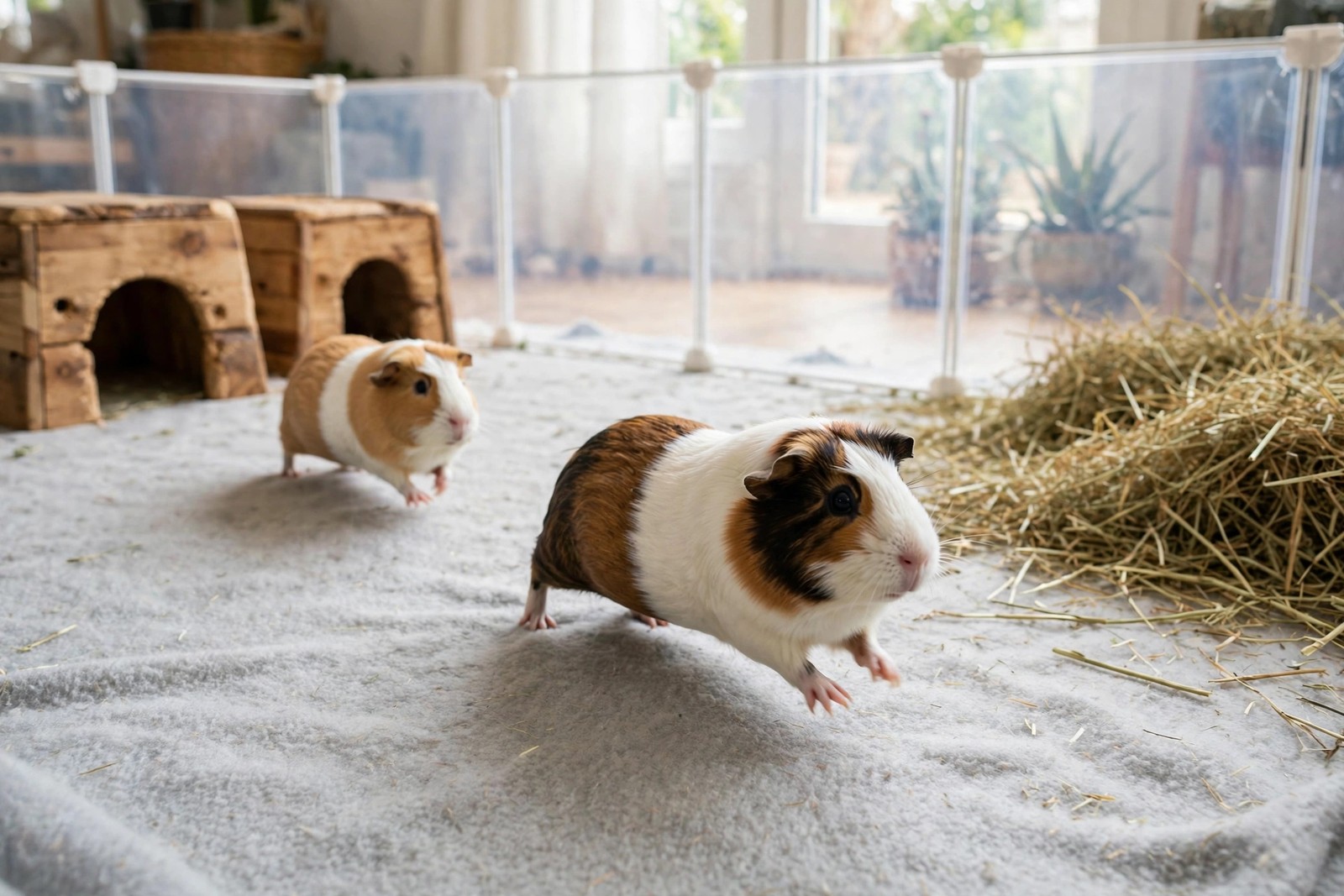
The word really in this question exists because of the cages in most pet shops. A typical small cage sold for guinea pigs gives them room to sit, eat, and turn around, and not much else, yet guinea pigs are ground animals that run laps at speed, popcorn when they are happy, and live in pairs or groups that need to pass each other without a squabble. Floor space, on one level, is the honest measure, and most shop cages fail it by half or more.
The Numbers: Single, Pair, and Group
One guinea pig needs at least 7.5 square feet of continuous floor, about 0.7 square meters, which looks like a pen around 30 by 36 inches (76 by 91 centimeters). A pair, which is the smallest group most guinea pigs should live in, needs at least 10.5 square feet, about 1.0 square meter, roughly 30 by 50 inches (76 by 127 centimeters), and that is a minimum to build on, not a generous target. Add roughly 2 to 4 square feet for each extra pig, and lean toward the larger end for boars, who are bigger, more territorial with each other, and far more likely to fall out in a pen that only just meets the minimum. If a rescue or breeder asks about your pen size before rehoming to you, these are the figures they are checking against, and a bigger pen is often what swings a borderline application.
What Counts as Floor Space, and What Does Not
Only the main, single-level floor counts. Ramps, lofts, and upper decks are bonuses a guinea pig may or may not use, and they never make up for a small base, because a guinea pig's exercise is running in a straight line and its social life happens shoulder to shoulder on the ground. Measure the inside of the pen, not the outside, and measure the usable area after the hay rack, houses, and tunnels go in, since two big hide houses in a minimum-size pen can eat the running track. Each pig needs its own hide to retreat into, plus one spare if you can fit it, arranged so no pig can be cornered inside one with the only exit blocked. Open grid pens and playpen-style enclosures that join into one large rectangle usually reach these sizes far more cheaply and flexibly than a single fixed cage, and they can grow when your group does.
Shape matters as well as size. A long rectangle of the same area beats a square, because the straight run down the long side is where laps happen, and it beats an L-shape with a narrow neck that one pig can block. When you measure, measure the run your pigs will actually get.
Living in the Space You Provide
A pen at the right size behaves differently day to day. It stays cleaner, because droppings and damp bedding spread over a larger area instead of concentrating where the pigs sleep, and it lets you set up real zones: hay at one end, houses at the other, a kitchen corner where stray hay and food land. Daily floor time outside the pen is still welcome, especially for pigs in a minimum-size setup, but it is an extra, not a substitute, because a guinea pig cannot bank exercise from an hour's roaming against twenty-three hours in a box. Weigh your pigs weekly, watch whether both can eat, rest, and move at the same time without one guarding space, and treat repeated squabbles as a space signal before treating them as a personality clash. Sending the measured pen dimensions and the zone layout to everyone in the household through KinsLe's Family Sharing stops a helpful relative helpfully shrinking the pen to make room for something else.