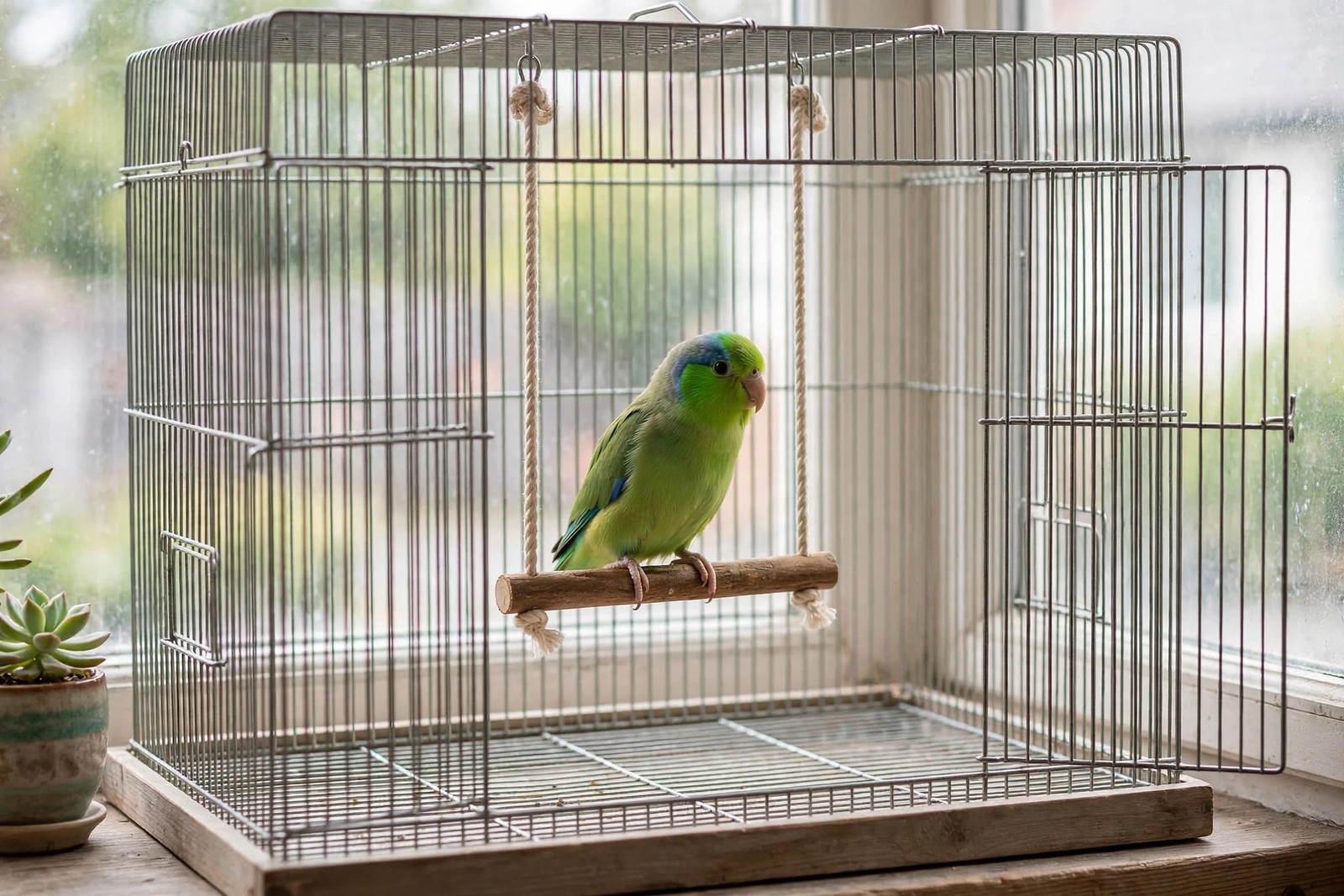
A parrotlet weighs barely an ounce, yet it behaves like a much larger parrot: busy, bold and busy again. Its cage should measure at least 24 inches wide, 18 inches deep and 24 inches tall, and a longer cage is a better buy than a taller one, because parrotlets travel by flying in short, level hops from perch to perch rather than by climbing up and down. If you have room for a flight-style cage around 32 inches wide, a parrotlet will use every inch of it. Tall, narrow cages sold for decoration waste most of their volume on air the bird never uses, and their small footprint also leaves no proper room for the separate food, water and bathing cups a parrotlet needs each day.
Bar Spacing: The Number That Keeps a Parrotlet Safe
For a parrotlet, bar spacing must sit between 3/8 inch and 1/2 inch, and it must never exceed 1/2 inch anywhere on the cage, including around doors and the tray gap. A small head can push through a surprisingly wide space, and a bird that gets its head through but cannot back out can panic and injure itself badly. Run your fingers along every panel before the bird moves in, checking for a sprung bar or a wider gap where two sections join. Choose smooth, bird-safe powder coating or stainless steel with no rust, no flaking finish and no sharp wire ends, and make sure feeder doors close flush, since parrotlets are persistent, clever escape artists who test every opening they can reach.
Setting Up the Inside for a Very Small Parrot
Furnish at parrotlet scale. Perches around 1/2 inch in diameter, in varied natural textures, suit small feet better than one thick dowel running wall to wall. Add a small swing, a shreddable toy and a foraging toy that hides a seed or a piece of vegetable, and place perches so the bird can fly a clear line across the cage without crashing through a thicket of hanging toys. Keep food and water cups away from the favourite roost so droppings stay out of them. House a single parrotlet in this size as standard; pairs can be intensely territorial, and two birds sharing will need a noticeably larger cage plus a spare cage ready, because bonded parrotlets sometimes have to be separated quickly after a fight. Give a sharing pair two separate food cups at opposite ends as well, since a territorial parrotlet will guard a single cup and quietly starve its cage mate of both food and confidence.
Checking the Fit Against Your Own Bird
A well-sized cage shows in the bird's behaviour: a parrotlet that flies voluntarily, plays, bathes and settles to sleep at night is using its home properly, while one that sits fluffed and silent, or bar-chews at the corners for long stretches, may be short of space, stimulation or both. Keep the cage in a social room against a wall, out of draughts and kitchen fumes, and let the bird out daily for supervised flight in a room with windows covered and doors closed, because out-of-cage time adds exercise but never excuses an undersized cage the rest of the day. Write the measurements down when you buy, since a replacement cage bought in a hurry is where spacing mistakes happen. KinsLe's Care Pass lets you send a sitter a temporary link carrying your parrotlet's cage details, bar-spacing limit, lock routine and favourite foods, so a helper can care for the bird exactly as you do while you are away.