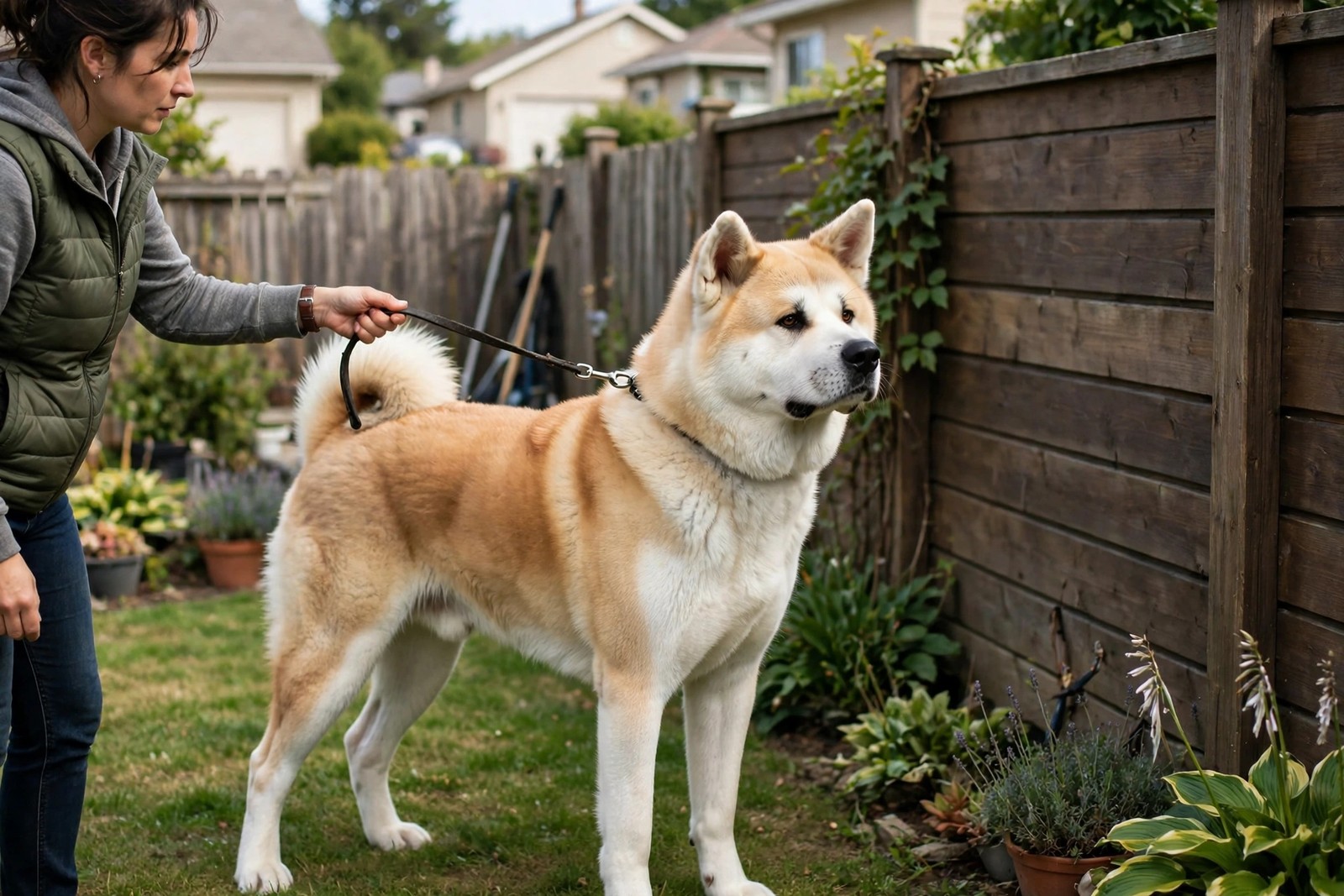
An Akita in a suburban setting is a decision about physics and paperwork as much as temperament. This is a large, powerful, dignified breed with a dense double coat, a strong guarding instinct, and loyalty that tends to focus on its own household. Neighbours, fences, insurers, and visitors all become part of the ownership picture, because a dog of this size living on a street of adjoining gardens cannot be managed informally.
Size and Strength, Stated Plainly
Adults typically weigh 65 to 115 pounds, with a broad head, heavy bone, and the neck and shoulder strength to move an adult handler who is caught off balance. A lunge at a passing dog or a squirrel can pull a lead from an unprepared hand, so equipment and training are safety items: a well-fitted collar or harness, a lead you can grip under load, and loose-lead and recall work started in puppyhood and maintained for life. Adolescence is the demanding stretch, when a dog approaching adult weight tests boundaries with a teenager's confidence. Every adult who will walk the dog should be able to hold the dog at full commitment, and children should never hold the lead alone. Cars and crates must fit the adult dog, not the puppy who arrives, and lifting an injured or elderly Akita is a two-person job that home layout should anticipate.
Fencing, Neighbours, and Household Rules
Suburban closeness raises the management bar. Fencing should be tall, solid, and checked at ground level, with gates that latch securely, because an Akita who can see through a fence may react to passing dogs and a determined dog can test weak panels. Many Akitas are reserved with strangers and can be intolerant of unfamiliar dogs, so introductions to visitors need a routine: the dog settled behind a gate or in another room until calm, rather than greeting at the front door in a surge of excitement. Discuss the dog honestly with close neighbours, keep front garden time supervised, and set household rules that everyone follows, covering feeding, visitors, and who handles the dog when children visit. Socialisation should be thorough and early, building neutral behaviour around people, dogs, and street noise, while accepting that a mature Akita may remain aloof rather than sociable.
Insurance and Breed Lists, Checked Early
Insurance deserves research before a puppy is reserved, because large guarding breeds sit on breed lists that some insurers treat differently: cover may be declined, priced higher, or offered with conditions, and the only way to know is to ask directly and read the wording. Third-party liability cover matters particularly in a suburb, where the dog lives close to neighbours, delivery callers, and visiting children, so confirm that liability is included and note any excess that would apply to a claim. Check household insurance in parallel, since some home policies ask about dog breed and may set conditions. Avoid assuming a policy renews unchanged, and keep answers about breed, weight, and any incident history accurate, because an inaccurate application can void the cover you were relying on.
A Realistic Running-Cost Picture
Weight drives costs across the board, and planning ranges help more than surprises. A transparent planning example for a healthy adult might total roughly 2,400 to 3,600 in local currency per year, built from food at 900 to 1,300, routine veterinary care and parasite control at 400 to 600, insurance at 700 to 1,100, and training, equipment, and grooming supplies at 400 to 600, and those components sum exactly to the stated total range. Surgery and medication are commonly priced by weight, so a single operation can cost notably more than the same procedure for a small dog, which argues for an emergency reserve alongside insurance. Identification is a final practical layer: a strong dog and a faulty gate are a bad pairing, and a collar carrying one of KinsLe's Verified QR ID Pet Profiles lets a neighbour who finds your Akita reach you from a phone scan without waiting for a vet visit.