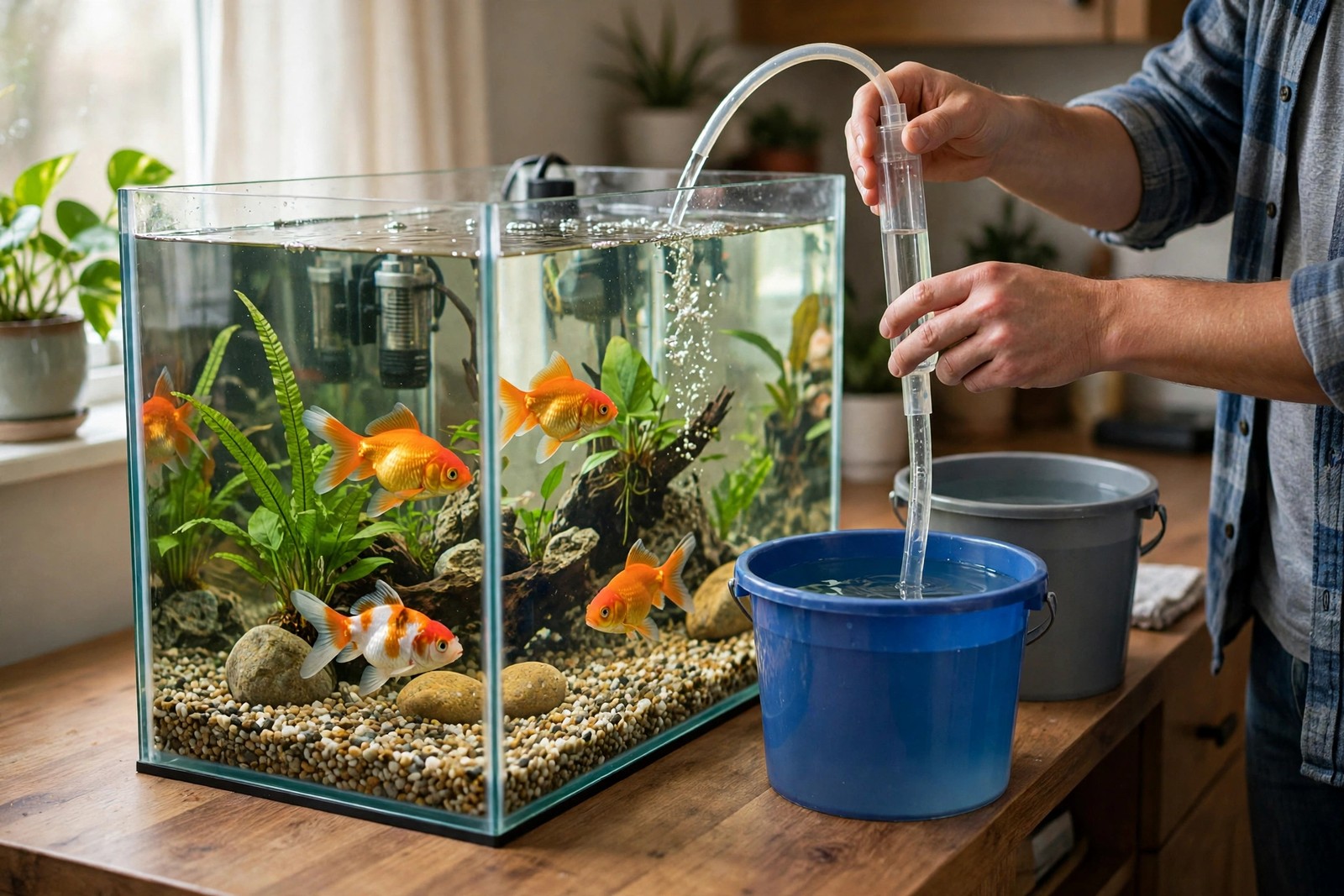
Goldfish are heavy waste producers living in a closed box of water, so the weekly water change is not cosmetic housekeeping — it is the main way nitrate, dissolved waste and hormone build-up leave the system between filter cycles. The filter converts ammonia to nitrite and then to nitrate, but nothing in a standard home setup removes nitrate except plants in modest amounts and you, carrying buckets. Skipping weeks lets nitrate climb steadily, and goldfish kept in high-nitrate water often show faded colour, clamped fins, poor growth and repeated minor infections.
How Much to Change Each Week
For a typical stocked goldfish tank, replace 25 to 50 percent of the water every week. Use the lower end only for a lightly stocked, well-filtered tank whose nitrate stays low between changes, and the upper end for fanciful varieties, growing juveniles or any tank where nitrate rises quickly. Two smaller changes in a week suit a problem tank better than one very large change, because each refill shifts temperature and chemistry and smaller shifts stress fish less.
Judge the percentage by your test results rather than by habit alone. Test nitrate just before a change: if it regularly climbs high by week's end, increase the share you replace or shorten the interval. If ammonia or nitrite ever reads above zero in an established tank, do a prompt partial change that day and investigate feeding and filtration instead of waiting for the scheduled day.
The Change, Step by Step
Gather buckets used only for the aquarium, a siphon with a gravel vacuum, water conditioner and a thermometer before you start.
- Switch off the heater and filter so falling water cannot expose a running heater or drain a filter dry.
- Siphon out your chosen share, pushing the gravel vacuum into the substrate in sections and lifting the trapped waste — uneaten food and droppings collect there, especially under ornaments and in corners.
- Fill a bucket with tap water, add conditioner at the rate stated on its packaging to neutralise chlorine or chloramine, and check the temperature against the tank with a thermometer, adjusting until the two match closely.
- Refill slowly, pouring over an ornament or your hand to break the flow, so gravel, plants and fish are not blasted by the current.
- Restart the equipment, confirm the filter is primed and running, and watch the fish for a few minutes afterwards.
Clean filter media in removed tank water, never under the tap, because chlorinated tap water can kill the beneficial bacteria the media houses. Replace only part of the media at a time, and never on the same day as a large water change.
Matching Water and Avoiding Shocks
Temperature-matched, dechlorinated refill water matters because goldfish react badly to sudden shifts: cold refills can trigger lethargy and white spot outbreaks in susceptible fish, while warm refills drop oxygen levels. Keep the refill within a degree or so of the tank temperature. If your tap water's pH differs markedly from the tank's, smaller and more frequent changes narrow each swing. Never top up evaporation losses and call it a change — topping up replaces water but leaves every dissolved waste behind, so concentrations keep rising.
Note the date, the percentage replaced and any test readings each time you finish, because a tank that needed 30 percent weekly last season may need 50 percent as the fish grow. Logging those figures in KinsLe's Care Teams after each change builds a record that shows exactly when your goldfish outgrew the old routine, so the next person on duty adjusts the share rather than repeating a percentage that no longer keeps nitrate down.