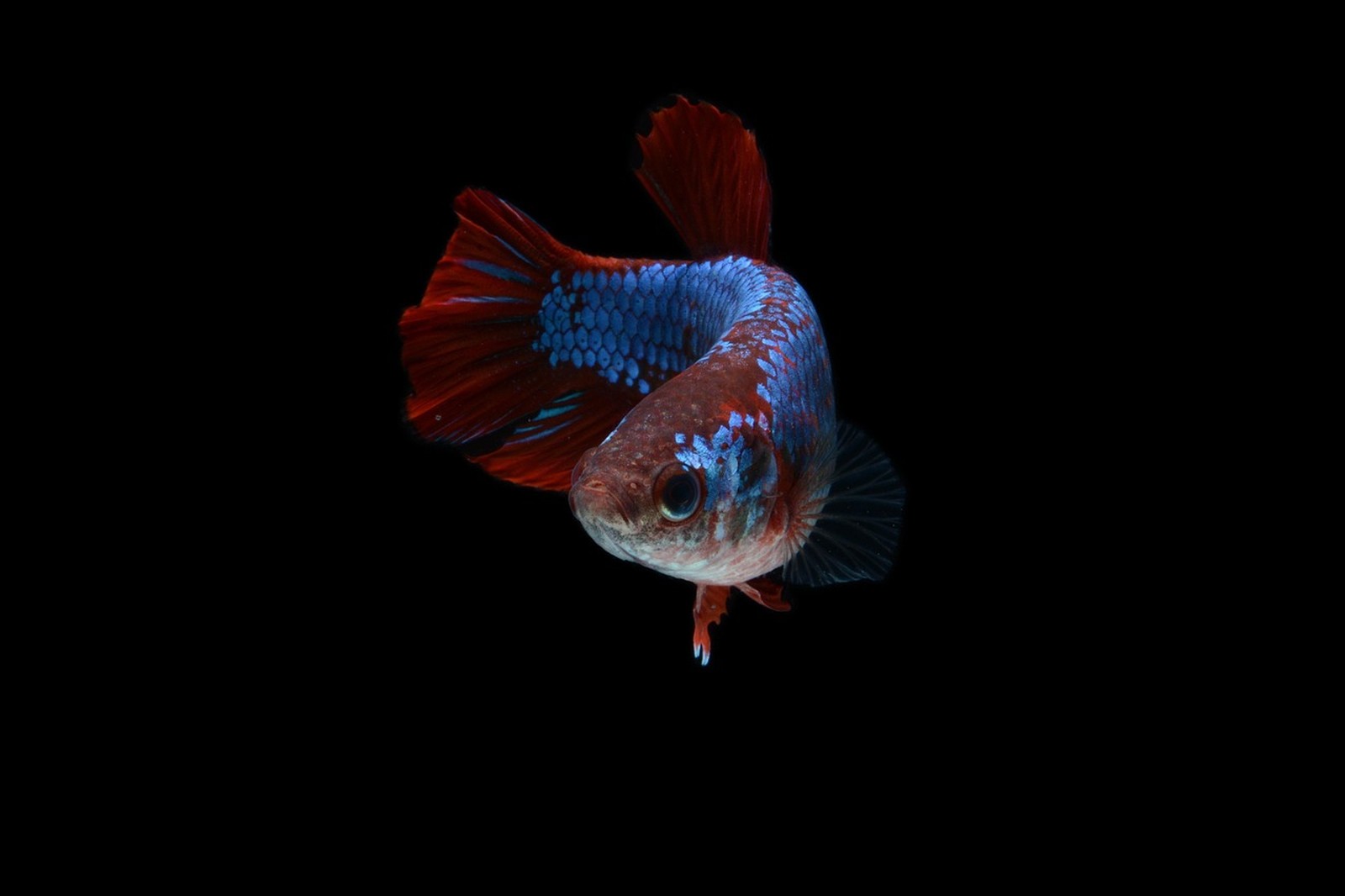
The betta's other name, Siamese fighting fish, is a job description. Wild bettas live in shallow, densely planted water where a male holds a small territory, and generations of selective breeding sharpened that territorial instinct into outright aggression toward rivals. A pet male betta does not know the fish facing him is in another tank, a reflection, or a tankmate he has lived beside for months. He reads a rival, and his whole body answers.
What a Fight Looks Like
It starts with display. The male flares his gill covers out like a ruff, spreads every fin to look as large as possible, deepens his colour, and swims sideways-on toward the other fish in stiff, jerky advances. If neither fish backs down, display turns to circling, then to darting bites aimed at fins and flanks. Fights between two males rarely settle into a truce; the loser cannot leave the territory in a glass box, so biting continues until fins are shredded and one fish is exhausted, hiding, and open to infection through its wounds. Even seeing a rival constantly, through a divider or a neighbouring tank, keeps a male in a state of repeated flaring and stress, which is why a brief mirror session is enrichment and a permanent mirror is harassment.
Who Else Gets Attacked
A male betta judges by appearance, not species. Colourful fish with flowing fins, male guppies being the classic example, can be read as rival bettas and chased or nipped, while plain, quick, dissimilar fish in a roomy, well-planted tank often live alongside a betta undisturbed. Individual temperament varies widely: some males tolerate snails and shrimp and little else, and a betta peaceful for months can turn on a tankmate as he matures. Sororities of females are often sold as a safe alternative, but females carry the same territorial streak in milder form, and a group that held together for weeks can unravel into bullying, so female groups need space, heavy planting, close watching, and a spare tank ready.
Breeding Is the Exception, and a Risky One
The one time a male and female meet, courtship, is carefully staged by breeders and still dangerous. A male that is ready builds a nest of bubbles at the surface and displays to a female shown first from safety; after spawning he drives her away and tends the eggs himself, and she must be removed or he will attack her in defence of the nest. Outside that managed sequence, a male and female betta sharing a tank full-time is a fight waiting for a trigger, not a pairing.
Living With a Territorial Fish
Give a male his own planted space, keep his sightline to other males blocked, and choose any tankmates by shape and behaviour rather than by hoping he will adjust. Watch fins at feeding time: neat fins and a fish patrolling calmly mean peace, while torn edges, clamped fins, hiding, or a tankmate living in one corner mean separate the fish first and solve the stocking afterwards. Keep a note of which companions he accepts, since that tolerance is individual. Owners who share those feeding and fin observations through KinsLe's Care Teams build a clear record of a betta's behaviour over time, so the first torn fin after a new arrival is noticed the same day rather than at the next water change.