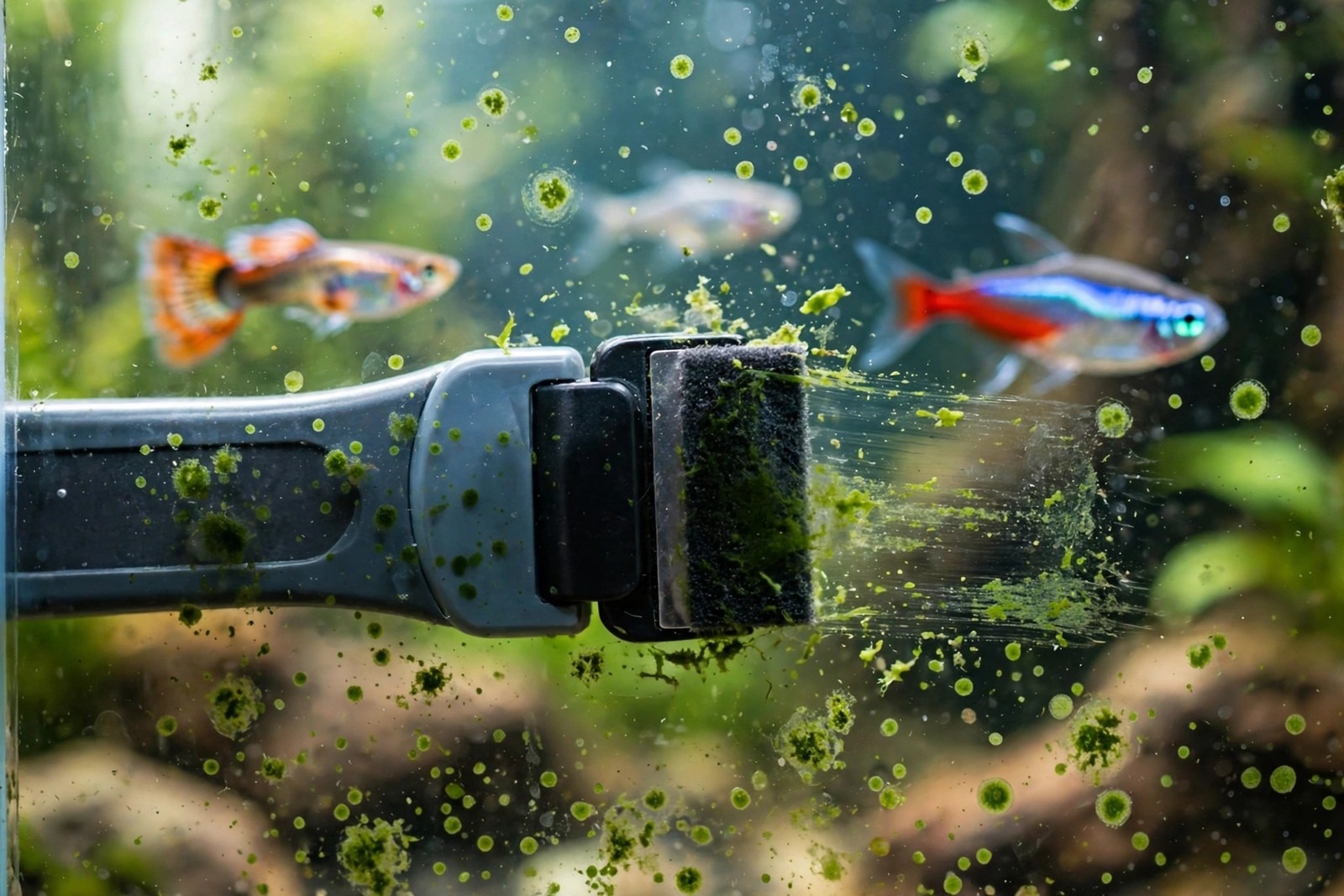
The Direct Answer: Too Much Light Plus Too Many Nutrients
Algae keeps coating your tank glass because it’s getting exactly what it needs to thrive: light and nutrients. Excess lighting hours — especially beyond 8–10 hours a day or from a nearby sunny window — combined with surplus nutrients from overfeeding, overstocking, or infrequent water changes creates an all-you-can-eat buffet for algae. A little algae is completely normal (some tank mates even graze on it), but thick green films or stubborn spot algae are your tank waving a flag: something in the light-nutrient balance is off. The good news? The causes are fixable, and the fixes are simple.
Reading What the Algae Is Telling You
Different algae point to different imbalances, and learning the language helps you respond precisely. Soft green film that wipes off easily usually means too much light or a new tank still finding its balance. Stubborn green spot algae — those hard dots that need a razor blade — often signal low phosphate relative to light, or simply intense lighting on slow-growing surfaces. Brown diatom dust is classic in new tanks and typically fades as silicates get used up. Hair or thread algae waving from plants points to excess nutrients plus strong light. None of these are emergencies for your fish, but each is a diagnostic clue — match the type to the cause before you start changing things randomly.
The Usual Suspects in Your Routine
Run through the checklist honestly. How long are your lights on — and is the tank near a window adding uncontrolled daylight? Are you feeding more than your fish eat in two to three minutes, letting the rest decay into phosphate and nitrate? When was your last water change, and are nitrates creeping up between them? Is the tank overstocked for its filtration? Even the light’s age matters: old fluorescent tubes shift spectrum as they weaken, and that shift favors algae over plants. Most algae outbreaks trace back to two or three of these compounding — fix the biggest ones first and the algae usually retreats within a couple of weeks.
Quick Wins That Actually Work
Start with light: put your tank lights on a simple outlet timer set to 6–8 hours daily, and move the tank away from direct window sun if possible. Cut feeding to what disappears in a couple of minutes once or twice daily, and siphon uneaten food promptly. Step up water changes temporarily — weekly 25–30% changes export the dissolved nutrients algae feeds on. During maintenance, scrape the glass with an algae magnet or scraper before siphoning so you remove the dislodged algae instead of letting it resettle. In planted freshwater tanks, adding fast-growing stem plants gives algae genuine competition for nutrients. Avoid reaching for algaecide chemicals first — they treat the symptom, stress fish and plants, and the algae returns if the underlying imbalance stays.
Care Teams Split the Upkeep
Algae control is really a consistency game, and consistency is a team sport in busy households. With KinsLe’s Care Teams, you can split algae scrubbing, glass checks, and water changes among family members — each task assigned clearly, each completion timestamped so everyone sees the upkeep actually happened. When scrubbing and water changes never slip through the cracks, algae never gets the foothold it needs.
Care Teams on KinsLe turns that rotation into writing: glass scrubbing goes to one named person, the weekly water change to another, and each finished job gets logged so the next person can confirm what is done.