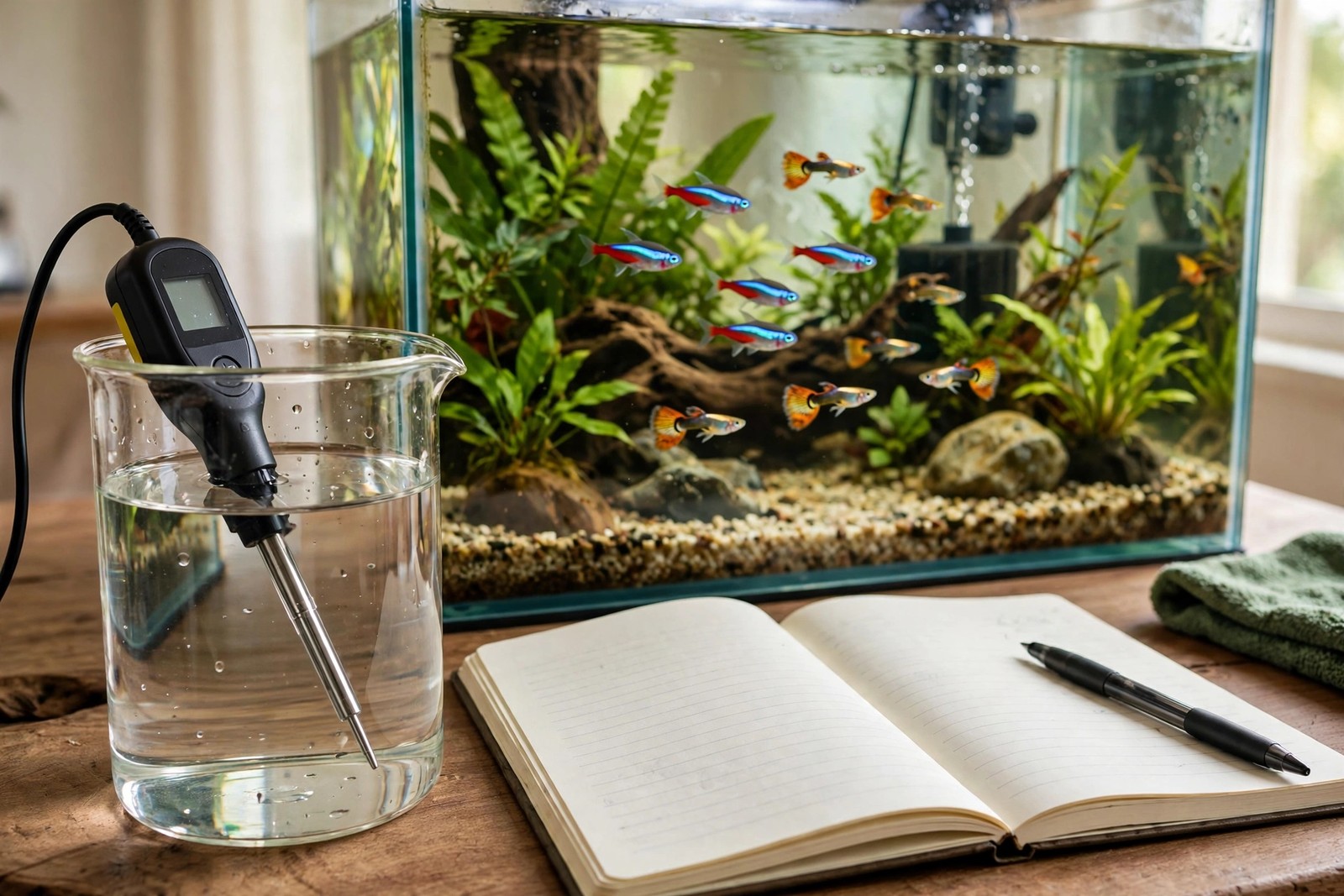
pH is a measure of how acidic or alkaline your aquarium water is. Fish live immersed in that water and exchange gases and salts through their gills and skin, so its chemistry is not background detail; it is the medium their bodies are constantly adjusting to. Understanding the scale, knowing the band your particular fish come from, and keeping the reading steady will prevent more trouble than any attempt to hold one exact number.
Reading the Scale
The pH scale runs from 0 to 14. A reading of 7 is neutral. Below 7 the water is acidic, above 7 it is alkaline, and each whole step on the scale represents a tenfold change in acidity, so a shift from 7 to 6 is far larger than it looks on paper. That is why small printed differences deserve respect and why fish react badly to sudden movement along the scale even when both the starting and finishing values look reasonable.
Test pH with a liquid kit or a calibrated digital meter rather than relying on the cheapest dip strips where precision matters, and test at a consistent time, because planted tanks can read slightly differently across the day as plants use and release gases. Record the figure, the date, and the time together; a single reading says where the water is, while a series says whether it is drifting.
The Range Tropical Fish Need
Many common tropical community fish do well in water of about 6.5 to 7.5, around neutral. That span covers a large share of the tetras, barbs, gouramis, and other familiar community species, especially the captive-bred forms that have been raised for generations in ordinary aquarium conditions. It is a guide band, not a promise for every fish sold as tropical. Soft-water species from acidic forest streams prefer the lower end and below it, livebearers generally prefer harder, slightly alkaline water, and some groups sit deliberately outside the band altogether.
Read the preferred range for each species before buying it, and group fish whose bands overlap comfortably rather than assembling a tank of opposites and splitting the difference. A fish kept steadily inside its own band eats, colours, and breeds as it should; a fish kept at the far edge of its tolerance may survive while staying dull, shy, and prone to illness. When you buy, ask what pH the shop's tanks run at, because moving a fish between very different readings needs a slow acclimation rather than a straight transfer.
Why Stability Matters More Than the Exact Figure
A sudden pH swing is the real danger. Rapid change shocks the systems fish use to balance salts and water in their bodies, and it usually arrives through well-meant interference: a very large water change with unmatched tap water, a chemical added to push the reading up or down that rebounds a day later, or a neglected tank corrected all at once. Chemical adjusters are particularly treacherous, because they can produce a sharp swing followed by a drift back, exposing fish to the change twice.
Keep pH steady by gentler means. Make regular partial water changes with water prepared to a similar reading, keep the tank clean so decaying matter does not acidify it gradually, and know your tap water's own pH so changes never arrive as a surprise. Where a species genuinely needs a different band from your tap supply, reach it slowly through the water you prepare for changes, over days, and hold it there consistently rather than correcting it in jumps. Retest after any change of substrate, decor, filter, or water source, and investigate a drifting trend early, while the steps needed are still small ones. KinsLe's Care Teams helps hold that steadiness by assigning the regular pH checks and water changes to named helpers, with each task marked complete with a timestamp in the tank's routine.