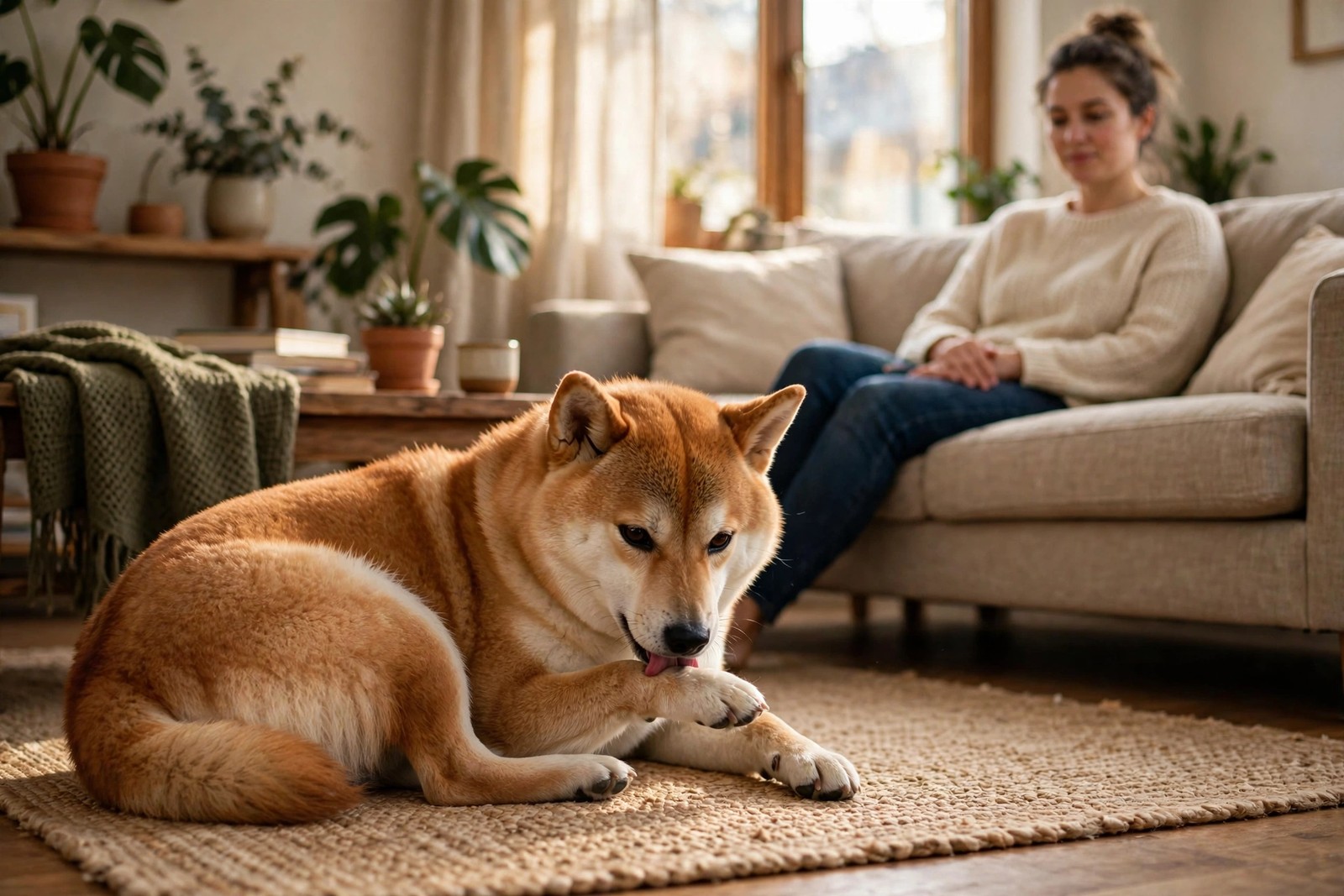
The comparison survives because it describes daily handling, not just temperament on paper. A Shiba Inu tends to groom itself with unusual care, licking its paws and wiping its face after meals, and many keep their bedding and favourite resting places notably clean. Company is offered on the dog's terms. A Shiba may settle in the same room as you, follow household activity with close attention, and still decline a cuddle, move away from a reaching hand, or leave a fussing session halfway through. None of that signals a problem to solve. It is the breed's ordinary social style, and training that ignores it tends to stall quickly.
What Cat-Like Means in Practice
Cleanliness shows up in small daily choices: a dog who avoids mess, dislikes walking through mud where a route around exists, and settles in chosen, elevated, or tucked-away spots. Independence shows up in decision-making. A Shiba investigates a new object carefully, watches a stranger for a while before any approach, and reserves open enthusiasm for familiar people and routines it has accepted. Handling follows the same pattern. Brief, predictable touch paired with food, such as a paw held for a second and then released, builds tolerance for nail care and vet checks. Prolonged restraint, forced greetings, and being passed between visitors teach the opposite lesson, and a dog who learns that people ignore its signals may start giving clearer ones.
Why Repetition and Pressure Backfire
A Shiba who has performed a cue correctly twice has, from its own point of view, answered the question. Ask for the same cue ten more times and attention drains away, rewards lose value, and the dog starts scanning the room for something better to do. Punishment fails differently and worse. Scolding, lead jerks, or physical pressure rarely produce a more willing dog. They produce a dog who avoids the handler, leaves the training area, or complies slowly while trust quietly erodes. Owners sometimes read this as stubbornness, but the practical reading is simpler. The session offered too little, for too long, with too much pressure, and the dog voted with its feet, which this breed is entirely willing to do.
Sessions That Suit a Shiba
Keep training sessions to a few minutes, in a quiet place, and stop while the dog is still engaged, ideally just after a clear success. Pay with rewards the individual dog rates highly, which for many Shibas means small pieces of meat, cheese, or another strongly scented food rather than a plain biscuit, and vary what you practise instead of drilling one cue. Practise one or two repetitions, reward generously, and move on or finish. New cues are easier to teach before a meal, when food carries more value, and harder cues belong in familiar, low-distraction places before they are tried anywhere busier. Household consistency matters here. If one person accepts a slow, optional response and another insists and repeats the cue five times, the dog receives two different lessons about what the word means.
Recall, Leads, and Daily Management
Management carries the load where enthusiasm cannot be assumed. A Shiba with a history of independent wandering should not be relied on off lead in unfenced places, because a squirrel, another dog, or an interesting scent can outrank a recall cue in a second. Use a long line in open spaces so the dog can explore while you keep a reliable connection, and reward every voluntary check-in during ordinary walks so returning to you becomes a habit with a history of paying well. At home, use doors and gates as routine tools around visitors and deliveries, and let the dog choose whether to approach a visitor. A dog allowed to observe from a distance is usually calmer than a dog led forward to be greeted.
Households stay consistent when session notes live in one place, and Care Teams on KinsLe records who trained, what was practised, and how the dog responded.