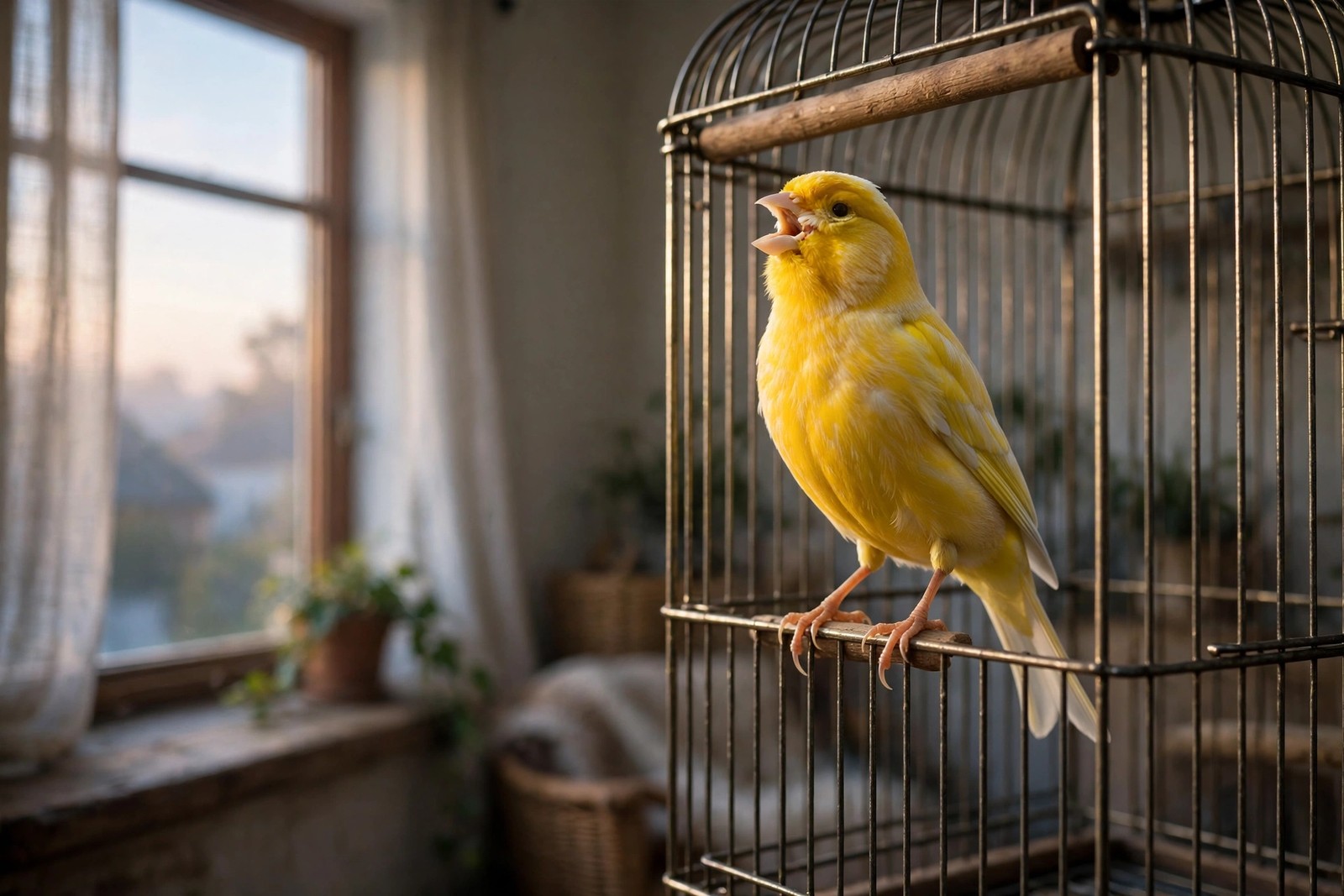
If your canary greets the sunrise at full volume, you are living with one of the oldest soundtracks in nature. Dawn singing is not a habit your bird picked up, and it is rarely about hunger or boredom. It is a light-triggered, hormone-driven behaviour that makes complete sense once you hear it from the canary's side of the bars.
Light Is the Starting Signal
A canary's body runs on photoperiod, the length of the day. Light entering the eye reaches the brain and, as days lengthen, stimulates the hormones that switch a male canary into breeding condition, growing his song from occasional practice into the full, sustained performance he is known for. That is why dawn song is strongest when days are long and fades when days shorten or the bird enters his molt. It also explains the bird that starts up when a hallway light clicks on before sunrise: his clock reads that light as dawn, whatever the clock on the wall says. Hens sing too, but usually more softly and briefly; the dawn concert at full strength is almost always a male in condition.
What the Song Is Saying
Song does several jobs at once, and dawn is the hour when all of them pay best. It advertises territory, telling rival males that this patch is occupied by a bird fit enough to sing at length. It advertises the singer himself to any hen within earshot, because a long, complex, energetic song is an honest signal of health that a weak bird cannot fake. And it works as a contact call after the night, a way of announcing survival and re-establishing position before the day's feeding begins. Cool, still dawn air carries sound further than midday turbulence does, and a bird that sings before rivals wake gets an audience with no competition, so evolution has stacked the strongest singing into the day's first light.
Why Not All Day, Then
Your canary probably does sing in bursts later on, especially in response to household noise, running water, music, or other birds, but the dawn session is different in kind: longer, louder, and delivered whether or not anything answers. Through the middle of the day, feeding, bathing, and resting compete with singing for the bird's time and energy. Toward evening many males add a shorter dusk performance before settling. A male who suddenly stops dawn singing outside the molt, or whose song weakens and roughens, is giving you a change worth noting, because song is a sensitive gauge of condition and a fading voice can be an early sign of airway trouble or general illness that an avian vet should hear about.
Shifting the Wake-Up Without Silencing Him
You cannot, and should not, train a healthy male out of dawn song, but you can move his dawn. A breathable cage cover fitted in the evening keeps his world dark until you lift it, and most canaries hold their concert until the light arrives. Aim for 10 to 12 hours of covered darkness each night, which suits his sleep needs as well as your own, and keep the covered cage in a room where early household lights and screens do not leak around the edges. Blackout curtains in the bird's room achieve the same thing for early summer sunrises. What does not work kindly is keeping the cage dark and covered for most of the day, because a canary needs full daylight hours for feeding, activity, and the very cycle that keeps his hormones and molt in step. KinsLe's Care Teams makes the cover routine easy to hold across a household, since whoever is last up can take the evening covering duty and whoever rises first can take the morning reveal, each marked done with a timestamp.