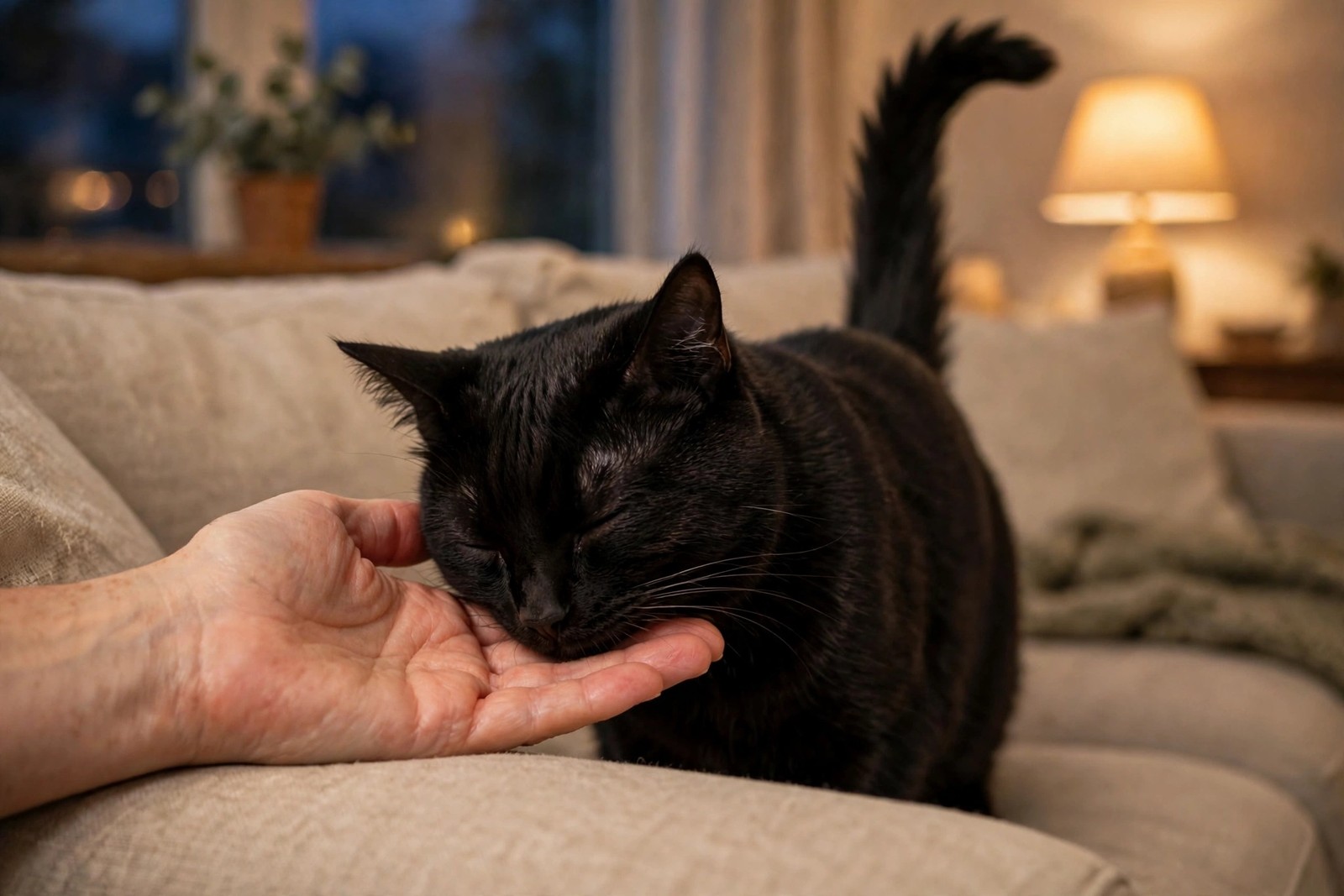
When your cat walks up, lowers her head, and pushes her forehead firmly into your hand, leg, or face, she is doing something deliberate. The gesture is called bunting, and it is one of the clearest compliments a cat can give. It is also a piece of scent work, and once you understand the glands involved, the whole performance reads like a signature being written on you.
Scent Glands Doing Social Work
Cats carry scent glands in their cheeks, along the chin, on the forehead, and at the corners of the mouth. Pressing and rubbing those areas against an object or a person deposits facial pheromones, chemical messages that other cats read as familiar and safe. Cats rub door frames, chair legs, and their favourite people for the same reason: to build a shared group scent that says this place and these companions belong to us. A cat will re-mark you after you come home smelling of the outside world, and after a shower you may notice a thorough top-up session, because your scent profile needs restoring to the household blend.
Affection, Greeting, and Occasionally an Order
Bunting usually arrives with friendly company: tail held upright, sometimes with a slight quiver, ears forward, whiskers relaxed, and often a slow blink or a soft chirp. Cats bunt each other as a greeting after time apart, and kittens learn it early within the litter. Directed at you, it is social bonding first. Context adds the footnote. A head-butt delivered at the usual feeding hour, followed by a walk toward the kitchen and a look back over the shoulder, is a greeting with a dinner request attached. One delivered when you sit down with a book is more likely asking for a hand to be freed for stroking or play. Read the body that comes with it rather than the gesture alone.
The right response is simple. Stay still, let her press and rub at her own pace, and offer the side of your hand or a scratch under the chin or along the cheek, where those glands sit and where most cats most enjoy contact. Avoid grabbing her head, pushing back hard, or turning it into rough play, which muddles a greeting into a wrestling invitation.
One Look-Alike That Is Not Friendly
Bunting is social, brief, and aimed at you or at furniture as she passes. Head pressing is different: a cat that stands or sits pushing her head continuously against a wall, a corner, or the floor, seeming disoriented, restless, or unusually sleepy, is showing a worrying sign that needs prompt veterinary attention, not interpretation as affection. Keep the distinction clear for everyone who cares for her, because a new sitter could easily misread it.
Head-butting also tends to increase when something in the house has changed, since fresh furniture and cleaned surfaces hold no group scent. Expect a marking round after a move, a deep clean, or a visitor with a strong-smelling bag, and let it happen; it is how she re-stamps home as home. If your household shares her care, put the greeting-versus-pressing distinction where everyone will see it: KinsLe Messenger keeps the conversation about each pet gathered in that pet's own hub, so a note in her thread reaches the whole family and nobody mistakes a friendly bunt for a warning sign, or the reverse.