
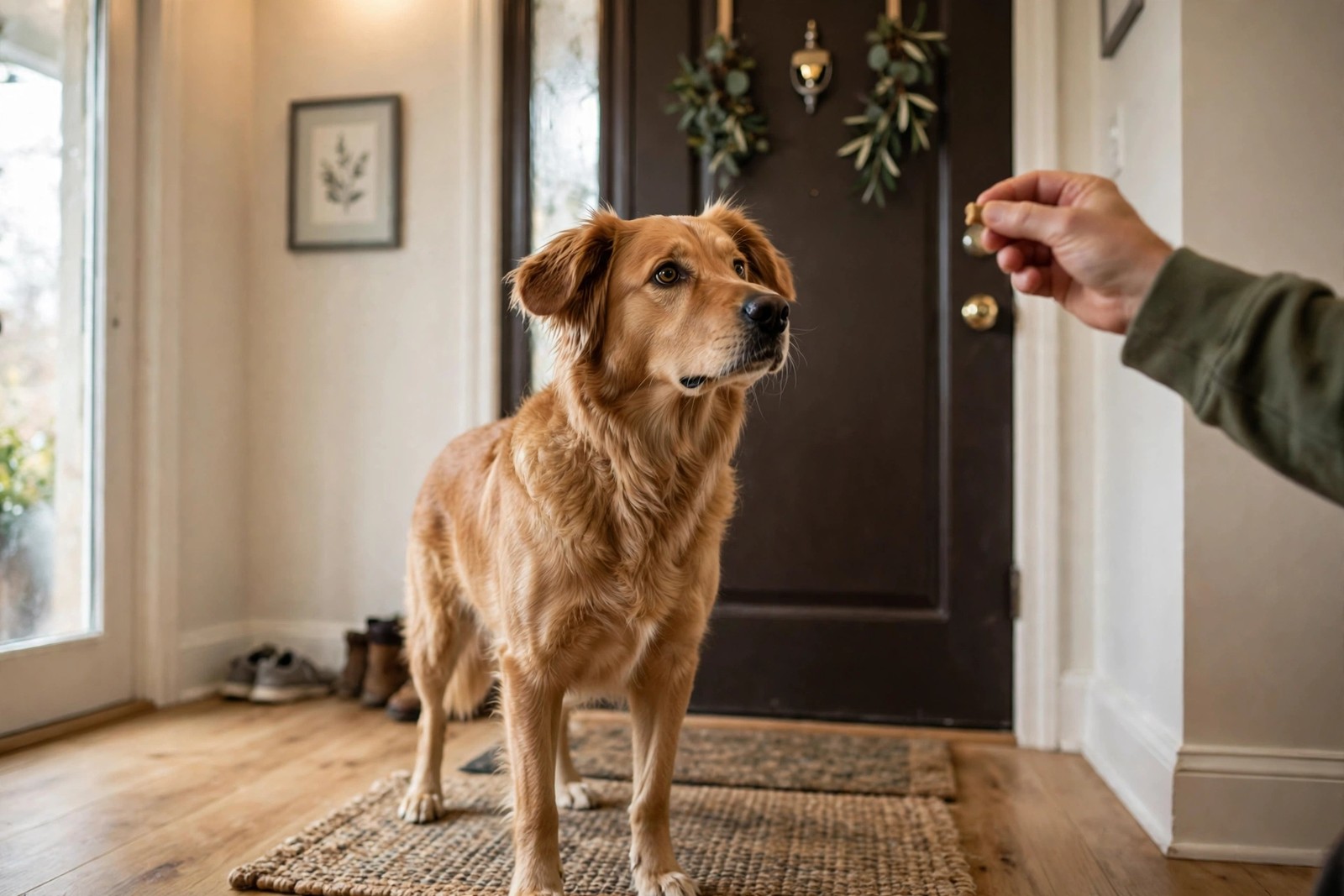
The doorbell is the most predictable excitement in a dog's day, and barking at it is not disobedience. To a dog, the bell or knock announces that something is happening at the boundary of its home, and dogs are wired to raise the alarm at exactly that moment. Alert barking tells the household that an arrival needs attention, territorial barking warns the arrival that this home is occupied, and excited barking greets the people a sociable dog hopes are coming in. Many dogs run all three at once, in a loud, spinning performance that looks wild but follows a clear script.
Why the habit reinforces itself
Doorbell barking is one of the few behaviours a dog's world rewards every single time it is performed. The delivery driver rings, the dog barks, and the stranger immediately walks away: from the dog's perspective, the barking drove the intruder off. A visitor comes in, the dog barks, and the visitor delivers attention, fuss, or treats, so the barking produced the best part of the day. Even shouting at the dog to be quiet can join in as more excited noise. Because the outcome always follows, the response gets faster and louder with practice, and many dogs generalise from the real bell to a doorbell on television or a knock in an advertisement. Breaking the habit means changing what follows the bell, not out-shouting the dog at the door.
Retraining the sequence
Build a new script in quiet practice sessions first, away from real visitors. Play a recorded doorbell sound at low volume, or have a household member knock softly, and reward your dog for looking at you and staying quiet; raise the volume gradually over days only while the dog can still succeed. Separately, teach a mat or bed station away from the door: send the dog to it, reward settling there, add a knock, then a bell, then a person stepping in, one step at a time, with the dog on a lead at first if it charges the door. Keep real greetings calm in the meantime: visitors ignore the dog until it has four feet on the floor and a quieter body, and management such as a baby gate or a closed hallway door is fair while training is in progress, because every rehearsed frenzy undoes practice.
What to expect, and what not to do
Progress is measured in seconds of quiet and distance from the door before it is measured in silence, and most dogs need weeks of short practice rather than one long session. Do not punish barking after the fact, drag the dog away by the collar in the heat of the moment, or let one household member feed the dog from the doorstep while another trains the mat routine, since mixed rules are the usual reason doorbell training stalls. A dog whose barking comes with lunging, snapping, or guarding visitors once they are inside needs a qualified behaviour professional rather than a home drill, and sudden barking changes in a senior dog deserve a veterinarian's input. Scheduling the practice sessions and assigning who runs the mat routine for real deliveries in KinsLe's Care Teams keeps the doorbell plan moving on busy days when a parcel, not a training plan, decides the timing.