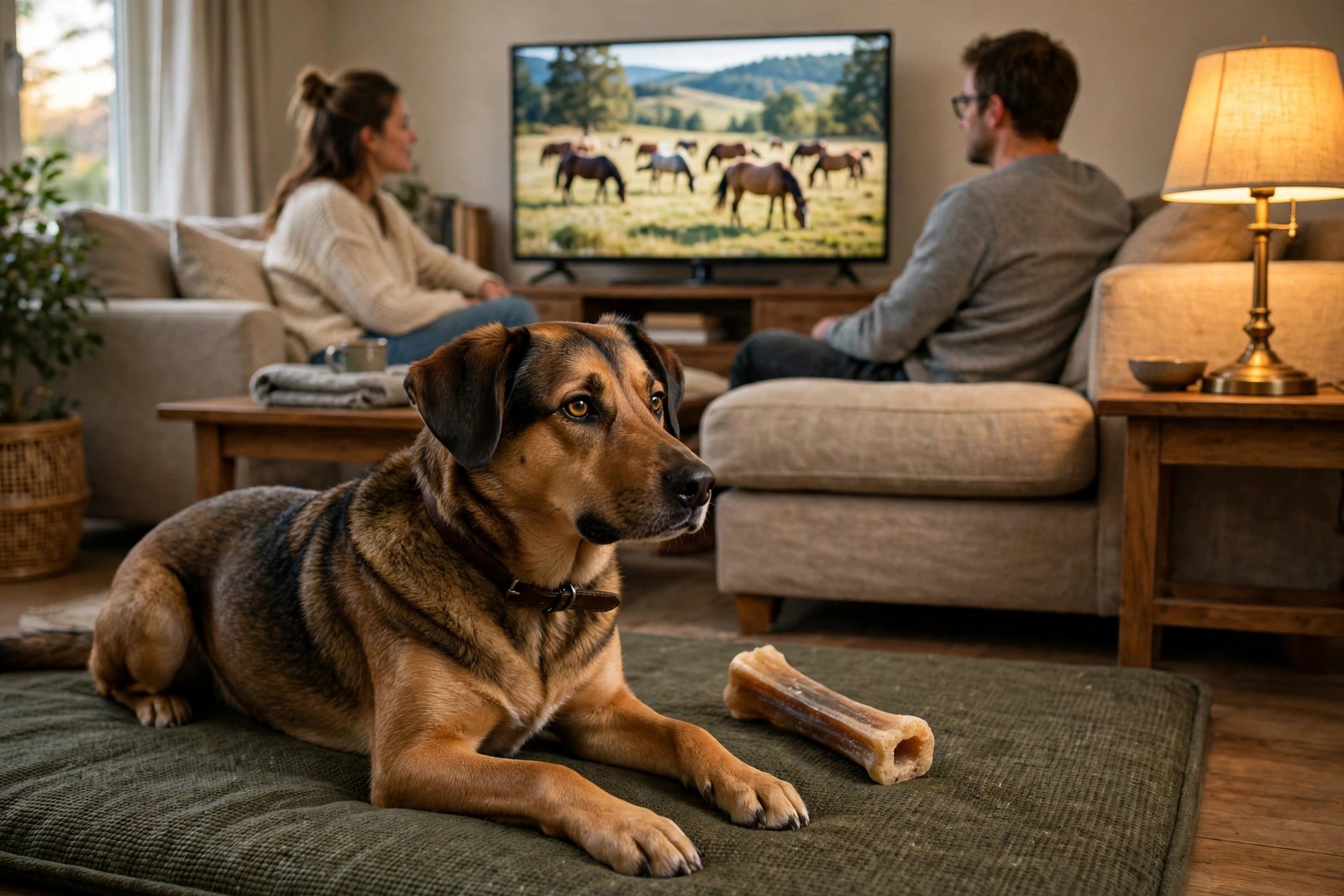
Your dog is not confused in any simple way. A modern television gives a dog a large, bright, fast-moving picture at dog eye level, often with animal sounds arriving from speakers placed right beside the image. Put a running herd, a barking dog, or a close-up of a horse's head at that size in your living room and you have built something a dog's perception is entitled to treat as an animal event, especially when the whole household is watching it intently, which itself tells the dog the event matters.
What Your Dog Is Actually Perceiving
Movement does the convincing. Dogs are highly tuned to motion, direction changes, and the rhythm of legs, and an animal crossing a screen delivers all three at life size or larger. Sound completes the illusion: barks, whinnies, bird calls, and hooves come from exactly where the picture is, and unlike a radio voice, the sound and the moving shape agree with each other. Scent is missing, but scent was never the sense a dog uses first for something it can already see moving across the room.
Sensitivity varies by individual and by breeding. Herding dogs, selected for generations to notice and respond to movement at distance, and terriers, selected to react fast to small, quick animals, often notice screens that a more phlegmatic dog ignores completely. Puppies and young dogs frequently react to early screen animals and then habituate; a dog whose barking has been exciting, funny, or effective at making the room react is more likely to keep the habit into adulthood.
Why the Barking Tends to Escalate
A real animal answers back in ways that resolve the encounter: it postures, moves off, or turns out to be a friend. A screen animal does none of this. It ignores your dog entirely, keeps moving on its own schedule, and then vanishes mid-confrontation when the shot cuts. That unresolved pattern winds an aroused dog up rather than settling the matter, so barking that starts as announcement can become frustration, with spinning, whining, or rushing the screen. Every evening it is rehearsed at full volume, the sequence gets easier to start, which is why management matters more than scolding a dog mid-bark, when it can barely hear you over its own arousal.
Set Viewing Up So Calm Is Possible
Put your dog's settle mat well back from the screen rather than on the rug in front of it, and give a long-lasting chew on that mat during animal-heavy programs, so your dog has a job at a distance where arousal stays manageable. Reward calm glances at the screen and, even more, glances away from it, with quiet praise and occasional food delivered to the mat. Keep the volume moderate, because sudden loud animal calls startle as well as attract.
Build the skill on easy material first: short clips with slow, distant animals, practiced for a few minutes and ended before your dog winds up, teach more than an entire nature documentary endured at full arousal. Pause or skip a program if your dog escalates past the point of hearing you, and move your dog out with a chew rather than letting the rehearsal run. If screen arousal spills into guarding the television area, snapping at other household dogs during programs, or an inability to settle long after the set is off, bring a qualified behaviorist in, because the problem has outgrown viewing management. With KinsLe Care Teams, you can assign the mat-and-reward routine as a shared evening duty for whoever is watching, each practice marked complete with a timestamp, so your dog gets the same setup from every viewer in the house.